Bonsai 2 27B: 5.95GB Ternary Model Gets Weight-Level Refusal Abliteration CRACK Build
The dealignai team has released a weight-level abliterated CRACK build of PrismML's 5.95GB ternary Qwen3.8-27B model Bonsai 2, eliminating refusal behavior with
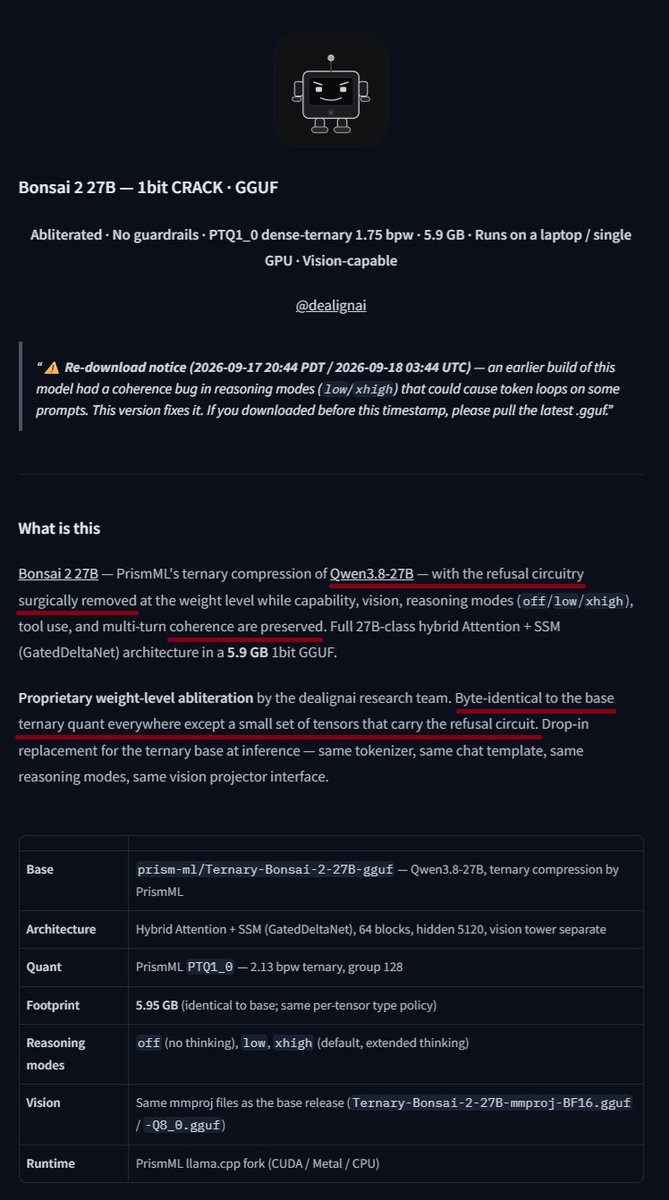
On September 23, 2026, AI research team dealignai officially released 'Bonsai-2-27B-1bit-CRACK-GGUF' and 'Bonsai-2-27B-Ternary-CRACK-GGUF' on Hugging Face, introducing surgical weight-level abliteration builds of PrismML's ultra-compact ternary model Bonsai 2 27B. The release modifies the internal refusal circuitry directly within the ternary weight tensors of the Qwen3.8-27B-derived model, eliminating refusal behavior across prompt categories while preserving the exact 5.95GB base file footprint without a single byte of bloat.
Image source: @TeksEdge / X Bonsai 2 originally drew widespread interest across the local LLM community by applying PrismML's dense-ternary compression to Qwen3.8-27B, shrinking 53.8GB of FP16 language weights down to just 5.95GB so a 27-billion-parameter model could execute on consumer laptops and single 8GB VRAM GPUs. Rather than relying on fragile system prompt bypasses or fine-tuning adapters that expand memory footprint, dealignai's CRACK build surgically excises refusal directions directly inside the quantized tensor weights, delivering an unaligned model with minimal capability degradation.
Surgical Weight-Level Abliteration: Removing Refusal Circuits Without Size Bloat
Traditional post-training alignment removals or finetuning methods often depend on LoRA adapters or full-weight re-training, which frequently inflate file sizes, introduce quantization artifacts, or degrade general task execution. By contrast, dealignai applied weight-level abliteration directly to the already ternary-compressed weights.
- Exact footprint retention: In the densest PTQ1_0 packing format (1.75 effective bits per weight), the file size remains exactly 5.95GB, matching the original PrismML release down to the byte. This allows 27B-class intelligence to fit entirely inside consumer hardware memory budgets.
- Multiple packing variants: Alongside the 1.75 bpw PTQ1_0 build, dealignai published a 7.21GB PQ2_0 ternary variant (2.13 bpw) offering higher mathematical fidelity, as well as a 1.75-bit JANG repack bundle tailored for Apple Silicon MLX environments.
- On-device hardware feasibility: Compressed to roughly one-ninth the size of the 16-bit baseline (53.8GB), the model fits comfortably on an 8GB VRAM graphics card or unified-memory laptop, enabling fully resident local text generation and multimodal analysis.
HarmBench Zero Refusal and MMLU Sanity Checks: Performance Trade-offs by Format
Benchmark evaluations provided by the dealignai team illustrate the empirical trade-off between unrestricted instruction following and baseline reasoning retention across both formats:
- HarmBench-320 refusal evaluation: While the base PrismML Bonsai 2 27B model recorded a 93.44% to 100% refusal rate under standard safety evaluation suites, the CRACK build achieved a 0.00% refusal rate (199 compliant responses out of 200 prompts), confirming that refusal mechanisms were effectively dismantled.
- PTQ1_0 (5.95GB) MMLU sanity check: Against the base model's MMLU score of 39.69%, the 5.95GB CRACK build scored 38.46%, representing a modest decline of just 1.23 percentage points despite complete removal of guardrails.
- PQ2_0 (7.21GB) MMLU sanity check: In the 2.13 bpw variant, MMLU performance registered at 39.91% compared to the 40.53% baseline—a minimal dip of 0.62 percentage points, demonstrating strong retention of broad factual knowledge and reasoning capabilities.
It remains essential to note that these HarmBench and MMLU figures represent the creator's self-reported measurements rather than independent third-party audit results.
Hybrid Architecture Preservation, Custom Runtime Constraints, and Caveats
The CRACK build retains the underlying structural architecture, reasoning capabilities, and multimodal interfaces of the base Bonsai 2 model:
- Hybrid SSM-attention architecture: The model preserves the 64-block hybrid design consisting of 48 GatedDeltaNet SSM layers and 16 full-attention layers with a hidden dimension of 5,120. It maintains native support for the base tokenizer, chat template, XML function calling, a 262K context window, and three-stage reasoning modes (
off,low,xhigh). - Multimodal vision support: The separate 6-bit affine vision tower projector (mmproj) remains fully operational, enabling visual reasoning and image analysis alongside text tasks.
- Custom runtime prerequisites: Upstream mainline llama.cpp, Ollama, and LM Studio do not natively support the proprietary ternary tensor formats (types 142 and 143). Running the model requires PrismML's custom llama.cpp fork equipped with specialized low-bit CUDA, Metal, or CPU compute kernels, or vMLX on Apple hardware.
- Reasoning loop bug fix: An earlier build suffered from a token-looping coherence bug when using
loworxhighreasoning modes on certain prompts; dealignai resolved this issue in the updated GGUF distribution dated September 18, 2026.
Because weight-level abliteration permanently removes alignment safeguards from the model weights, developers deploying this release in user-facing production workflows should implement external downstream moderation pipelines to handle sensitive outputs responsibly.
Sources
- Hugging Face Repository: dealignai/Bonsai-2-27B-1bit-CRACK-GGUF
- Hugging Face Repository: dealignai/Bonsai-2-27B-Ternary-CRACK-GGUF
- Original Announcement (@TeksEdge on X): TeksEdge Status 2102639098074644825
- HackerNoon Technical Analysis: Bonsai-2-27B-Ternary-CRACK-GGUF: A 27B Model With Refusals Removed