Tim Blazytko Releases AI Agent Playbook for Breaking Obfuscated Binaries
Binary reverse engineering researcher Tim Blazytko has released an attacker's playbook and sample suite demonstrating multi-stage AI agent pipelines against com
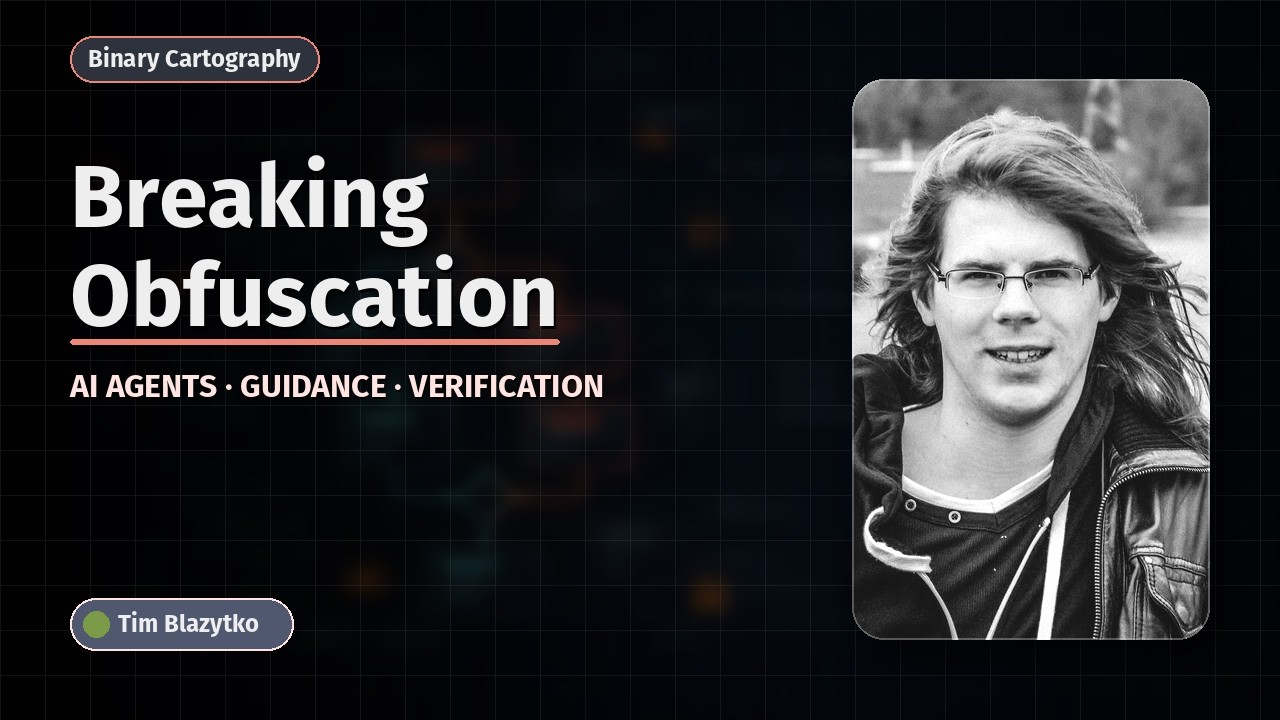
Binary analysis and reverse engineering researcher Tim Blazytko (@mr_phrazer) released a new technical presentation and hands-on artifact suite on September 24, 2026, outlining an attacker's structured methodology for breaking complex obfuscated binaries using multi-stage AI agent workflows.
Image source: https://www.youtube.com/watch?v=oGBj1v8t7Fc
The technical talk, titled 'Breaking Obfuscated Binaries with AI Agents: An Attacker's Playbook', addresses the practical realities of reverse engineering protected executables that cannot be solved by single-turn prompting or standard conversational models.
Limitations of One-Shot Inference and the Attacker's Phased Strategy
When large language models (LLMs) are used in isolation against binary analysis challenges, complex obfuscation schemes such as control flow flattening and virtualization routinely trigger context exhaustion, severe hallucination, and invalid control flow reconstructions.
Tim Blazytko highlights the inherent shortcomings of one-shot prompting and introduces an attacker-centric strategy focused on decomposing the deobfuscation challenge into structured sub-tasks.
- Granular Problem Decomposition: Rather than attempting end-to-end deobfuscation in a single query, the workflow breaks down strong protections that cannot be one-shotted into discrete, structured analysis tasks delegated to agents.
- Domain Tooling and Analyst Guidance: Rather than relying solely on isolated LLM text inference, the workflow combines reverse engineering domain tools with structured analyst guidance to verify disassembled instructions and control structures at each phase.
- Iterative Validation Loops: The agentic architecture executes targeted verification checks at each stage, incorporating feedback loops to correct intermediate hypotheses whenever an analysis step fails consistency checks.
Open-Source Slides and Practical Binary Samples on GitHub
To support reproducible research and technical education, Tim Blazytko has published complete presentation materials alongside practical exercise binaries.
All research artifacts are hosted in the public GitHub repository mrphrazer/binary-cartography under the 2026-09-agentic_deobfuscation directory.
- Presentation Slides: Outlines the attacker strategies, analyst guidance, and multi-stage verification architecture designed to tackle strong binary protections that resist one-shot prompting.
- Hands-on Sample Binaries: A curated collection of obfuscated challenge binaries enabling security researchers and reverse engineers to test and benchmark the agent workflow locally.
Operational Constraints and Academic Research Focus
While the methodology highlights compelling automated deobfuscation capabilities, it does not represent an unattended, push-button solution for all targets.
Complex commercial virtualization protections and advanced anti-debugging routines continue to resist autonomous LLM processing. Successful deobfuscation requires pairing agentic reasoning with domain-specific binary tooling and experienced human oversight to structure the analysis stages.
Furthermore, the playbook, slides, and sample binaries have been published strictly for academic and defensive security research, aimed at advancing software vulnerability discovery, malware triage, and binary hardening practices.