CLM-8B Released: Ultra-Fast System 1 Model Bridges Actions and States via Contrastive Learning, Setting 81.6% DeepSWE SOTA
Researchers Azalia Mirhoseini and Jacky Kwok have unveiled CLM-8B, an 8B-parameter System 1 model that couples states and actions using contrastive learning. Se
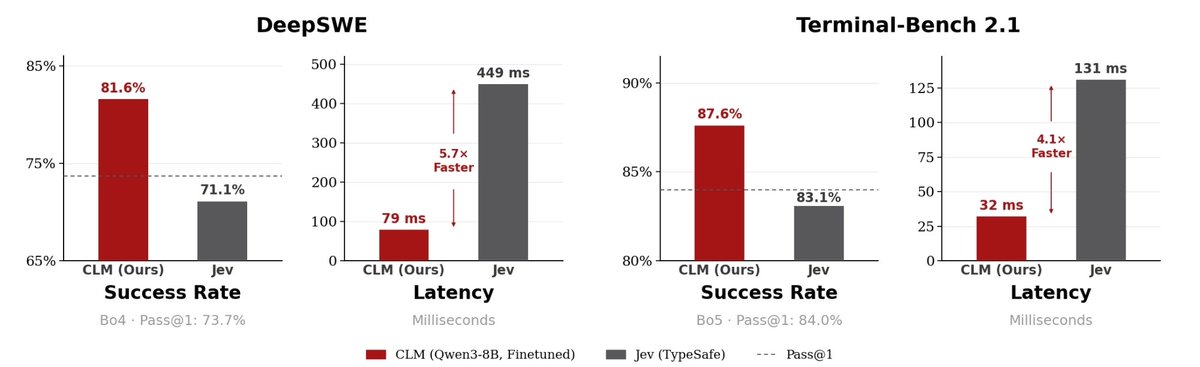
On September 24, 2026, AI researchers Azalia Mirhoseini and Jacky Kwok officially introduced Contrastive Language Models (CLMs) and released CLM-8B—an 8-billion parameter System 1 model designed to directly connect states and actions through contrastive learning objectives—alongside its underlying dataset, PyTorch checkpoints, and serving infrastructure.
Image source: @Azaliamirh / X
Conventional autonomous agent architectures frequently face severe runtime bottlenecks because each decision step requires a large autoregressive language model to generate tokens sequentially. CLM-8B reframes action selection from an autoregressive generation challenge into a vector similarity matching problem. In doing so, it delivers inference speeds up to 9 times faster than leading System 1 alternatives such as Jev while maintaining parity across zero-shot decision benchmarks.
Decoupling State and Action: Contrastive Architecture Replacing Autoregressive Generation
The central technical breakthrough of CLM-8B lies in its decoupled contrastive architecture. Instead of concatenating full observation prompts and candidate actions into a single sprawling context window for sequential text decoding, CLM maps state representations and candidate actions into separate embedding spaces.
- State-Action Disaggregation: The model encodes incoming environment observations and candidate actions independently, aligning their joint representations through contrastive loss.
- Action Precomputation and Embedding Caching: In environments where action spaces are predetermined or recurring, candidate action embeddings can be precomputed and cached. When a new state is observed, the optimal action is identified via contrastive vector similarity comparison rather than token-by-token sequence generation.
- System 1 Offloading for Multi-Agent Workflows: Heavy foundation models (System 2) remain focused on complex long-range reasoning, while CLM-8B (System 1) takes over routine micro-actions—such as UI navigation, keyboard entry, and frequent tool selection—with minimal latency and reduced compute overhead.
Agentic Coding SOTA and Up to 9x Inference Speedup over Jev
The research team published comprehensive benchmark results and latency evaluations comparing CLM-8B against established baselines.
When paired with lightweight finetuning, CLM-8B achieved new state-of-the-art results on long-horizon agentic coding evaluations utilizing dedicated process reward model (PRM) verifier heads:
- Benchmark Records on DeepSWE and Terminal-Bench: With lightweight finetuning, CLM-8B reached an 81.6% success rate on DeepSWE and 87.6% on Terminal-Bench 2.1, setting new state-of-the-art benchmarks in complex coding environments.
- Parity with Jev at 9x Speed: In zero-shot evaluations across computer-use, interactive gaming, and API tool calling, CLM-8B matched the benchmark accuracy of Jev while executing up to 9 times faster.
- Speedup Constraints and Environmental Caveats: According to the researchers, the 9x speed advantage is most pronounced in environments featuring extensive candidate choices (such as WikiRacing) or identical action sets reused repeatedly across many states (such as the T-Rex runner game). In settings where actions must be synthesized as unbounded freeform text or cache reuse is minimal, speed improvements will vary.
Open Source Ecosystem and Upcoming CLM-35B Roadmap
All primary artifacts for CLM-8B have been released as open source through the team's Hugging Face organization.
- Open Weights and Datasets: The PyTorch model checkpoint
Contrastive-LM/CLM-v0.1-8Bis publicly available on Hugging Face under theContrastive-LMorganization. The release also includes the DeepSWE PRM heads (deepswe-prm-heads-8k), training and evaluation embeddings (deepswe-prm-embeddings-8k,tb21-clm-cv-embeddings-8k), and cross-validation heads (tb21-clm-cv-heads-8k). - Reproducible Infrastructure: Released repository scripts provide complete setups for task-disjoint 3-fold training and best-of-5 evaluation rollouts.
- CLM-35B Planned for Early October: The researchers announced that a larger 35-billion parameter model—engineered for higher generalization across broader domains and even higher operational throughput—is scheduled to launch in early October 2026.
Weights, dataset shards, and reproduction scripts can be inspected via the official repository links below.