Tencent 'Hy4 Flash' Local Inference Trap: Unmerged llama.cpp PR #32517 and GGUF Compatibility Issues
Examining Tencent's 220B MoE model Hy4 Flash, its GGUF compatibility constraints due to unmerged llama.cpp PR #32517, and practical local running specifications
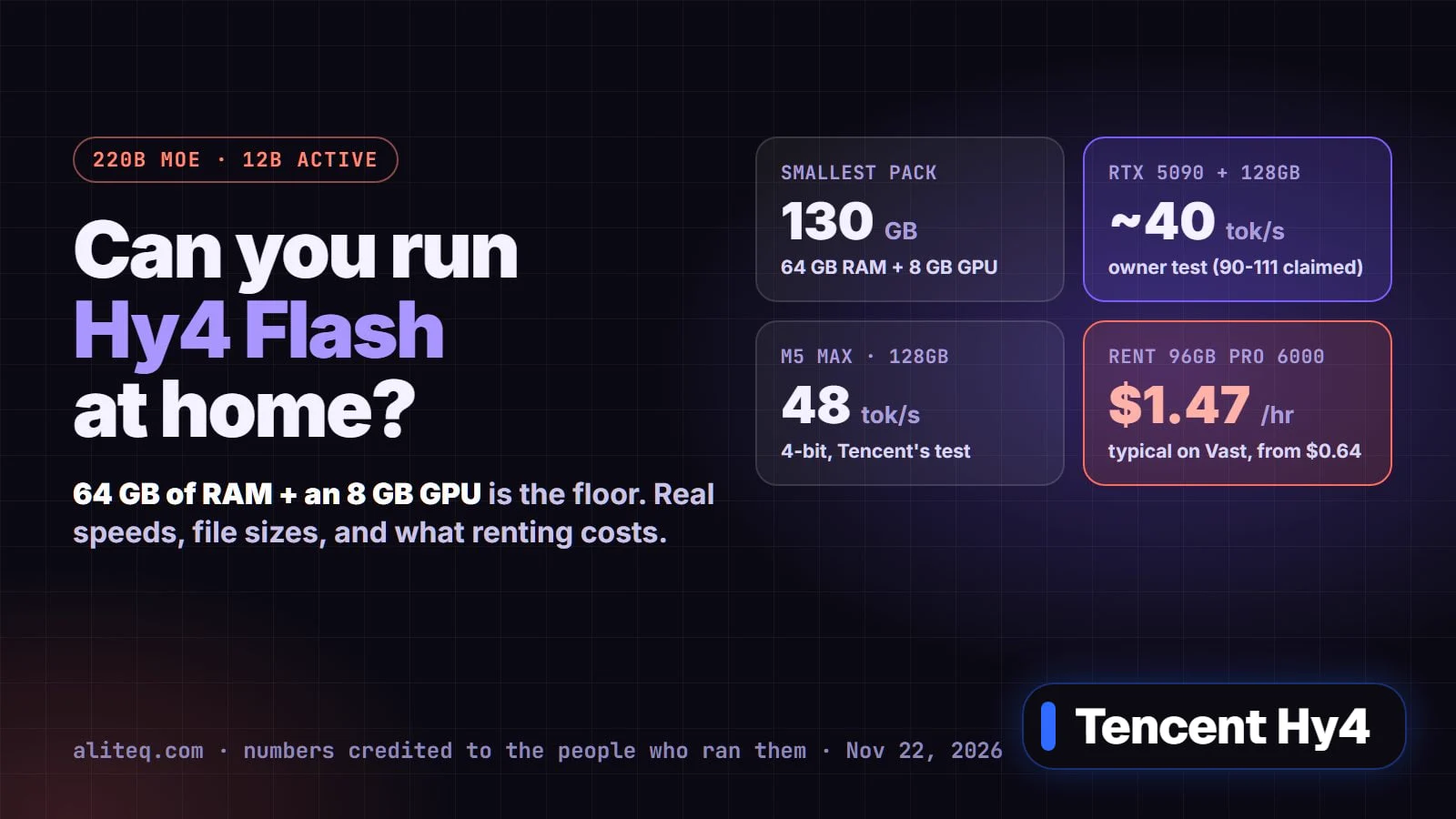
Tencent has captured the attention of the developer community by releasing 'Hy4 Flash', a large open-weights AI model, via Hugging Face. Despite boasting a total parameter count of 220 billion, its efficient design hinted at the possibility of local execution even on consumer hardware. However, contrary to expectations that one could simply download GGUF (GGML Universal Format) files and run them instantly, hidden traps involving compatibility hurdles in standard inference engines and unmerged source branches have emerged.
Image source: https://aliteq.com/can-you-run-hy4-flash-locally
The days when downloading a model's quantization format was all it took to run local AI are shifting. As large models like Hy4 Flash introduce diverse architectural variations, a time lag has opened up between these innovations and the speed at which upstream inference engines and open-source ecosystems adopt them. This article breaks down the architectural traits of Tencent's Hy4 Flash, the technical barriers faced during local execution, and realistic hardware requirements.
220B MoE Architecture and Key Design Traits of Hy4 Flash
Hy4 Flash utilizes a Mixture-of-Experts (MoE) architecture that dramatically reduces active parameters per token relative to its massive aggregate size. MoE is a technique that routes tokens through only a subset of specialized expert subnetworks, boosting processing speed without sacrificing overall model capacity.
According to its model card, Hy4 Flash comprises a 155.5-billion-parameter backbone, 63.5 billion parameters of 'Engram' lookup tables, a small vision encoder, and an 850-million-parameter drafter for speculative decoding, totaling approximately 220.3 billion parameters. In practice, each token engages roughly 11.3 billion active text parameters. It also supports a massive 1-million-token context window while streamlining the attention layer's memory cache structure to keep cache footprints a fraction of previous iterations.
The Local Execution Bottleneck: Unmerged llama.cpp PR #32517
Within the ecosystem of llama.cpp—the widely used C/C++ open-source inference engine for local Large Language Model (LLM) execution—a technical roadblock currently hinders running Hy4 Flash out of the box.
To properly load GGUF files associated with the model (including AngelSlim GGUF releases), users must currently build llama.cpp from an open, unmerged pull request branch (#32517).
Consequently, stock versions of llama.cpp, popular graphical user interfaces like LM Studio, and local runners like Ollama cannot load standard Hy4 Flash GGUF files without manual source building. Community testers have noted loading warnings or outright execution failures on standard releases, meaning technical friction remains high until the official PR is formally merged.
Minimum 64GB System RAM and Realistic Hardware Specs
Despite these compatibility hurdles and the sheer scale of the model, utilizing dedicated open-source engines like 'Strata' opens a path to running Hy4 Flash locally on high-end consumer PCs or Macs.
Under Strata's baseline SQ-64 package, the model requires 64 GB of system RAM plus an 8 GB GPU, with a download size of about 130 GB. Resulting GGUF file sizes range from 83 GB (2-bit) to 168 GB (4-bit).
Real-world benchmarks shared by hardware enthusiasts show that a Windows rig paired with 128 GB of system RAM and a high-end GPU achieves around 40 tokens per second on mixed workloads. Apple Silicon Macs (such as an M5 Max with 128 GB of RAM) reach approximately 48 tokens per second at 4-bit quantization. Meanwhile, laptops and standard consumer machines with under 64 GB of RAM cannot accommodate the model locally, making rented cloud GPUs or remote APIs the more practical route for casual testing.
Sources
- Aliteq: Can you run Hy4 Flash locally?
- GitHub: llama.cpp Pull Request #32517