Google Releases 17-Page Practitioner's Blueprint for Building Agent Swarms with Gemini 4 Neon
An analysis of Google's new 17-page practical guide on multi-agent swarms using Gemini 4 Neon, Hydrogen, and Carbon models within Google Antigravity.
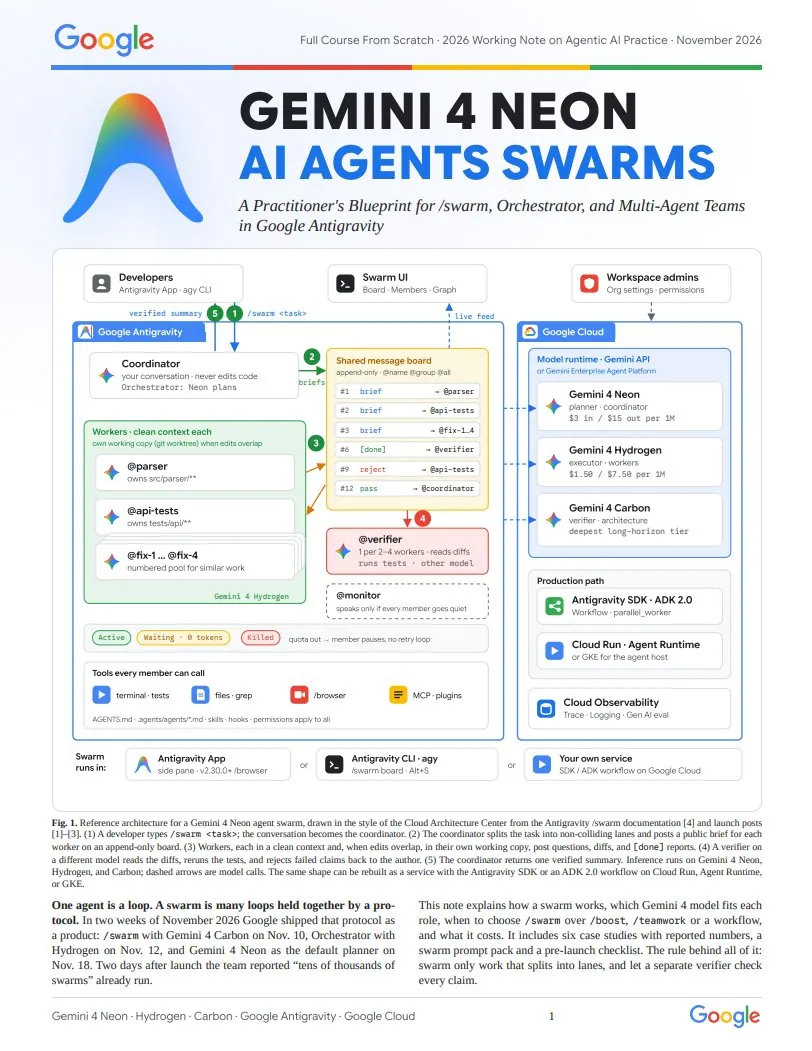
Image source: https://x.com/0xMovez/status/2125996695171273186
In November 2026, the Google Cloud team officially published a comprehensive 16-to-17-page practical guide blueprint detailing how to build multi-agent AI teams using the Gemini 4 foundation model family. Garnering significant attention across developer communities and social platforms, this document addresses the context overload and bottlenecks that occur when a single AI model attempts massive, complex source code modifications. Instead, it proposes an 'agent swarm' architecture where multiple autonomous agents collaborate through defined roles and protocols.

Image Credit: @0xMovez / Google Cloud
In the realm of AI agents, a "swarm" goes beyond merely launching multiple bots at random; it represents a structured framework where agents coordinate through explicit communication rules. Shortly after publication, the Google engineering team reported that tens of thousands of swarms were already actively running within the Google Antigravity environment. This article breaks down the core role distribution and collaboration protocols outlined in the blueprint.
Gemini 4 Model Family and Role Specialization: Coordinator, Worker, and Verifier
When handling large-scale software engineering or complex data workflows, relying on a single AI model for planning, execution, and validation quickly leads to bloated context windows and diminished reasoning capability. To overcome this limitation, the blueprint maps the Gemini 4 product line onto three distinct operational roles:
- Coordinator: Serving as the overall planner, the mid-tier Gemini 4 Neon model acts as the default coordinator. It ingests natural language user instructions, breaks down the broader task into non-colliding sub-tasks, and posts structured task briefs onto a shared message board. Crucially, it manages the conversation flow without directly editing code.
- Worker: Tasked with actual code modifications and execution, Gemini 4 Hydrogen models populate the worker pool. Each worker operates within a clean context and maintains its own working copy (via git worktree) to prevent overlapping file conflicts.
- Verifier: Charged with rigorously inspecting completed work, Gemini 4 Carbon—the deepest long-horizon reasoning tier—serves as the verifier. The verifier reads diffs, reruns test suites, and rejects failed claims back to the author, ensuring high output quality before any task is marked complete.
This tripartite separation maximizes parallel output while structurally preventing individual model errors from cascading through the pipeline.
The Antigravity /swarm Protocol and Workspace Isolation
Google's development environment, Google Antigravity, introduced the /swarm command and native orchestrator features to operationalize this framework. While older sub-agent architectures relied on hierarchical child sessions reporting exclusively back to a parent context, the swarm protocol establishes an open, synchronized environment:
- Shared Message Board: An append-only public message board where all agents read and write ordered histories. Agents address each other using tags like
@name,@group, or@allto coordinate tasks in real time. - Workspace Isolation: To prevent editing collisions, workers operate inside clean contexts and distinct working copies using git worktree mechanisms, restricting edits strictly to designated lanes (such as
src/parser/**). - Active and Waiting States: Idle members consume zero token costs while parked, waking up instantly only when explicitly mentioned or pinged by another agent.
These protocol guarantees allow complex refactoring and multi-module updates to proceed concurrently without constant human intervention.
Practical Considerations and Cost Efficiency
The guide also addresses the economic realities and operational constraints of running multi-agent swarms. As agent counts scale, API invocation volumes and token consumption grow proportionally.
Specifically, the Gemini 4 Hydrogen worker model is positioned economically at $1.50 per million input tokens and $7.50 per million output tokens, whereas Gemini 4 Neon planner handles coordination logic. Consequently, swarms are recommended not for trivial scripts, but for large-scale engineering tasks where work naturally decomposes into independent lanes and rigorous verification justifies the compute expenditure.
By combining the Antigravity SDK (ADK 2.0) with Google Cloud runtimes like Cloud Run or GKE, teams can rebuild and host these swarm topologies as scalable microservices. This milestone signals a shift in developer workflows from manual coding to managing orchestrated multi-agent teams.
Sources
- Original X Post (@0xMovez): Google 17-page PDF on building agent swarms with Gemini 4 Neon
- Practitioner's Blueprint PDF (Google Drive): Gemini 4 Neon AI Agents Swarms Practitioner's Blueprint