NVIDIA Open-Sources Sana: A 2.6B Controllable World Model Running on a Single GPU
NVIDIA NVlabs has open-sourced Sana, a 2.6B parameter world model controllable via an image, text prompt, and camera trajectory, capable of running on a single
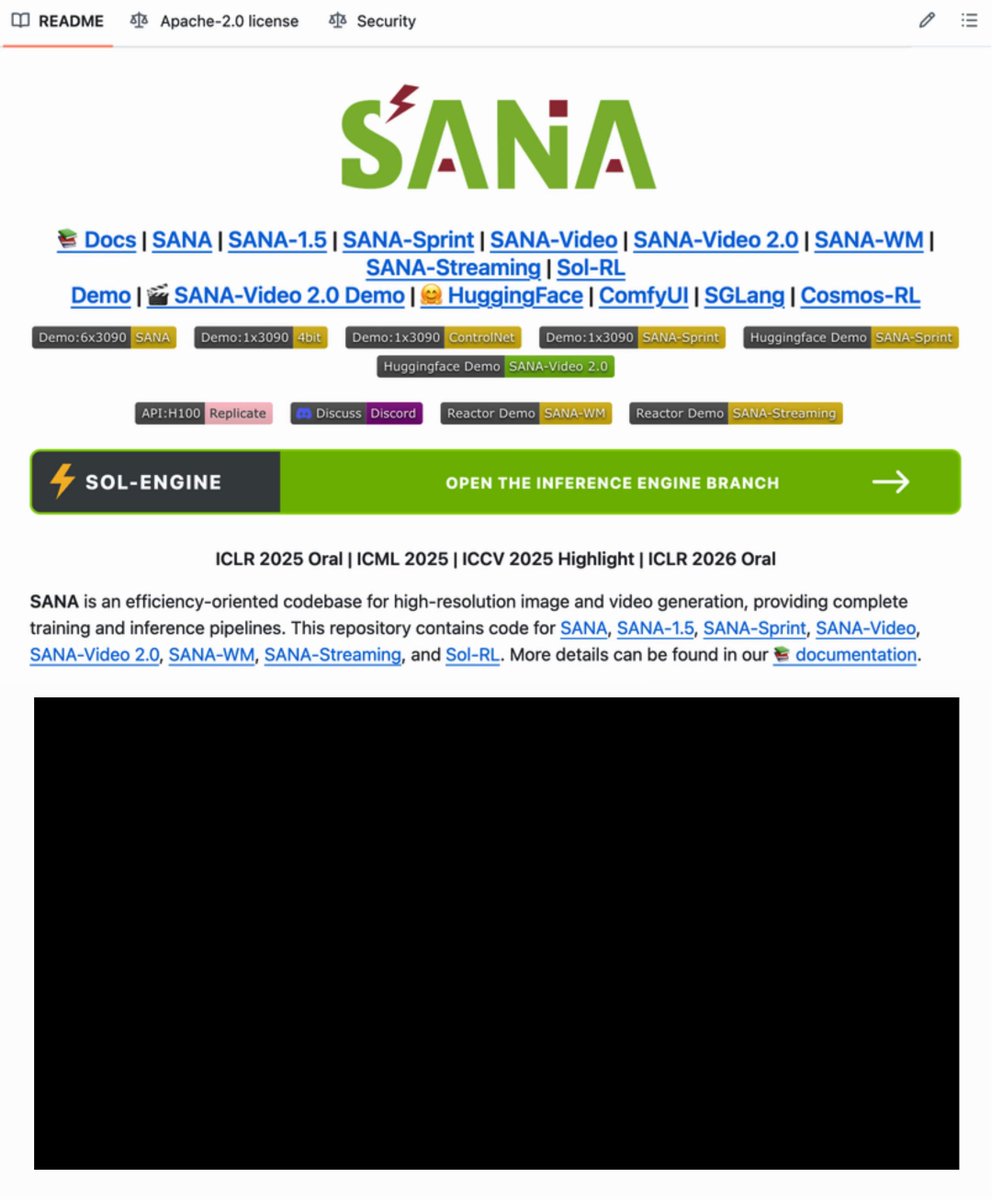
On October 14, 2026, NVIDIA NVlabs released the official code and research paper on GitHub and arXiv for Sana, an open-source 2.6-billion-parameter (2.6B) world model that generates controllable 3D environments from an initial image, a text prompt, and a camera trajectory.
Image source: @simplifyinAI / NVIDIA NVlabs
Generative world models have traditionally been constrained by high-overhead infrastructure requirements, demanding multi-GPU clusters and extensive distributed compute that put research out of reach for independent developers and smaller labs. By compacting the architecture into a 2.6B parameter model, Sana makes world-model experimentation accessible on a single high-performance GPU, such as an NVIDIA RTX 5090 or an H100, without requiring distributed cluster setups.
Multimodal Control Architecture and Core Application Areas
The core mechanism of the Sana world model lies in coupling visual conditioning, semantic instructions, and spatial camera control into a unified generative pipeline.
By supplying a single reference frame, a descriptive text prompt, and a defined camera trajectory vector, users can direct the model to synthesize a coherent 3D scene that dynamically responds to camera movement.
- Spatial Controllability: Unlike standard text-to-video generation that lacks camera trajectory controls, Sana enables controllable environment synthesis responsive to camera movements.
- Target Applications: The model is suited for embodied AI, robotics research, and virtual simulation environments.
Single-GPU Workstation Execution and Hardware Requirements
The primary architectural milestone highlighted by researchers is Sana's independence from multi-GPU clusters during inference and local testing.
- Supported Hardware Tiers: Sana is designed to execute on single flagship GPUs such as the NVIDIA RTX 5090 or the data-center-grade NVIDIA H100 Tensor Core GPU.
- Democratizing Research Workflows: Bypassing multi-GPU node requirements allows researchers to load model weights and evaluate trajectory-guided spatial generation on a single dedicated workstation.
- VRAM Considerations: Although single-GPU execution is a notable efficiency leap, target hardware centers on flagship cards with high VRAM allocations (such as RTX 5090 and H100). Verifying support, memory overhead, and potential quantization paths on smaller consumer GPUs remains necessary via repository specifications.
Trajectory Consistency, Drift Prevention, and Production Verification
Alongside its accessible parameter footprint, practical integration into robotics and simulation workflows requires evaluating long-horizon stability.
In particular, given its 2.6B footprint on a single GPU, researchers have highlighted whether scene consistency holds together or whether visual drift occurs once the camera trajectory extends beyond the initial frame as a key question requiring benchmark verification.
With NVIDIA NVlabs releasing the complete codebase and research paper under an open-source framework, practical benchmarks evaluating trajectory drift, spatial coherence, and integration into simulation environments are expected to emerge across the developer community.
Sources
- Official GitHub Repository: NVlabs/Sana
- Simplifying AI (@simplifyinAI) Announcement on X: NVIDIA 2.6B Open-Source World Model Sana Announcement