Colibri: Open-Source Tool Running Large AI Models on Laptops Without Dedicated GPUs
Colibri enables standard laptops to run large open AI models without dedicated GPUs via dynamic disk offloading, featuring single-script setup and Claude Code i
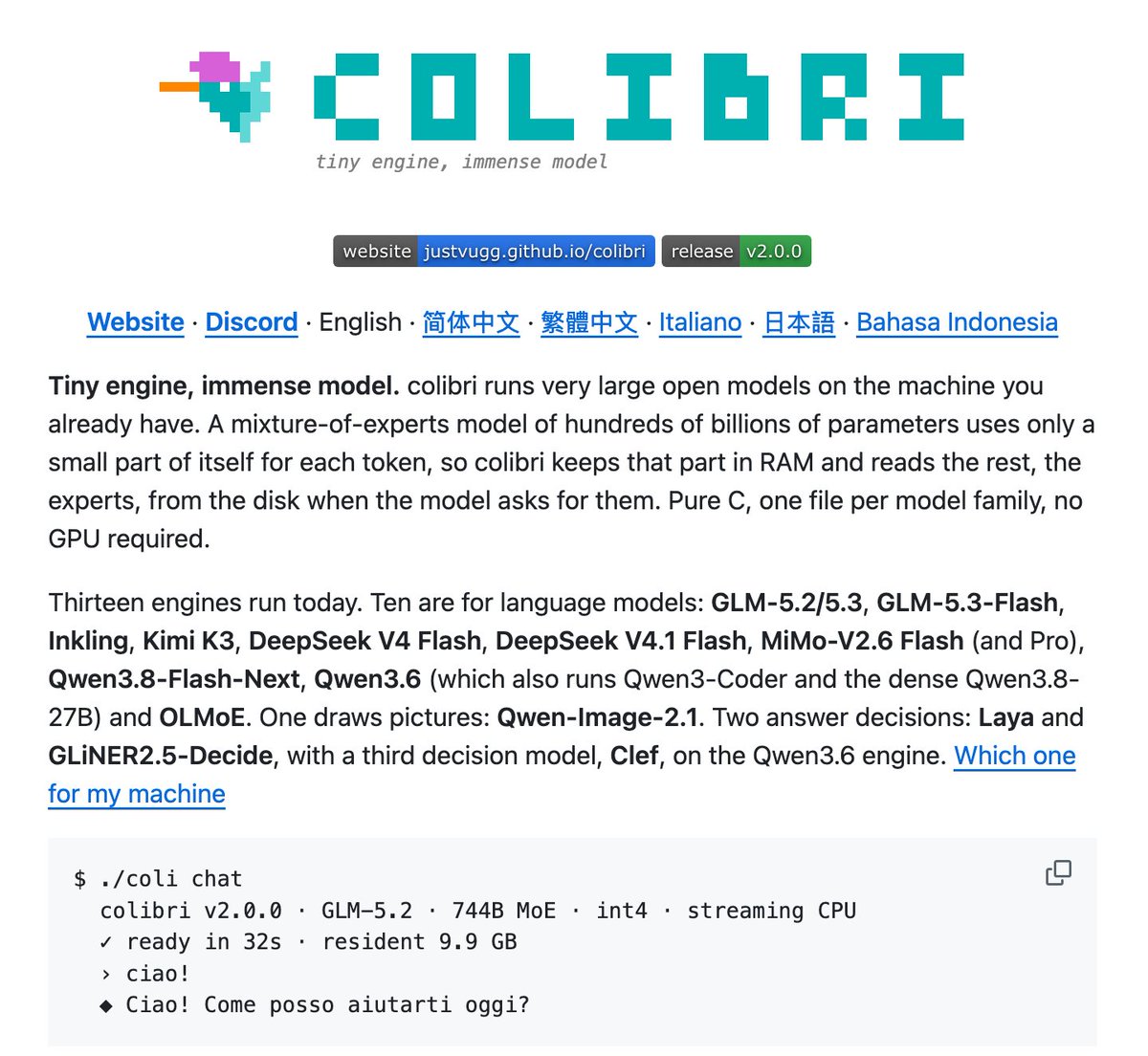
Running datacenter-scale open-source artificial intelligence models on consumer hardware has historically required costly dedicated graphics cards (GPUs) equipped with massive video memory (VRAM). Addressing this hardware bottleneck, 'colibri' (JustVugg/colibri), an open-source project that has rapidly gathered nearly 42,000 GitHub stars, demonstrates a practical method for executing large open AI models directly on standard laptops without requiring a discrete graphics card.
Image source: @alex_verem (X)
The architecture of colibri capitalizes on a core structural characteristic of large neural networks: during text generation, models only utilize a small subset of their total parameters for each generated word. By keeping only the active weights in system RAM and streaming the remaining parameters dynamically from disk (SSD) when required, colibri enables standard consumer laptops to host models originally engineered for high-performance enterprise data centers—ensuring complete data privacy without recurring subscription costs.
Dynamic Disk Offloading and Active Weight Streaming
Conventional local inference frameworks operate under the assumption that the entire model weight matrix must reside concurrently inside high-speed VRAM or unified system memory. In standard laptop environments lacking dedicated GPUs, attempting to load massive models through traditional runtimes triggers immediate Out-Of-Memory (OOM) exceptions during initialization.
Colibri overcomes this barrier by introducing a decoupled memory-and-storage pipeline:
- Selective Parameter Activation: Rather than loading multi-gigabyte models monolithically, colibri leverages the observation that language models activate only a fraction of their parameters per token step.
- RAM Footprint Minimization: Only the currently active weights required for the immediate matrix computation are retained in system memory (RAM).
- On-Demand Disk Streaming: Inactive parameter blocks remain on high-speed solid-state drives (SSD) and are read sequentially on demand as the computation advances.
Through this dynamic offloading mechanism, portable laptops without discrete GPUs can execute models built for server racks without overflowing physical memory.
Hardware Requirements, Single-Script Setup, and Claude Code Integration
Colibri emphasizes deployment ergonomics, providing an automated onboarding workflow that removes the friction of manual configuration:
- Automated Single-Script Configuration: A single setup script evaluates the host laptop's hardware specifications and automatically recommends and configures the largest model the device can comfortably handle.
- Hardware Memory Tiers: Minimum execution begins at 8GB of system memory (RAM), with 16GB or more recommended to ensure smooth execution and stable inference overhead.
- Claude Code CLI Compatibility: The tool natively interfaces with Claude Code, allowing developers to point their terminal coding utilities directly at an AI model running on their local machine.
- Local Privacy and Cost Independence: All computational inference executes entirely on-device without outbound network requests. No user inputs, prompts, or proprietary source code ever leave the physical machine, and users operate free of third-party API metering or ongoing cloud service tiers.
Disk Streaming Latency and Practical Workflow Trade-Offs
While executing large open models on a laptop without a dedicated GPU overcomes physical hardware barriers, streaming parameters from disk introduces distinct latency trade-offs.
Developer discussions around colibri highlight that maintaining active expert weights in RAM while streaming the rest from an SSD makes even large models with over 400 billion parameters runnable on consumer laptops. However, because inactive weights must be dynamically fetched from storage during inference, generation latency is inherently higher than running fully resident models in high-speed VRAM, leading developers to note that inference speed remains a key operational factor in user experience.
Consequently, practitioners recommend a pragmatic division of computational tasks:
- Ideal for Local Execution: Handling proprietary source code, privacy-sensitive internal tasks, and routine daily development without incurring cloud API metering or recurring subscriptions.
- Hybrid Workflow Strategy: Relying on hosted cloud models for tasks demanding instant responsiveness or peak reasoning capacity, while directing standard, high-volume development tasks to the local model on the developer's laptop.
With colibri's automated script selecting the largest model suited to the host laptop's configuration, developers can establish a localized, cost-free AI pipeline tailored to their specific hardware profile.
Sources
- GitHub Repository: JustVugg/colibri
- Alex Veremeyenko on X: @alex_verem