Magnitude: Open-Source Local LLM Profiling, Hardware Tuning, and Agent Harness Connector
Magnitude profiles your PC hardware, ranks local LLMs with estimated tok/s, applies speculative decoding, and bridges local models to Pi, OpenCode, and Claude C
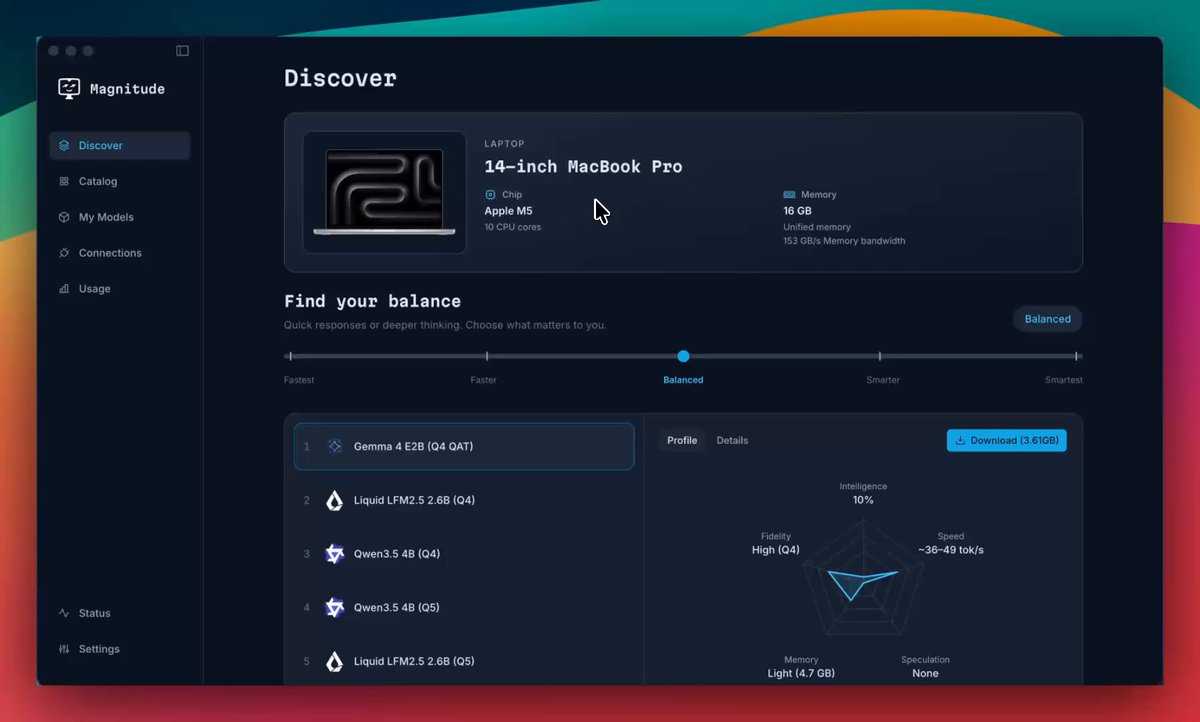
For developers looking to run local large language models (LLMs) on their own desktops or workstations, finding the right model architecture and quantization format for their hardware is often a frustrating cycle of trial and error. Calculating memory bandwidth limits, measuring VRAM overhead, and wiring runtimes into active agent workflows can quickly stall adoption. To solve this friction, an open-source project named Magnitude has launched, combining automatic hardware profiling, hardware-tailored model tuning, and one-click integration with major coding agent harnesses.
Image source: @_avichawla / Magnitude
Hardware Profiling and Four-Metric Model Ranking Before Download
Magnitude’s primary distinction is its ability to accurately evaluate local system capabilities and predict real-world inference throughput before downloading multi-gigabyte model weights.
While traditional local AI setups rely on manual guesswork, Magnitude automatically inspects the host machine’s processor, available system RAM and VRAM, and memory bandwidth. It supports Apple Silicon, NVIDIA GPUs, AMD GPUs, and CPU-only configurations.
Once profiling is complete, the application estimates generation speed (tok/s) across every supported model and quantization level in its catalog. To help users make informed decisions, it ranks candidate models across four foundational criteria:
- Speed: Projected token generation speed (tok/s) calculated from hardware compute cores and memory bandwidth
- Accuracy: Precision and adherence when handling complex prompts without hallucination
- Intelligence: Benchmark scores reflecting reasoning depth, instruction-following, and coding performance
- Memory Required: Minimal RAM and VRAM footprint needed, factoring in context window expansion
By inspecting these metrics beforehand, developers can avoid common pitfalls such as out-of-memory (OOM) crashes and unacceptably sluggish inference after downloading large weight files.
Tailored Speculative Decoding and On-Demand Resource Lifecycle
Beyond selecting an appropriate model, Magnitude automates low-level runtime optimization and memory lifecycle management directly on the host machine.
The runtime configures context sizes, concurrency levels, and speculative decoding tailored specifically to the host hardware. By pairing a smaller draft model with a larger target model, speculative decoding can substantially boost effective token generation rates compared to standard single-model inference on consumer GPUs.
For resource efficiency, Magnitude implements an on-demand model lifecycle:
- Load on Request: Model weights are loaded into active memory only when an agent or user issues an inference request.
- Unload when Idle: When inference stops and the system sits idle, the model is automatically unloaded to release system memory.
- Unload on Memory Pressure: If other system applications require memory, the runtime safely unloads weights to protect system stability.
One-Click Integration with Pi, OpenCode, and Claude Code Harnesses
What makes Magnitude particularly relevant for developers is its native ability to bridge local models directly into the tools and agent harnesses they already use daily.
Distributed as both an open-source desktop application and a lightweight CLI, it requires no persistent daemon setup:
- CLI Installation:
npm install -g @magnitudedev/cli - Execution:
magnitude(runs directly without a background daemon) - Skill Extensibility: Built-in support to extend capabilities across Excel, PDFs, Chrome, and more
Most importantly, Magnitude provides single-command or one-click connections to major coding agent harnesses including Pi, OpenCode, Hermes, Claude Code, Codex, and Cline. This enables developers to run autonomous agents entirely offline without API keys, per-token billing, or usage quotas.
Users must still account for the physical constraints of their local hardware, as RAM and VRAM capacity dictate the maximum feasible parameter size and quantization depth. Depending on the target coding harness and local shell environment, basic CLI path configurations or bridge setup may be required. Magnitude is distributed under the permissive Apache 2.0 open-source license.
Sources
- Magnitude Official Website: Magnitude - Run the best local models for your machine
- Avi Chawla Official Announcement (@_avichawla): Magnitude Launch Announcement
- Magnitude GitHub Repository: GitHub - magnitudedev/magnitude