Xyne Releases XOR: An Open-Source Multimodal Decision Model Based on Qwen3.6
Xyne has released XOR on Hugging Face, an open-source multimodal decision model built on Qwen3.6 with a 260k context window for enterprise data sovereignty.
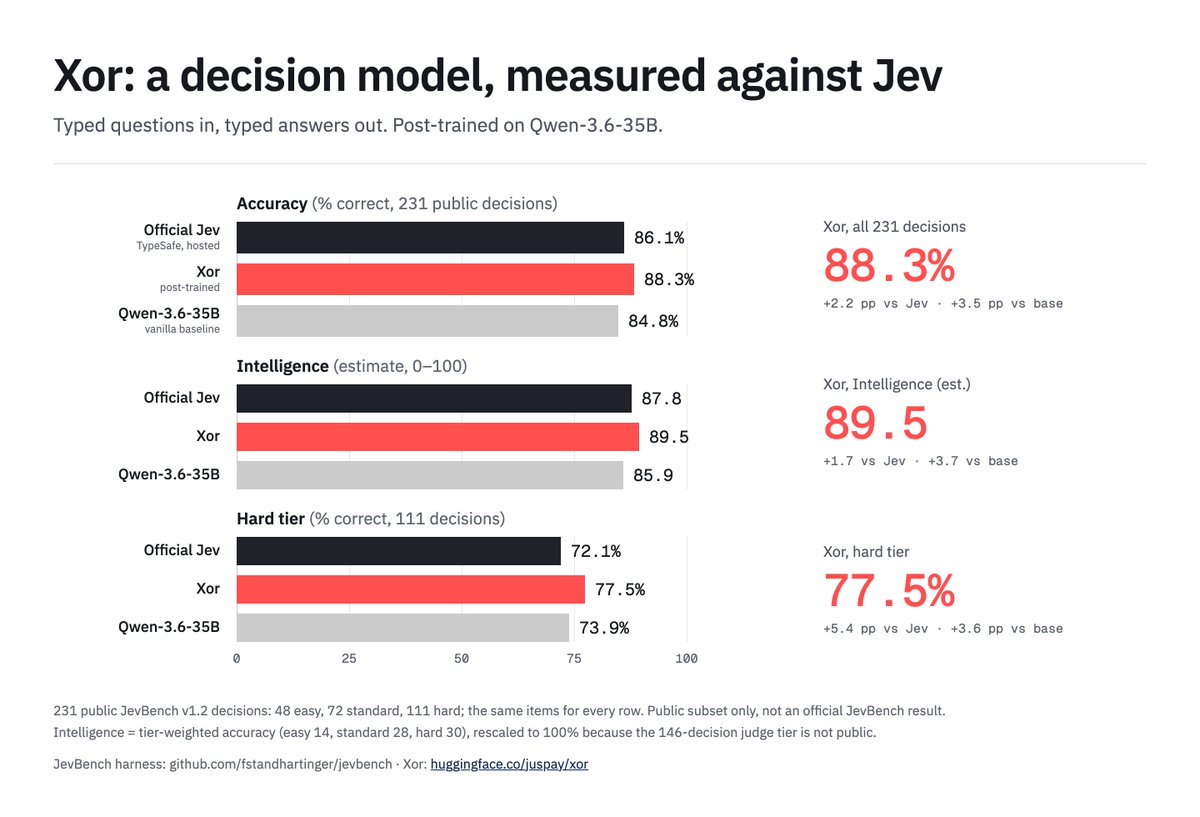
On September 24, 2026, AI research and development team Xyne officially announced and released the open weights for XOR, an open-source multimodal decision model hosted on Hugging Face under the repository juspay/xor. Positioned as an open alternative to TypeSafe's proprietary commercial decision model Jev, XOR is built upon Alibaba's open foundation model Qwen3.6 (post-trained on Qwen-3.6-35B). It natively supports both textual and visual classification tasks while introducing an expansive 260k-token context window designed to overcome the strict input length boundaries that have constrained previous lightweight routing models.
Image source: Xyne (@XyneAI)
As multi-agent workflows and autonomous tool-calling architectures become foundational to modern software, specialized decision models have rapidly gained prominence. These models handle high-frequency micro-judgments—such as intent classification, conditional tool dispatch, and dynamic LLM tier routing—at ultra-low latency and predictable cost. However, the dominant high-accuracy decision models have largely operated as closed, cloud-hosted proprietary APIs. For enterprise deployments handling confidential internal documents, proprietary codebase metadata, and desktop screenshots, transmitting internal telemetry to third-party endpoints has raised persistent data sovereignty concerns. Xyne's release of XOR directly addresses this gap by offering an open-weight foundation designed for private infrastructure and sovereign enterprise orchestration.
260k Context Window and Multimodal Classification Architecture
The defining architectural attribute of XOR is its combination of large-scale context processing and multimodal visual perception, departing from the narrow single-turn text constraints typical of earlier decision routers.
Dedicated router models like Jev have traditionally focused on fast decision-making over concise text inputs or structured metadata. In contrast, XOR inherits Qwen3.6's multimodal capabilities, enabling it to ingest extended system logs, multi-turn agent execution traces, large codebase structures, and visual inputs such as UI screenshots or complex documents to render classification judgments.
- Unified Text and Visual Classification: Processes both textual instructions and direct visual inputs—such as application interfaces and diagrams—to determine agent downstream actions or tool selection.
- Expanded 260k Context Window: Operates over complete operational histories and multi-document contexts without truncation, enabling context-aware decision routing in long-horizon workflows.
- Enterprise Data Sovereignty: Designed for private enterprise infrastructure, ensuring sensitive operational data and screenshots remain within internal environments rather than traversing external cloud APIs.
Benchmark Performance and Early-Release Calibration Boundaries
In its launch announcement, Xyne shared performance data evaluating XOR against TypeSafe's official hosted Jev and a vanilla Qwen-3.6-35B baseline across 231 public JevBench v1.2 decision tasks (composed of 48 easy, 72 standard, and 111 hard items, representing a public subset rather than an official benchmark certification).
According to the published metrics, XOR achieved an overall accuracy of 88.3% across the 231 public decisions, surpassing official Jev (86.1%) by +2.2 percentage points and the base Qwen-3.6-35B model (84.8%) by +3.5 percentage points. On the tier-weighted Intelligence metric (scaled from 0 to 100), XOR registered 89.5, outscoring Jev (87.8) and the baseline (85.9). On the 111 hard-tier decisions, XOR reached 77.5% accuracy, delivering a +5.4 percentage point margin over official Jev (72.1%) and +3.6 percentage points over the base model (73.9%).
However, Xyne offered a candid assessment of the model's current boundaries, explicitly stating: "Xor isn't besting Jev at everything right now. On some benchmarks though, Xor will surprise you. And we're just getting started :)" The development team emphasized that this initial release represents an opening milestone for community collaboration, noting that ongoing post-training and output probability calibration remain core engineering priorities.
Engineering Considerations: Inference Latency and Model Scale
The release has sparked technical discussions across the AI developer community regarding the operational tradeoffs between parameter scale and decision latency.
Because decision models are primarily valued for ultra-fast routing that spares full-scale LLM invocations, community observers noted that a 35B parameter base model presents substantial compute and VRAM overhead for real-time edge or microservice deployments. Questions have also emerged regarding the architectural balance between single-pass vision-language model (VLM) embeddings and multi-stage cascade pipelines that combine lightweight specialized classifiers.
In response to developer feedback, Xyne outlined an active community collaboration roadmap addressing three key technical directions:
- Smaller and Local Versions: Releasing quantized and distilled lightweight variants optimized for low-memory edge devices and ultra-low-latency local inference.
- Domain-Specific Flavors: Tailoring specialized model checkpoints for targeted workflow domains and enterprise requirements.
- Enhanced Calibration: Refining probability output distributions to ensure predictable, mathematically grounded thresholding in mission-critical production pipelines.
By introducing open weights, multimodal capabilities, and an expansive context window to the decision model landscape, Xyne's XOR provides organizations with a viable path toward sovereign, self-hosted agent orchestration.