OpenAI Announces Breakthroughs in Math and Physics: Kakeya Conjecture and QCD Proofs
OpenAI has revealed three new research achievements in mathematics, computer science, and physics, including proofs addressing the Kakeya conjecture and the Exp
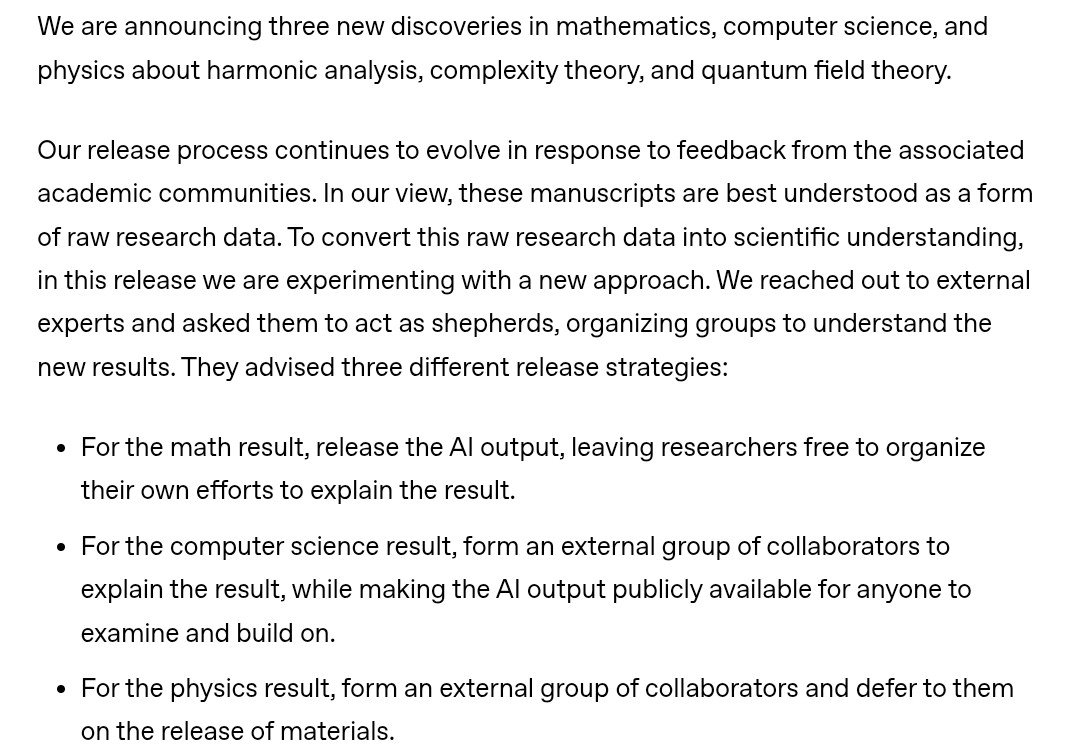
On October 27, 2026, OpenAI officially announced three new research discoveries and proofs derived by its internal AI models across mathematics, computer science, and physics. This disclosure highlights the potential of AI systems to contribute meaningfully to foundational scientific problem-solving.
Image source: Andrew Curran / OpenAI (@AndrewCurran_)
The announced findings cover three major topics: local smoothing and the Kakeya conjecture in mathematics, the refutation of the Exponential Time Hypothesis (ETH) in computer science, and the mathematical existence proofs for quantum chromodynamics (QCD) and completions of the Standard Model in physics.
AI-Generated Proofs for Foundational Scientific Problems
According to OpenAI researchers, their internal models produced a natural language proof for Yang–Mills existence on September 9, 2026, followed by a proof for QCD on September 18, 2026.
Due to the length and complexity of the work, the release was postponed until the Lean formalization was completed. The formalization of Yang–Mills existence finished on October 16, 2026, prompting the launch of this academic collaboration. Alongside these proofs, preprints concerning local smoothing for the Euclidean wave equation and the refutation of the Exponential Time Hypothesis were released.
Academic Collaboration and Ongoing Review
OpenAI emphasized that these research results were developed through engagement with academic communities. Because rigorous peer review and independent academic verification are essential steps, the released preprints and Lean formalization artifacts are currently undergoing examination by the broader mathematics and physics communities.
These research findings have been shared via OpenAI's official announcements and preprints, and independent academic evaluation remains ongoing.
Sources
- OpenAI Official Blog: Building scientific understanding with academic communities
- Andrew Curran X Post: 2026-10-27 X Thread
- OpenAI Math GitHub Repository: The Exponential Time Hypothesis is False Preprint