A New Horizon for Robot Foundation Models: X Square Robot Unveils 'WALL-OSS-1.0' VLA Model
X Square Robot has introduced WALL-OSS-1.0, a native VLA foundation model built on Qwen3.5. It achieved a 55.1% zero-shot success rate across 312 real-robot tas
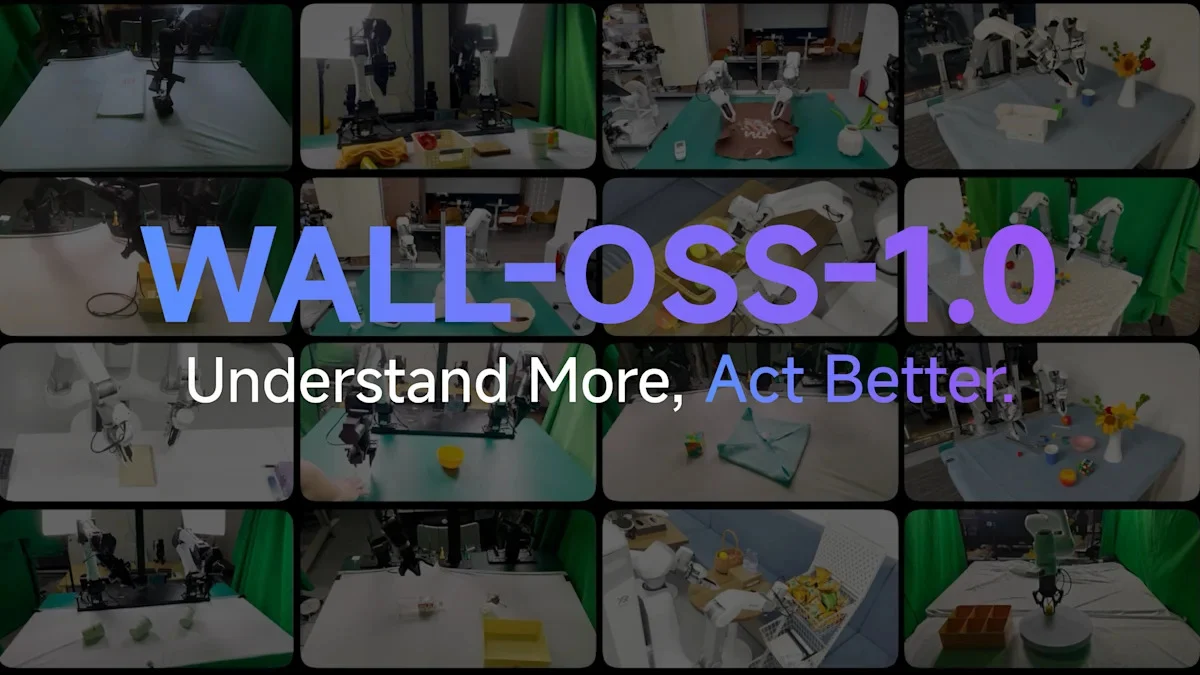
On November 23, 2026, Shenzhen-based robotics company X Square Robot officially introduced 'WALL-OSS-1.0', a native vision-language-action (VLA) foundation model that unifies vision, language, and physical action into a single learning framework. This release marks a significant step toward general-purpose robot intelligence, enabling robots to enter unfamiliar environments and execute new instructions without task-specific fine-tuning.
Image source: https://finance.yahoo.com/technology/ai/articles/x-square-robot-introduces-wall-074400752.html
While artificial intelligence has made rapid strides in understanding language, images, and video, translating that comprehension into reliable physical action has long been a core challenge in robotics. Many existing VLA models begin with a pretrained vision-language model and graft robotic actions on through subsequent training. In contrast, WALL-OSS-1.0 adopts a native pretraining approach, allowing vision, language, and robotic action data to shape the model's capabilities together from the ground up.
Native VLA Training Approach and Architecture
WALL-OSS-1.0 is built upon Alibaba's Qwen3.5 large language model base. The model incorporates an improved action tokenizer that converts continuous robot movements into compact sequences of discrete tokens, allowing physical experience to be learned alongside visual and linguistic knowledge.
Rather than relying purely on imitation learning of demonstrated movements, its training objectives include action comprehension, evaluating proposed behaviors, and error correction. A flow-matching Action Expert module further translates visual and language context into precise, continuous robot commands, with real-time chunking helping successive movements remain smooth during execution.
Zero-Shot Evaluation Across 312 Real-Robot Tasks and Benchmark Performance
A central challenge in general-purpose robotics is generalization—determining whether a robot can apply learned capabilities to situations it has never encountered during training. X Square Robot subjected WALL-OSS-1.0 to rigorous evaluations across both simulation and real-world setups.
In an open-ended evaluation covering 312 unique real-robot tasks freely chosen by evaluators, WALL-OSS-1.0 achieved a 55.1% zero-shot success rate without task-specific demonstrations or fine-tuning. These tasks spanned unfamiliar objects, tool use, bimanual coordination, and multi-step manipulation.
On simulation benchmarks such as X2Real, the model secured strong scores, while on ManipArena—a real-world benchmark featuring 15 tabletop tasks—it significantly outperformed its predecessor WALL-OSS-1.0-0.5 and alternative baselines. The performance gap was particularly pronounced in tasks combining semantic understanding with physical manipulation, such as sorting, matching, and instruction-based object selection, where it reached a 78% success rate.
The XR Harness Agent Framework and Industrial Deployment
Real-world operations rarely involve isolated single actions. Even a directive like "Clean up the table" requires collecting fruit, organizing scattered items, and stacking plates in correct sequences. To address this complexity, X Square Robot has introduced XR Harness, an agentic framework connecting high-level task planning with physical execution.
XR Harness consists of three interconnected systems. System 2 interprets user goals, plans task steps, and revises plans based on feedback. System 1 coordinates physical execution, while System 0 connects actions and observations to robot controllers and sensors through the Robot Agent Protocol (RAP). Through this architecture, high-level agents can direct manipulation skills using natural language.
Moving beyond research benchmarks, the technology is already being applied to industrial automation, including parcel sorting for leading logistics customers. In production environments, the model handles packages of varying sizes, orientations, and barcode alignments. Cross-site evaluations demonstrated that the policy retained over 90% of its sorting speed and success rate despite variations in lighting and worktables across locations.
Model Family Expansion and Developer Access
To accommodate diverse computing requirements and deployment constraints, X Square Robot is expanding WALL-OSS-1.0 into a model family. The 4B parameter WALL-OSS-1.0-Lite and 2B Nano variants provide smaller alternatives for efficient inference and affordable task adaptation. Notably, under tested configurations, the Nano model supported 18 robots simultaneously on a single NVIDIA Blackwell GPU.
Additionally, the company is introducing WALL-API-1.0, an interface designed to make its embodied AI capabilities accessible to developers, researchers, and enterprise partners. This initiative lowers barriers to experimentation and application development across various industrial systems. Actual code and model weights are scheduled to be open-sourced soon.
Sources
- X Square Robot Official Blog: X Square Robot Introduces WALL-OSS-1.0
- GlobeNewswire Press Release (Yahoo Finance): X Square Robot Introduces WALL-OSS-1.0