vLLM Adds Single-Step Structured Decision Mode Powered by DiffusionGemma
vLLM now supports single-step structured decisions with DiffusionGemma, seeding fixed response templates to extract choices, scores, and confidence in a single
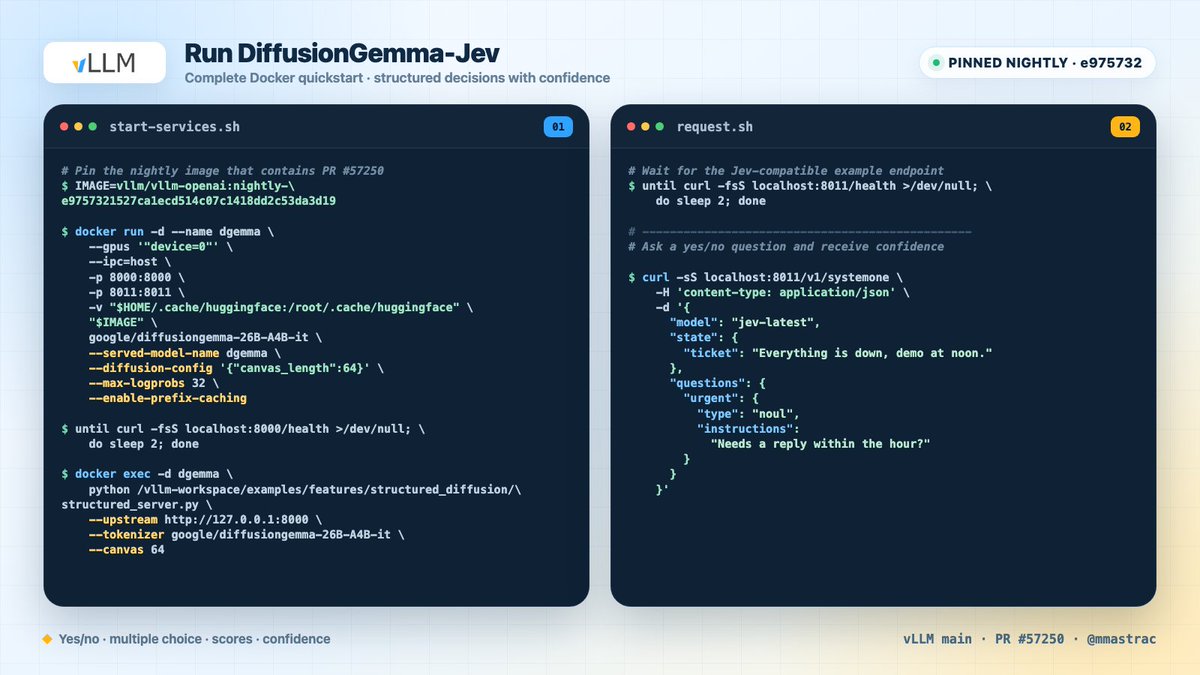
On September 23, 2026, the high-performance open-source serving framework vLLM (@vllm_project) officially announced the upstream integration of a structured decision mode powered by DiffusionGemma, a discrete text diffusion foundation model. Driven upstream by contributor Matt Mastracci (@mmastrac), this new feature—dubbed DiffusionGemma-Jev—bypasses the token-by-token sequential decoding bottleneck inherent to autoregressive models, enabling developers to obtain bounded decisions along with confidence probability distributions in a single denoising pass.
Image source: @vllm_project
The development ports the micro-decision philosophy popularized by the Jev decision model directly onto an accelerated open-source diffusion LLM (dLLM) serving stack. By sidestepping the latency penalties of sequential decoding and grammar-constraint finite state machine (FSM) overhead common in autoregressive routing pipelines, this approach offers an immediate performance leap for AI agent harnesses and decision-heavy classification workloads.
Bidirectional Attention Canvas and Single-Step Denoising Mechanics
The underlying mechanism leverages the distinctive architectural properties of DiffusionGemma (built on Google's Gemma 4 architecture as a 26B-parameter discrete diffusion model).
Unlike conventional autoregressive models that generate text left-to-right via causal attention masks, DiffusionGemma's decoder employs non-causal bidirectional attention across an entire output canvas. Every position on the canvas can simultaneously attend to the full prompt context stored in the KV cache, the surrounding JSON structure, and all other answer slots.
- Canvas Template Seeding: Fixed structural elements, such as JSON syntax, field labels, or surrounding options, are pre-seeded onto the canvas. Only the specific target slots intended for the model's answer are initialized with noise.
- Single Forward Denoising Pass: Rather than executing dozens of iterative refinement steps required for open-ended text diffusion, the engine runs exactly one forward denoising pass across the prompt and seeded canvas to evaluate the noisy answer slots.
- Direct Probability and Entropy Extraction: In that single pass, vLLM reads the vocabulary log-probabilities and entropy directly across each noisy slot index, instantly recovering the most likely answer along with confidence metrics.
- Single-Token Slot Constraint: To ensure canvas positions remain aligned without shifting, target slots must correspond to a single token; multi-token options can be mapped on the client side into single-token labels such as "A" or "B".
This architecture enables deterministic extraction of Yes/No verdicts, multiple-choice selections, and numerical ratings without requiring specialized classifier heads or token-level constrained decoding.
Single-Step Latency and Agentic Decision Routing
Unlike autoregressive pipelines where sequential token generation and constrained decoding overhead accumulate latency on routing calls, evaluating candidate tokens across fixed canvas slots in a single forward denoising pass significantly reduces turn latency for decision-heavy workloads.
This execution profile is particularly valuable for autonomous agent architectures:
- Single-Call Decision Branches: Rather than running multi-turn generations followed by JSON parser validation passes, an agent harness can extract a clean choice and its associated confidence score in a single network round-trip.
- Entropy-Based Escalation: Because the serving engine exposes the complete probability distribution and entropy per slot rather than an opaque argmax token, workflows can dynamically route easy decisions instantly while escalating cases where entropy fails a configured threshold to larger reasoning models.
- Immunity to JSON Syntax Drift: Because formatting tokens are fixed onto the canvas beforehand, the model cannot produce malformed schemas, broken brackets, or omitted keys, completely eliminating JSON syntax parsing failures in production pipelines.
Nightly Preview Availability and Operational Considerations
The structured decision capability is currently available for testing through the official vLLM nightly container image (vllm/vllm-openai:nightly).
Developers can run the nightly container image, launch the example server, and issue requests to the Jev-compatible structured endpoint. vLLM provides implementation recipes and documentation guides covering example deployments and client usage.
Engineering teams evaluating this feature should note key operational boundaries:
- Developer Preview Lifecycle: As an early preview feature in the nightly stream, configuration parameters, request schemas, and argument conventions remain subject to refinement prior to a finalized stable release.
- Scope of Slot Confidence: The extracted probability distributions reflect relative token likelihoods within the pre-seeded canvas slots. They do not validate the factual or logical soundness of the input prompt itself, meaning production deployments should calibrate entropy thresholds against verified benchmark sets.
Sources
- vLLM Official X (@vllm_project): DiffusionGemma-Jev Upstream Release Announcement
- vLLM Official Recipes: DiffusionGemma 26B Jev-Style Structured Decisions Guide
- vLLM Official Documentation: Structured Reads on DiffusionGemma
- vLLM Official Blog: DiffusionGemma: The First Diffusion LLM Natively Supported in vLLM