Boosting LLM Reasoning Without Adding Parameters: The Principle of 'Virtual Logic Depth'
Google DeepMind has introduced 'Virtual Logic Depth,' a scaling dimension that boosts LLM reasoning capabilities without increasing parameter size by looping da
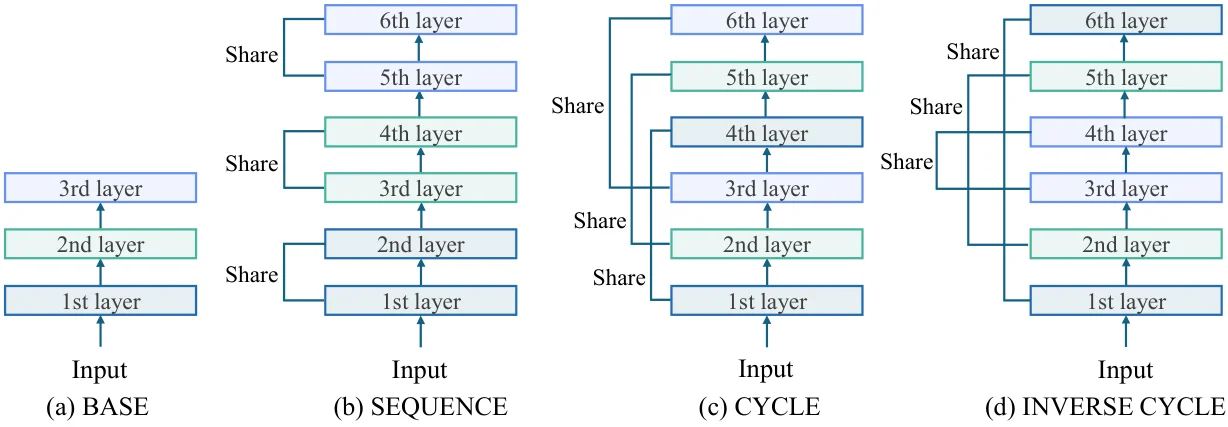
Google DeepMind has proven that you can significantly boost an LLM's reasoning capabilities without adding a single new parameter, challenging long-held scaling assumptions across the artificial intelligence industry.
Image source: Zhu et al., Beyond Parameters (arXiv:2506.18233), Figure 2
Shared by original author @HowToPrompt__, this research introduces a fourth scaling dimension beyond depth, width, and parameter count, termed "Virtual Logic Depth." Instead of building massive new layer stacks, the approach loops data through existing parameters, providing a powerful pathway for efficient local models.
The Fourth Scaling Dimension and Layer Looping
For years, the AI industry operated on a single assumption: making an AI smarter required making it bigger through more parameters, more GPUs, and higher enterprise API costs.
- Traditional Scaling: Elite reasoning required massive enterprise infrastructure and trillion-parameter models.
- The New Finding: DeepMind demonstrated that parameter count dictates a model's knowledge capacity, but not its reasoning capability.
- The Mechanism: By taking existing layers and routing data through them in a loop, the model thinks about the problem multiple times before answering—adding zero extra size or memory footprint.
Transforming the Economics of AI and Local Models
This breakthrough fundamentally alters the economics of AI deployment for developers and small operators.
- Reduced Dependence: Complex problems no longer require heavy reliance on trillion-parameter monopolies or expensive enterprise APIs.
- Local Model Optimization: Tiny, cheap, local models can be looped iteratively to out-reason larger counterparts on specific complex tasks.
- Practical Takeaway: The future of efficient AI engineering focuses on teaching compact models how to think twice through structured iterative reasoning rather than simply expanding raw parameter scale.
Original Source
- Research Paper: Google DeepMind Paper (arXiv:2506.18233)
- X Post: @HowToPrompt__ on X (October 20, 2026)