App Binary Reverse Engineering and Feature Rebuild Tips Using REA, Free AI Models, and Claude Opus 5.5
A practical 3-step pipeline guide for decomposing app binaries using free AI models and REA, then cleanly rebuilding features with Claude Opus 5.5.
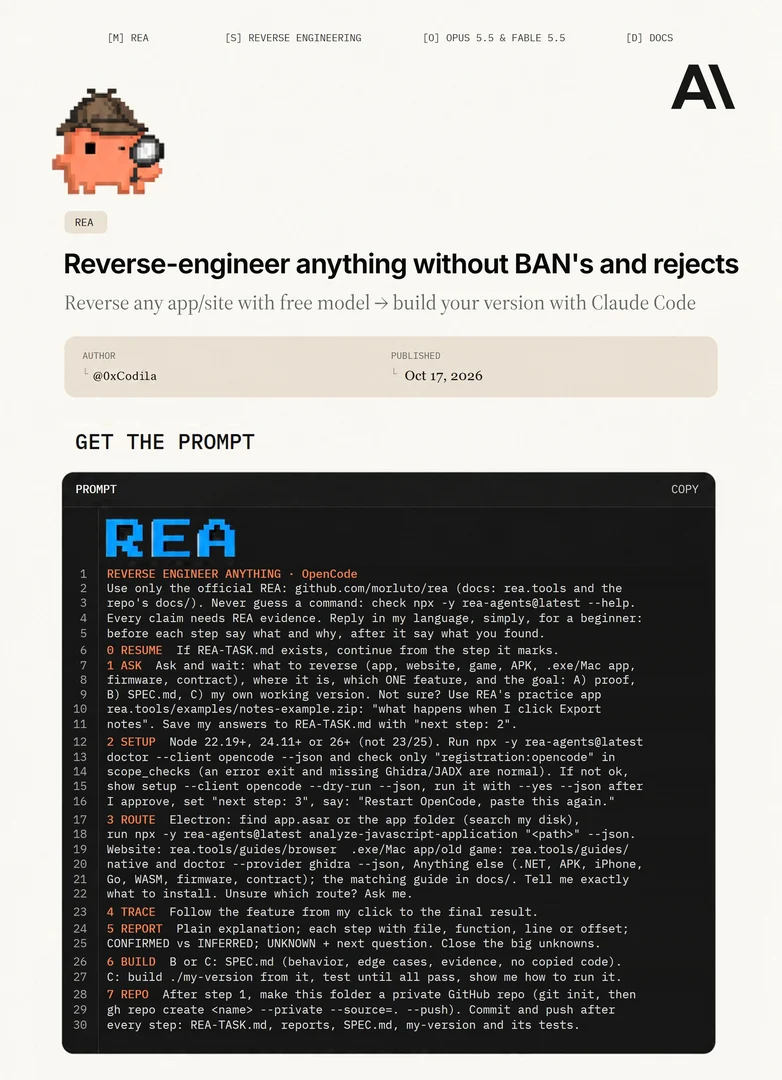
A streamlined workflow for analyzing app binaries and package structures while bypassing structural complexities and model limitations has been shared in the developer community. According to developer @0xCodila, the method splits the pipeline by using cost-effective free models for deep binary decomposition, then passing the structured findings to Claude Opus 5.5 for clean feature reconstruction.
Image source: X / @0xCodila
The 3-Step Reverse Engineering Pipeline
The core strength of this workflow is the clear separation between analysis and reconstruction. Attempting to handle the entire binary inspection process within a single prompt often exhausts context limits and hits model guardrails.
- Phase 1 (Decomposition): Utilize lightweight free AI models or the REA (Reverse Engineer Anything) toolkit to extract binary layouts, function call graphs, strings, and module dependencies without executing untrusted code.
- Phase 2 (Context Refinement): Structure the extracted structural data and artifact summaries into explicit interface specs that high-performance coding assistants can easily ingest.
- Phase 3 (Feature Rebuild): Hand off the refined specifications and structured prompt context to Claude Opus 5.5, enabling clean, maintainable code generation for the target features.
Practical Considerations and Tips
When working with complex native binaries or obfuscated modules, combining traditional disassembler backends like Ghidra or Rizin with REA bridge capabilities drastically cuts down manual inspection overhead.
Instead of asking AI models to blindly decompile raw binaries, establish explicit interface definitions and module boundaries first. Providing a structured architectural map ensures higher fidelity and more reliable code output during the rebuild phase.