Unreal Labs Launches Unreal Agent: Open-Source Harness Cutting Costs by 40% via Asynchronous Execution
Unreal Labs has released Unreal Agent, an open-source AI agent harness that executes tools asynchronously without waiting for model turns, slashing costs by up
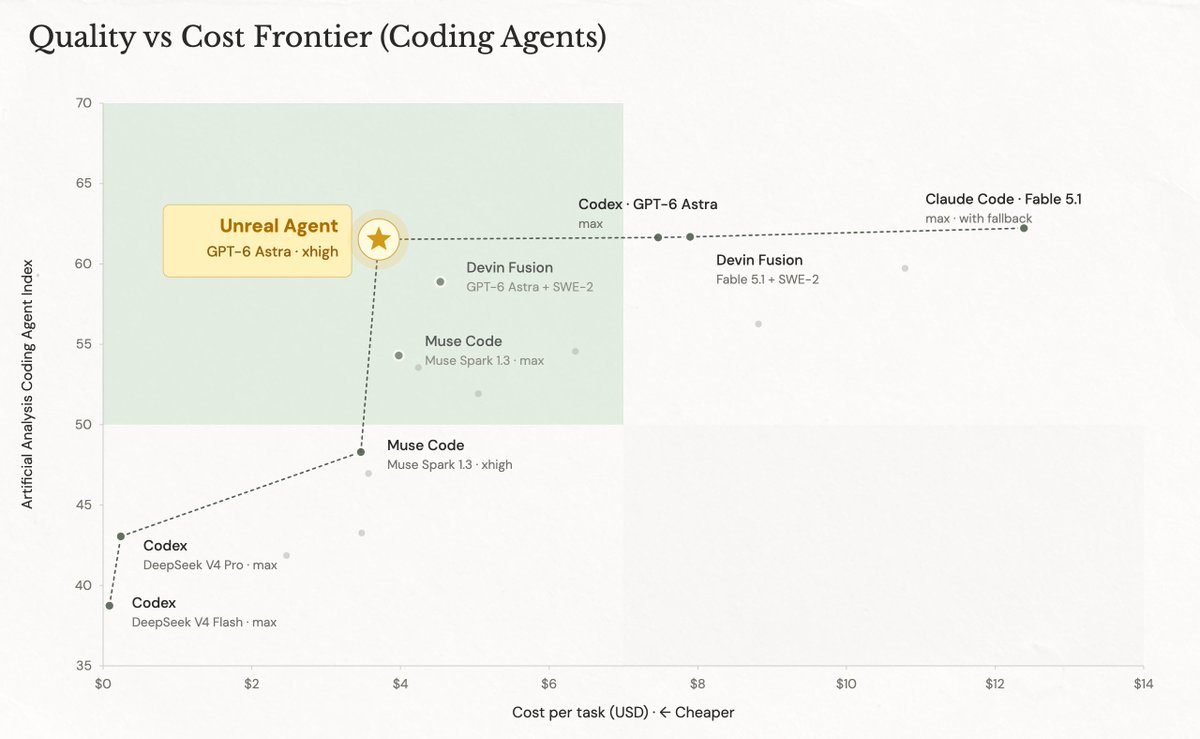
On September 22, 2026, AI research lab Unreal Labs officially introduced Unreal Agent, an open-source agent harness designed to substantially reduce the execution cost of large language model (LLM) agents on coding and system tasks. By breaking away from traditional turn-based blocking patterns and adopting an asynchronous tool execution loop alongside a unified single-bash tool architecture, Unreal Agent demonstrates up to 40% cost reductions compared to OpenAI's Codex across primary benchmarks and production workloads without sacrificing task performance.
Image Credit: Unreal Labs (@unreallabsai)
Traditional proprietary and open-source agent harnesses typically enforce synchronous, turn-based turn-taking: when the model requests a tool call, the entire interaction halts until the harness executes the tool and returns stdout or stderr back into the context window. Unreal Labs identified that this synchronous execution loop introduces massive idle latency and inflates token overhead during lengthy operations like compilation, test suite runs, and large codebase indexing.
Asynchronous Execution Loop and Unified Bash Tool Architecture
The core architectural innovation of Unreal Agent centers on its asynchronous execution loop, which completely decouples tool invocation from model turn progression.
Tools execute independently of model turns, allowing the harness to spawn long-running background processes while the model immediately proceeds with supplementary planning, downstream code generation, or speculative reasoning. As background tasks complete, their output buffers stream dynamically into the agent context, making fresh execution evidence available without blocking upstream turns.
This asynchronous pipeline unlocks two major workflow advantages:
First, users retain continuous interactive control. A developer can steer the agent, provide guidance, or alter operational parameters at any time without being forced to wait for running commands to terminate.
Second, the harness schedules independent tool tasks far more effectively between model calls. Rather than bloating context windows with numerous discrete tool schemas, Unreal Agent exposes a single bash tool interface and pairs it with a system prompt optimized to batch independent commands in unified tool invocations. This approach drastically curbs prompt schema overhead and trims total interaction rounds.
Terminal-Bench 4.0 Benchmark: Matching Frontier Accuracy at 39% Lower Cost
To evaluate performance and cost efficiency under rigorous conditions, Unreal Labs tested Unreal Agent using GPT-6 Astra (xhigh reasoning effort) on Terminal-Bench 4.0.
Terminal-Bench 4.0 serves as an industry standard agentic benchmark assessing autonomous problem-solving across complex terminal tasks, including software engineering, system configuration, and large-scale data analysis. According to verified benchmark results, Unreal Agent matched the Codex official leaderboard baseline score of 57.9% pass rate while reducing total operational cost by over 39%.
| Agent | Pass Rate | Total Cost ($) | Input / Trial | Output / Trial | Turns | Tools | Harbor Run |
|---|---|---|---|---|---|---|---|
| Unreal Agent | 57.9% | $1,428 | 1.73M | 32k | 28 | 37 | 27133053 |
| Codex (Leaderboard) | 57.9% | $2,350 | — | — | — | — | — |
| Pi | 55.0% | $1,827 | 2.83M | 35k | 44 | 57 | 6ccd097a |
In the Terminal-Bench 4.0 run, Unreal Agent completed the benchmark suite for $1,428, representing a 39.2% expenditure reduction compared to the Codex baseline ($2,350) at the identical 57.9% resolution rate.
The benchmark also highlighted efficiency gains relative to Pi, another prominent agent harness. While Pi achieved a 55.0% success rate at an aggregate cost of $1,827, Unreal Agent outperformed Pi by 2.9 percentage points in accuracy while lowering total expenses by approximately 21.8%. Notably, Unreal Agent compressed average input tokens per trial from 2.83M (Pi) down to 1.73M, reduced interaction turns from 44 to 28, and trimmed tool calls from 57 to 37.
Unreal Labs emphasized that this frontier efficiency extends beyond coding tasks into non-coding benchmarks, scientific problem-solving, and day-to-day enterprise workloads, reliably delivering up to 40% cost savings without degrading completion rates.
Open-Source Availability and Production Considerations
Unreal Agent has been released as fully open-source software under an open license on GitHub (unreallabsai/unreal-agent), enabling engineering teams and enterprise developers to audit, adapt, and integrate the harness into their private model infrastructure.
When evaluating Unreal Agent for production deployment, organizations should note two key architectural trade-offs:
First, the headline 40% cost savings are most pronounced in workflows featuring independent terminal operations and high opportunities for parallel tool batching. Strictly serial tasks where each step strictly depends on output from the immediate prior command will experience more moderate batching advantages.
Second, because a single bash tool allows executing arbitrary shell commands and spawning detached background processes, production deployments demand rigorous containerization and sandboxed virtual environments to guarantee host system security and enforce access boundaries.
As automated software engineering and autonomous terminal agents expand across production development stacks, inference costs and interactive latency remain central bottlenecks. Unreal Agent's combination of decoupled asynchronous execution and lean tool surfaces provides a compelling architectural blueprint for high-efficiency agent infrastructure.