Understanding Harness Engineering for AI Agents: A 48-Page Architecture Design Handbook
Based on the foundational 'Agent = Model + Harness' principle, this 48-page technical handbook breaks down the control systems surrounding AI models—covering AC
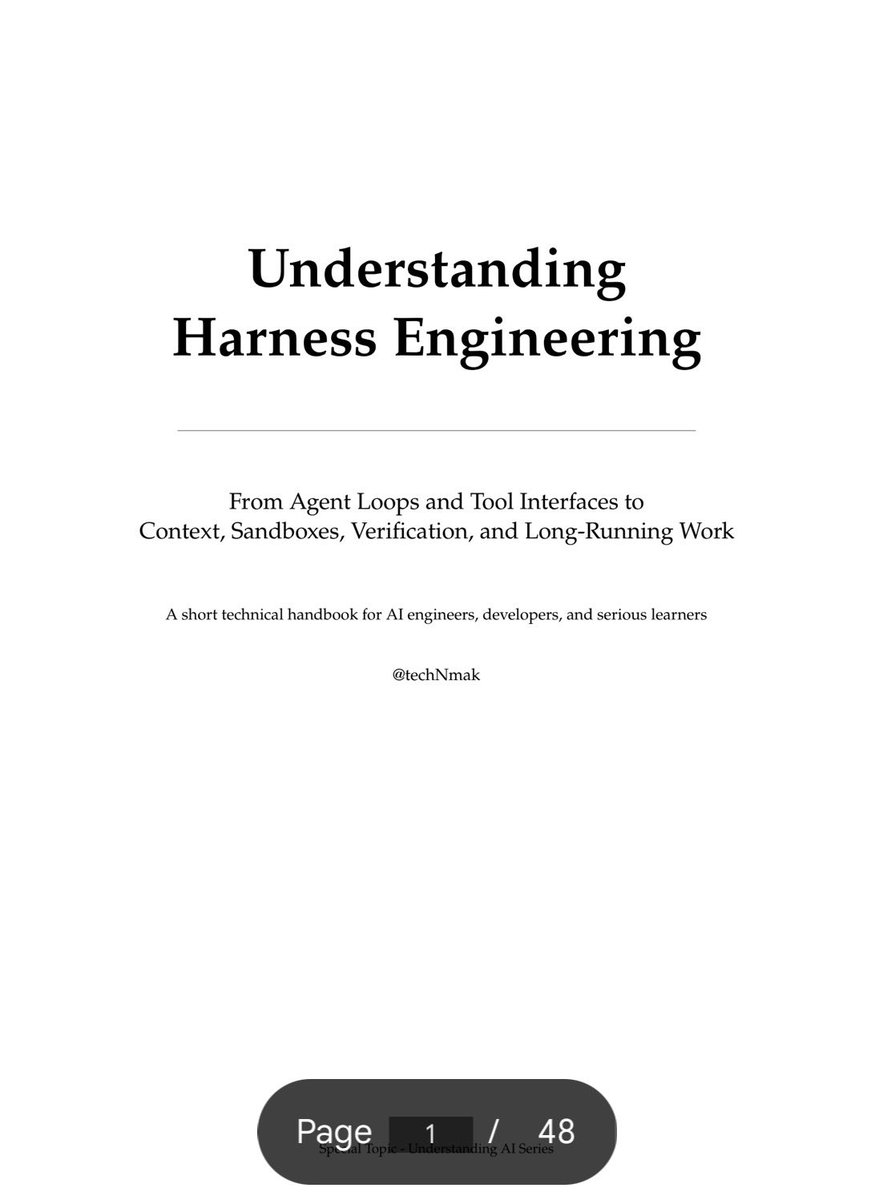
On October 4, 2026, data scientist and AI researcher Dr. Kirk Borne (@KirkDBorne) released a comprehensive technical guide titled "Handbook on Understanding Harness Engineering for AI Agents (48-page PDF)", detailing the control systems and operational layers required for production-grade AI agent systems.
Image source: @KirkDBorne / X
As the industry moves beyond simple prompting techniques and one-off tool calling into multi-turn, long-running agent workflows, "Harness Engineering"—the discipline of designing the external control layers, sensors, and state pipelines surrounding an AI model—has emerged as a primary focus of AI engineering in 2026. This 48-page handbook consolidates architectural principles and actionable checklists for transforming raw foundation model intelligence into reliable, autonomous agents.
'Agent = Model + Harness': The Foundation of Reliable Autonomous Systems
A central thesis in modern AI engineering is the formula 'Agent = Model + Harness'. Foundation models are computational engines designed to predict subsequent tokens based on input context; they do not inherently possess the mechanisms to observe environments safely, execute tools reliably, or independently verify task completion. The agent harness represents the complete surrounding system: guidance rules, verification sensors, context pipelines, and execution guardrails.
According to Atlan's 2026 analysis on harness engineering, 27% of AI agent failures trace to data quality rather than harness architecture or model limitations. This underscores why external data context pipelines and rigorous environmental controls are essential to ensuring operational reliability.
Rather than treating agent errors with blind prompt re-runs and hoping for better outcomes, harness engineering focuses on systematically modifying the runtime environment so that entire classes of failures are prevented structurally.
Core Architecture Layers: ACIs, MCP Tooling, Context Pipelines, and State Persistence
The handbook outlines critical layers required to build an enterprise-ready agent harness:
- Agent-Computer Interface (ACI): The structured interaction boundary between the agent and host operating systems, shell terminals, and remote APIs. Unlike human-facing GUIs, ACIs require strictly typed parameter schemas and predictable return formats to eliminate model ambiguity.
- Model Context Protocol (MCP) Integration: Standardizing tool execution interfaces through MCP, utilizing gateway layers to manage permission checks, dynamic tool discovery, and protocol translation (HTTP, gRPC, etc.) centrally.
- Separation of Active Context and Durable State: Strictly distinguishing ephemeral short-term working memory (Active Context injected into each turn's prompt) from persistent long-term storage (Durable State, such as checkpoints, disk files, and Git commit trees). Implementing context compaction techniques prevents token exhaustion during long-running tasks.
- Evaluator Loops and Independent Verification Sensors: Bypassing self-reported model completion by routing agent outputs through independent automated checks—including linters, unit test suites, shell exit codes, and schema validators—before declaring tasks finished.
Production Safety: Sandbox Isolation, Execution Budgets, and Deterministic Rollbacks
Operating autonomous agents in production environments introduces distinct security and infrastructure risks that the handbook addresses directly:
- Sandbox Isolation: Executing agent tools within isolated sandboxes to prevent destructive operations on host machines, such as accidental file deletion, database corruption, or unauthorized external network requests.
- Credential Protection and Prompt Injection Defense: Shielding raw API keys and database credentials from model context through central signing proxies, while deploying input validation gates to intercept adversarial prompt injection attempts.
- Execution Budget Enforcement: Setting hard boundaries on maximum turn limits, tool execution counts, and token cost thresholds to prevent costly infinite execution loops.
- Idempotency and Rollback Recovery: Applying state snapshot and transaction rollback patterns so that interrupted or failing multi-step tasks can safely revert to known stable checkpoints.
Implementation Realities and Practical Caveats
Engineering teams planning to reference the handbook should account for several key practical constraints:
The document is an architectural specification and conceptual handbook (PDF), not a pre-packaged binary or installable CLI tool. Integrating its patterns requires development teams to implement configuration files, tool schemas, and safety policies directly within their chosen agent harnesses (such as Claude Code, Codex, Cursor, or OMP).
Furthermore, unconstrained tool proliferation can degrade agent performance. Exposing too many tools simultaneously increases model ambiguity and wastes valuable context tokens. Teams must maintain strict scope control and apply the principle of least privilege across all agent tool registries.
Sources
- Kirk Borne Release Announcement: Kirk Borne (@KirkDBorne) via X
- Handbook Direct Access: Google Drive - Handbook on Understanding Harness Engineering for AI Agents [48-page PDF]