Ghidra MCP: Bridging AI Coding Agents to Binary Reverse Engineering and Game Modding
An overview of bethington/ghidra-mcp, an MCP server enabling AI coding agents to inspect game binaries via Ghidra and reuse function notes across game updates.
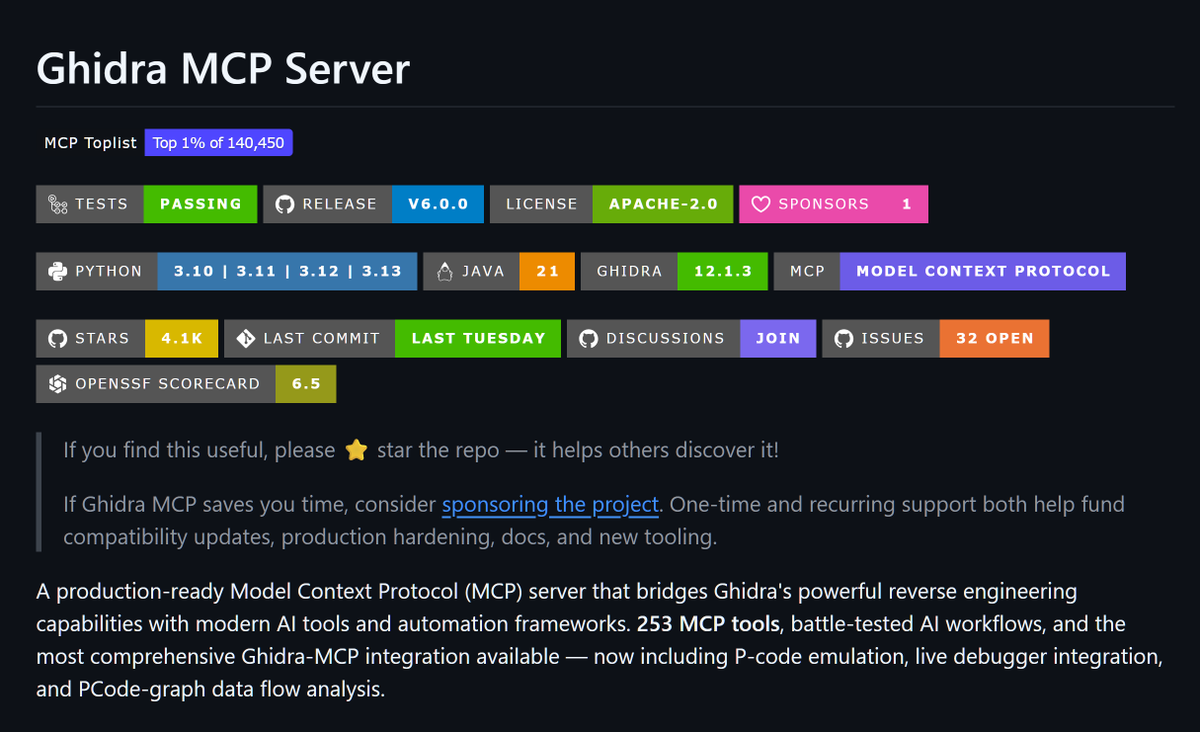
Reverse engineering compiled executables to uncover internal execution flows, memory structures, and game mechanics is traditionally one of the most demanding tasks in software analysis, requiring deep assembly expertise and extensive trial and error. The recent sharing of 'bethington/ghidra-mcp', an open-source project bridging the National Security Agency's (NSA) flagship software reverse engineering suite Ghidra with AI coding agents, introduces a structured approach to automating binary inspection. Operating over the Model Context Protocol (MCP), the server provides a standardized tool interface for AI agents to interact with Ghidra's analysis capabilities.
Image source: @aisearchio on X
By translating Ghidra's binary inspection and decompilation routines into programmatic tool calls, Ghidra MCP allows coding agents to conduct reverse engineering without manual GUI navigation. For game developers and modders, this reduces the trial-and-error of hunting down game logic and establishes a practical workflow for maintaining function notes across game updates.
Connecting Ghidra with Model Context Protocol: Abstracted Binary Inspection
In traditional reverse engineering, an analyst manually inspects decompiled output, navigates assembly listings alongside C pseudocode, and meticulously labels function signatures and variable offsets. While modern large language models (LLMs) excel at code comprehension, feeding raw binary dumps directly into an agent's context window quickly exhausts token budgets and degrades reasoning quality.
The bethington/ghidra-mcp server resolves this bottleneck by abstracting Ghidra's analytical capabilities into on-demand MCP tool calls.
- Granular Tool-Based Inspection: Rather than dumping entire binaries into context, agents can query Ghidra's analysis engine on demand to inspect targeted functions and retrieve decompiled code as needed.
- Accelerated Discovery: By leveraging Ghidra's pre-computed analysis data via tool calls, agents bypass exploratory guesswork and reduce trial-and-error when tracing executable logic.
- Natural Language Control: Developers can instruct their coding agents through natural dialogue—such as locating routines responsible for game logic or requesting decompilation of specific functions—leaving the agent to coordinate the underlying Ghidra tool calls.
Game Binary Analysis: Logic Identification and Cross-Version Note Reuse
Community discussions around Ghidra MCP highlight two primary benefits in game reversing: accelerating game logic identification and reusing function notes across updates.
- Targeted Game Logic Identification: Isolating specific game logic within compiled binaries often requires extensive trial and error. User feedback notes that by abstracting reverse-engineering steps into tool calls, agents help reduce the manual friction of locating and analyzing target game routines.
- Cross-Version Function Note Inheritance: For games that update frequently, patches often shift offsets and disrupt existing analysis. Community users point out that when binary code matches across versions, the repository allows function notes to be carried over, preventing redundant re-analysis after an update.
- Reducing Repetitive Analysis: Reusing verified function notes across matching code segments preserves accumulated analysis knowledge and helps maintain continuity when games receive maintenance patches.
Prerequisites, Token Budget Management, and Practical Limitations
Before integrating Ghidra MCP into an active development or modding workflow, engineers should keep several operational requirements and architectural boundaries in mind:
- Local Ghidra Runtime Dependency: This project is not a standalone reverse-engineering engine; it requires a properly configured local installation of the Ghidra runtime environment on the host system.
- Targeted Scope and Context Management: When analyzing large binaries, unconstrained agent queries risk exhausting context windows and incurring high token costs. Practitioners must narrow the analysis scope to specific target functions or modules.
- Code Matching and Patch Scope Dependency: Reusing function notes across versions depends on code matching accuracy and the extent of patch modifications. If an update introduces significant code changes, notes may not match automatically.