10 Practical Experiment Blueprints for the TypeSafe Jev API
A 10-project practical checklist to start experimenting with TypeSafe Jev's lightweight decision API—spanning accessibility-tree desktop automation, emulator co
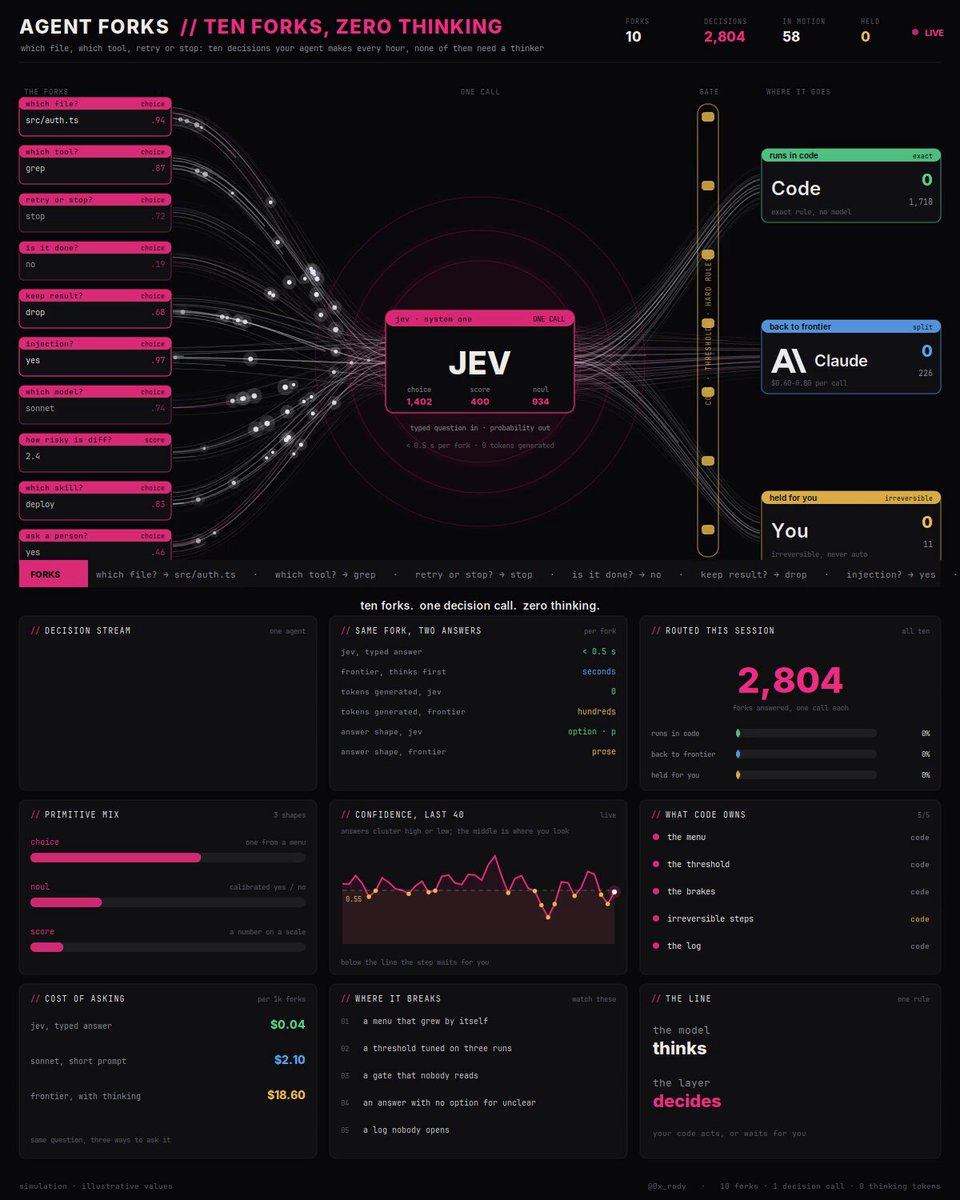
As lightweight, decision-specialized AI architectures gain widespread traction across engineering workflows, TypeSafe Jev has rapidly emerged as a prominent choice for sub-100ms reflex loops. Instead of deploying heavy autoregressive language models for basic state transitions, Jev's System One design evaluates structured application states and selects optimal discrete choices with minimal token overhead and sub-100ms latency.
Image source: @0x_rody
Developer @0x_rody shared an actionable checklist outlining 10 practical experiment blueprints for engineers who hold Jev API credentials and want to build effective proofs of concept. Spanning native OS automation, physical drone navigation, low-latency market making, and agent verification gates, these patterns illustrate where discrete decision models deliver immediate utility.
1. Native Desktop Automation and Emulator State Control
Passing high-resolution screenshots to multimodal LLMs introduces significant per-turn latency and high inference costs. Jev accelerates interaction loops by operating directly on structured application representations.
- 1. agent-desktop (Accessibility Tree-Based Desktop Automation):
Rather than guessing pixel coordinates from visual captures, the harness extracts interactive elements directly from operating system accessibility trees (macOS Accessibility, Windows UI Automation, Linux AT-SPI). Jev receives a compact candidate list—bypassing the need to inject 150+ tree nodes into LLM context—and instantly returns the target element alongside the operation to execute (such as
CLICK,TYPE, orSCROLL). - 2. typesafe-mario (Emulator RAM-Driven Super Mario Control):
Operates without taking or processing screenshots. The harness reads structured state data directly from the emulator's memory space (including character coordinates, obstacle vectors, and enemy positions). Jev evaluates the state vector to select discrete controller commands (
Run,Jump, orDodge) every frame.
2. Physical Devices and Real-Time Gaming Loops
Hierarchical control patterns allow Jev to provide tactical intelligence while low-level hardware safety routines remain strictly deterministic.
- 3. jev-drone (Hierarchical Drone Flight Management): Core stabilization, motor PID loops, and failsafes remain managed by dedicated flight controller (FC) firmware. Jev sits on top to make tactical decisions—such as altitude climbing, active braking, and obstacle avoidance paths.
- 4. OneVOneJev (Browser-Based 1v1 FPS Bot): Operates within a web-based 1v1 first-person shooter. On every decision tick, Jev evaluates spatial coordinates and player view angles to dictate movement vectors, reticle alignment, weapon discharge, and jump timing in real time.
3. Quantitative Trading and Market Regime Classification
In high-throughput trading environments, conventional LLM latencies are unacceptable. Jev enables low-overhead micro-decision pipelines.
- 5. jev-trader (Monad Testnet High-Frequency Market Making): Deploys onto the high-throughput Monad testnet to analyze order book bid-ask spreads and trade directionality. Operating with model latencies around 81ms, Jev evaluates discrete order adjustments against rapid market shifts.
- 6. Prism (Market Regime and Toxic Flow Diagnosis): Rather than routing trade execution directly through the model, Jev diagnoses real-time order flow dynamics—identifying states like toxic order flow, directional book pressure, and mean reversion tendencies—before handing off state markers to the primary algorithmic engine.
4. Data Curation and Agent Completion Gates
Jev provides robust verification and filtering layers to eliminate hallucinated agent closures and streamline dataset pipelines.
- 7. neo4jev (Intelligent Knowledge Graph Traversal): At each node in a complex graph structure, Jev evaluates outbound edges relative to the active query context, determining the most valuable traversal path without expensive full-graph expansions.
- 8. jev-curate (High-Throughput Training Data Screening): Processes large-scale JSONL and Parquet datasets, performing rapid quality scoring, relevance matching, and safety risk filtering to determine which records advance to downstream fine-tuning stages.
- 9. Canny (Coding Agent Completion Verification Gate): Prevents autonomous coding agents from prematurely declaring task completion while failing tests or unhandled exceptions persist. Canny cross-references tool outputs, code diffs, and test suites to verify whether the agent's completion claim is grounded and accurate.
- 10. killmyidea (Multi-Angle Startup Idea Scoring):
Evaluates early-stage venture proposals across market feasibility, technical friction, and competitive moats, returning a definitive verdict:
KILL(discard),FIX(refine architecture), orSHIP(proceed to build).
Original source
- Original post by @0x_rody on X: https://x.com/0x_rody/status/2106413848982880695 — 10 practical project blueprints and implementation patterns for the TypeSafe Jev API