Claude Fable 5.2 Reasoning Effort Benchmarked: Cost and Runtime from Medium to Max
A measured cost, runtime, and rendering quality breakdown of Claude Fable 5.2 across four reasoning effort levels—Medium, High, Extra High, and Max—generating a
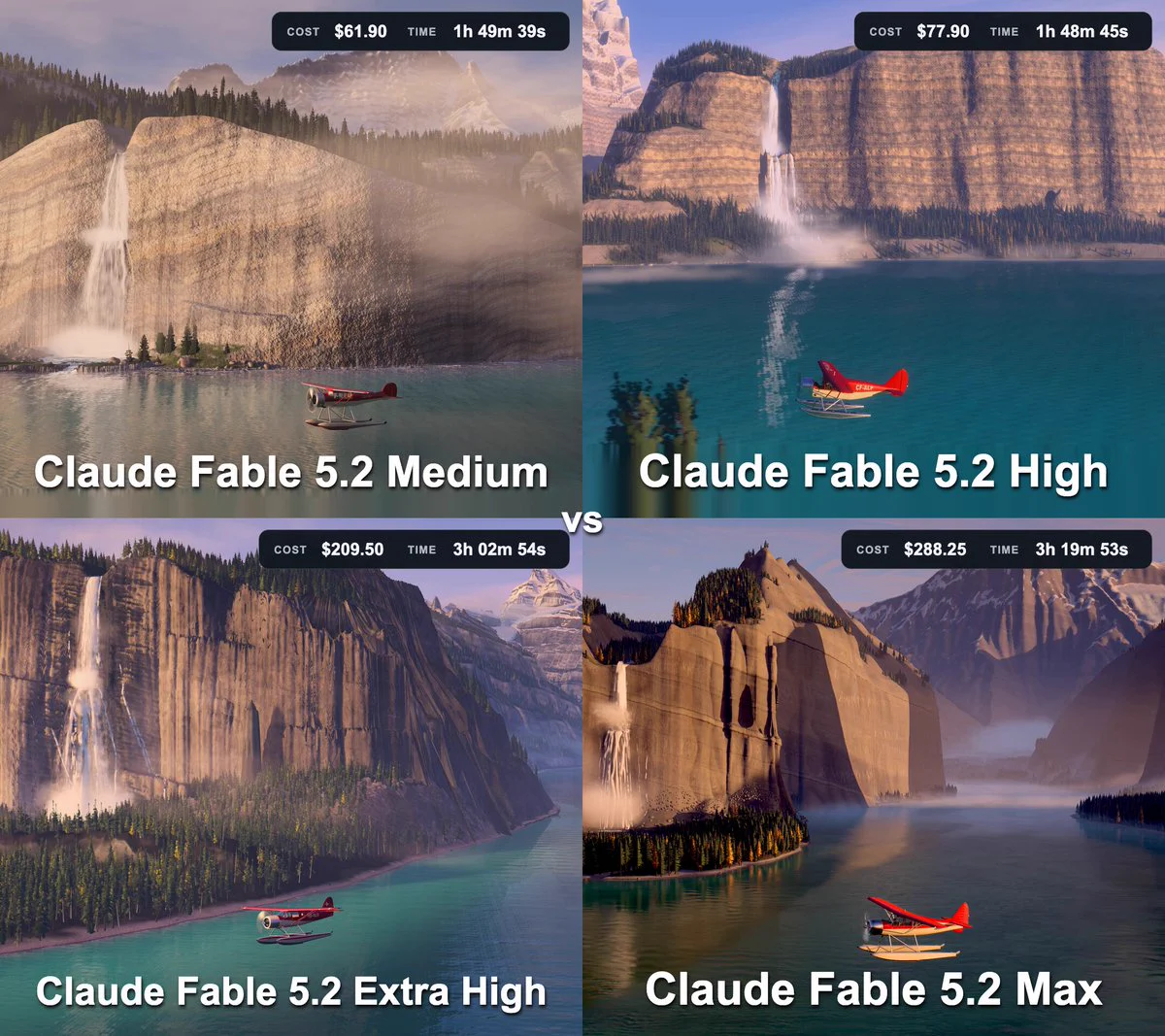
In AI video production pipelines, the reasoning effort parameter directly dictates token consumption costs and rendering wait times alongside output quality. Developer and AI creator Tony (@EnvolDev) published empirical benchmark data comparing Claude Fable 5.2 across four distinct reasoning effort settings—Medium, High, Extra High, and Max—while holding both the model and the prompt constant for a 25-second film clip.
Image source: https://x.com/EnvolDev/status/2121339316311888329
By controlling every variable except the reasoning effort configuration, this run highlights the exact cost inflection points and runtime jumps creators face when scaling reasoning tiers.
Empirical Metrics Across Four Reasoning Tiers
The test rendered a single 25-second film scene using the exact same prompt across all tiers. The observed runtime and billed cost breakdown:
| Reasoning Effort Setting | Estimated Cost (USD) | Render Runtime | Cost Multiplier (vs Medium) |
|---|---|---|---|
| Medium | $61.90 | 1h 49m 39s | Baseline (1.0x) |
| High | $77.90 | 1h 48m 45s | ~1.26x |
| Extra High | $209.50 | 3h 02m 54s | ~3.38x |
| Max | $288.25 | 3h 19m 53s | ~4.66x (4.7x reported) |
The total spread between lowest-tier Medium ($61.90) and top-tier Max ($288.25) represents a 4.7x cost increase. Compared against High ($77.90), Max demands 3.7x the budget for the same 25-second output.
Runtime measurements present a different dynamic. Medium and High completed in virtually identical windows (1h 49m vs 1h 48m). Similarly, transitioning from Extra High (3h 02m) to Max (3h 19m) added only roughly 17 minutes of compute time.
The Cost Cliff: High to Extra High
The most significant takeaway from the figures is the location of the steep price escalation:
- High to Extra High: Cost jumps by $131.60 (from $77.90 to $209.50), accompanied by over an hour of added render time.
- Extra High to Max: Cost rises by $78.75 (from $209.50 to $288.25), adding only 17 minutes of processing.
While Max represents the largest absolute outlay, the primary cost cliff sits between High and Extra High.
According to Tony's evaluation, Max delivered the highest overall visual quality without question. However, Extra High captured impressive cliffside and environmental detail at a $78.75 discount relative to Max. This creates a nuanced trade-off: some community observers argued that Extra High represents an awkward middle ground—taking the massive $131+ hit without reaching top-tier fidelity—while others found its visual result sufficient to forgo the final $78.75 leap to Max.
Single-Run Caveats and Production Recommendations
When applying these findings to production budgeting, two technical caveats apply:
- Single-Run Variance: Each data point reflects a single run. Generative models exhibit variance; two identical High runs can diverge in token usage, generation time, and intermediate composition. Repeated runs (three or more per tier) remain necessary to determine statistical consistency.
- Task Complexity and Alignment: Simpler motion or static framing rarely justifies Max's compute load. Deeper reasoning effort demonstrates its value primarily on complex multi-subject interactions, intricate physical simulations, and strict prompt adherence.
For commercial pipelines deploying Fable 5.2, an economical approach keeps concept drafting, blocking, and timing passes on Medium or High (under $80), reserving Extra High or Max exclusively for final presentation renders.
Original source
- Tony (@EnvolDev) on X: Claude Fable 5.2 Medium vs High vs Extra High vs Max Test Data