10-Step Blueprint for Building Coding Agent Harnesses with TypeSafe AI's Jev Emerges
A 12-page engineering blueprint for placing TypeSafe AI's System One model Jev into coding agent control loops has circulated online, detailing tool gating, con
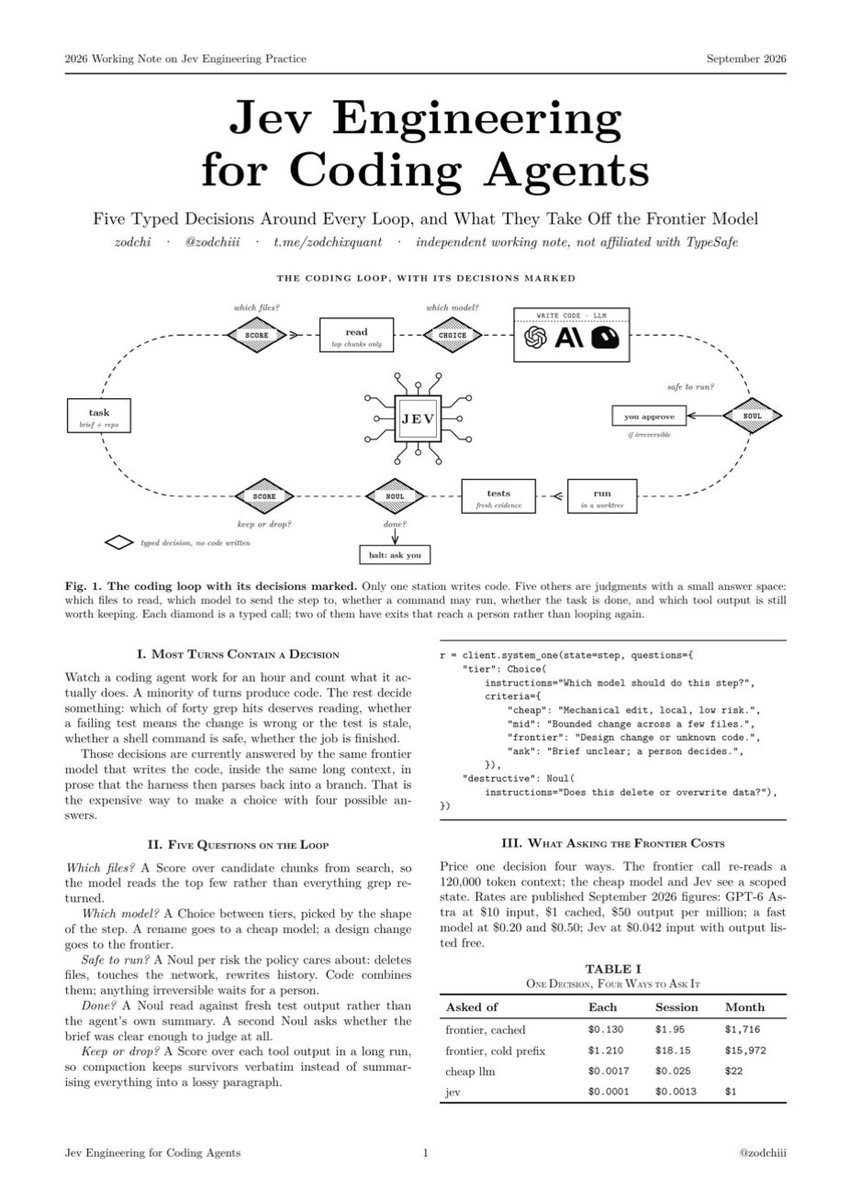
On September 22, 2026, a 12-page engineering document titled 'Jev Engineering for Coding Agents' began circulating on X, outlining architectural patterns for embedding TypeSafe AI's lightweight decision model Jev directly into coding agent harnesses. While the sharing account (@zodchiii) attributed the PDF to TypeSafe AI founder Diogo Amogo, the document's cover explicitly identifies it as an 'independent working note, not affiliated with TypeSafe.' The guide details how placing a non-generative System One model into the runtime control loop can offload routine classification, tool permission checks, and context filtering before invoking expensive frontier LLMs.
Image source: @zodchiii on X
Framed across a 10-step blueprint, the note targets the compounding cost and latency bottlenecks that emerging coding agent harnesses face during autonomous execution. Rather than routing every micro-decision through expensive frontier models, the architecture isolates structured judgment into a dedicated control layer, keeping primary agent workflows responsive and cost-efficient.
System One Decision Models and Semantic Branching in the Agent Hot Path
At the core of the blueprint is the placement of Jev—TypeSafe AI's specialized System One model—as a 'semantic branch instruction' directly inside the agent's hot execution path.
Unlike conventional generative models, Jev does not output freeform natural language. Instead, it evaluates input state and returns typed classifications, boolean judgments, and calibrated probability scores. According to TypeSafe AI's published benchmarks, Jev achieves up to 200x faster inference speed and 400x lower cost on micro-decision classification tasks compared to frontier language models, with pricing listed at $0.042 per million input tokens and free output.
In typical agent loops, verifying whether a proposed command requires explicit user confirmation or represents a benign file read often stalls execution while waiting for a full-scale LLM round trip. By embedding sub-second, low-cost evaluation directly into the harness, developers can implement programmatic permission gates and loop detection without incurring prohibitive token expenses.
Mitigating Context Overhead: Chunk Scoring and Tiered Tool Disclosure
The blueprint addresses significant token waste identified in empirical coding agent traces, where context retrieval heavily outweighs actual code generation.
Trace data indicates that file reading and codebase search operations account for 56.2% of tool turns and 46.5% of total token consumption, whereas final code writing consumes less than 10%. To prevent context windows from being saturated with irrelevant documentation and oversized schemas, the guide specifies several structural safeguards:
- Query-Specific Chunk Scoring: Instead of blindly concatenating search results into the agent context, the harness scores each retrieved text segment with Jev to surface only the most relevant passages.
- Tiered Tool Disclosure: Rather than loading full JSON schema definitions for dozens or hundreds of Model Context Protocol (MCP) tools at startup, the agent displays single-line summaries and lazily resolves complete schemas only when a specific tool is invoked.
- Trust- and Context-Aware Model Routing: Handoffs between models often degrade efficiency due to context reprocessing. The guide notes that while a pure Claude Opus loop costs 4.15 per benchmark unit, bouncing tasks between Opus, Sonnet, and back to Opus surges to 6.19 because each handoff forces full context re-evaluation. To prevent this, the blueprint routes sensitive infrastructure actions and complex reasoning to frontier models while assigning public documentation queries to low-cost models, governed by programmable policy gates (allow/ask/deny).
Benchmark Scope and Practical Harness Engineering
While the efficiency gains are compelling, applying these metrics to production environments requires understanding key benchmark assumptions and operational constraints.
First, the advertised '200x faster and 400x cheaper' metrics apply specifically to micro-decision steps—such as tool authorization, classification, and loop detection—rather than the end-to-end coding pipeline. Under Amdahl's law, overall wall-clock runtime is dominated by heavy downstream tasks such as large-scale code synthesis, dependency installation, compiler runs, and test execution.
Second, anecdotal feedback shared on X highlighted potential calibration pitfalls when deploying lightweight decision models to rare edge cases. In one practitioner check across 5,200 titles reported by an engineer (@Taj_youknow), Jev assigned estimated probabilities between 20% and 40% for an event that occurred only 1.7% of the time.
To maintain reliability, developers deploying Jev-like decision models inside harness control paths should implement input state normalization, define fallback thresholds that escalate ambiguous outputs to frontier models or human supervisors, and enforce structured audit logging (capturing chosen paths, rejected candidates, and cumulative cost budgets) to catch runaway loops before they derail execution.