TaoMate-H3-FL2VA Released: 3-Step LoRA for MiniMax H3 Delivers 11.45× Faster DiT Inference
ModelScope has unveiled TaoMate-H3-FL2VA, a 3-step LoRA runtime for MiniMax H3 FL2VA. It cuts 480p DiT inference to 14.8s (11.45× speedup) with synchronized str
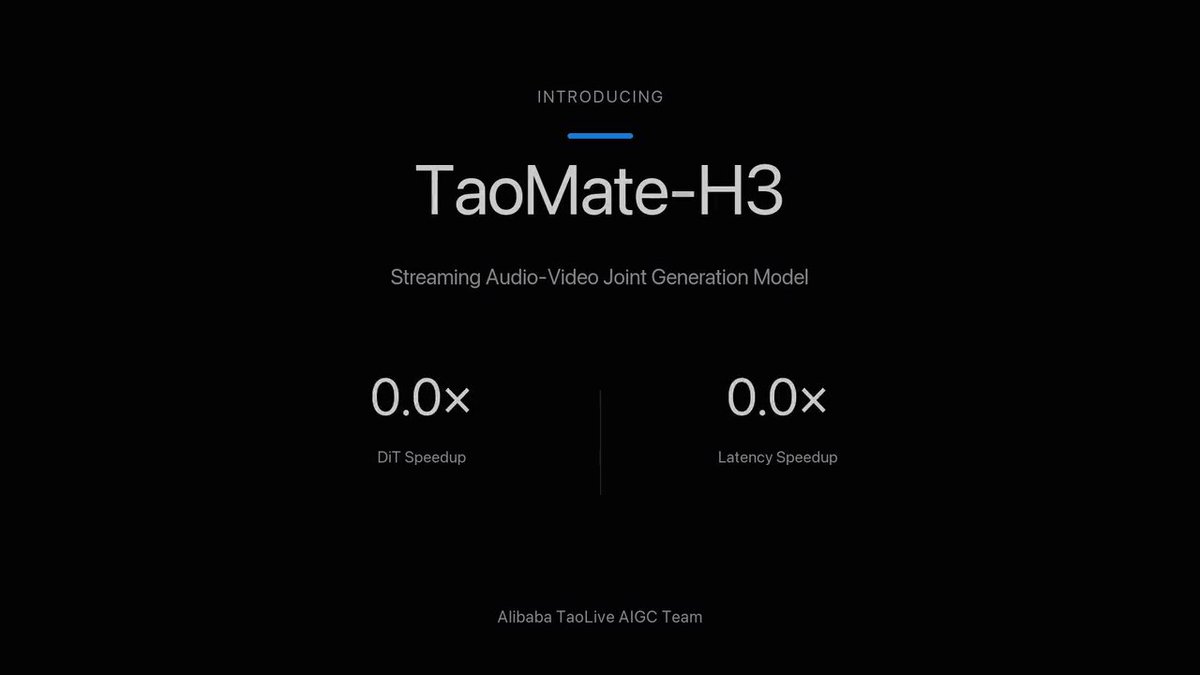
Open-source AI platform ModelScope (@ModelScope2022) has officially unveiled TaoMate-H3-FL2VA, a 3-step LoRA model and specialized runtime engineered for the MiniMax H3 FL2VA multimodal foundation model. Designed to enable near-real-time streaming audio-video generation, the release directly tackles the heavy computational bottlenecks characteristic of diffusion transformer pipelines.
Image source: ModelScope (@ModelScope2022)
Conventional video synthesis workflows powered by Diffusion Transformers (DiT) typically demand dozens of iterative denoising steps to achieve high visual fidelity. Moreover, generating silent video frames and subsequently stitching synthesized speech and sound effects via separate audio models introduces substantial end-to-end latency before the first frame can be viewed. TaoMate-H3-FL2VA pairs 3-step LoRA distillation with a synchronized timeline architecture, slashing diffusion compute overhead and providing developers with a streamlined pipeline capable of streaming audiovisual content.
11.45× Faster DiT Inference and 10.6× Earlier Playback in 480p Benchmark
The primary technical breakthrough in TaoMate-H3-FL2VA centers on its dramatic acceleration of DiT inference speeds.
According to reported benchmark measurements, generating a 10-second audiovisual sample at 480p resolution required only 14.8 seconds of pure DiT computation. Compared to the 169.6 seconds needed by the standard MiniMax H3 baseline under equivalent benchmark conditions, this represents an acceleration factor of approximately 11.45×.
- 11.45× DiT Acceleration: DiT inference time for a 10-second 480p sample drops from 169.6 seconds on the baseline pipeline to 14.8 seconds.
- 10.6× Improvement in Time to First Playable Video: Rather than waiting for full-sequence rendering to complete, the runtime outputs its initial playable stream in approximately 17.3 seconds, delivering a 10.6× improvement over the baseline.
- Benchmark Qualification: The reported 11.45× speedup and 17.3-second playback metrics reflect the specific 480p 10-second sample test setup; processing times for 768p and aligned 1080p resolutions, as well as different hardware environments, will naturally vary.
These latency gains transform what was previously a strictly offline batch process into a responsive engine viable for low-latency video generation and interactive media pipelines.
Synchronized Audio-Visual Architecture and Continuous 5-Second Block Generation
Beyond raw inference acceleration, TaoMate-H3-FL2VA restructures the relationship between visual frames and audio generation.
Traditional multimodal workflows generate visual sequences first, calling secondary audio models down the line to align lip movements and ambient sound effects. This decoupling frequently introduces phase errors, lip-sync drift, and timing discrepancies.
- Synchronized by Design: Speech, ambient sound effects, and video frames are generated simultaneously along a unified timeline, eliminating the need to reconcile and merge disparate streams in post-processing.
- Continuous Generation in 5-Second Blocks: Prompts are ingested and processed in 5-second segments. The system maintains visual character identity, voice timbre, and kinetic continuity across transitions as prompts shift.
- Multiple Resolutions and Aspect Ratios: The pipeline natively supports both portrait (vertical) and landscape (horizontal) orientations across 480p, 768p, and aligned 1080p outputs.
This unified generation paradigm materially reduces post-production engineering complexity for short-form video pipelines, live virtual avatar workflows, and interactive narrative systems.
Target Users, Base Model Prerequisites, and Licensing Constraints
TaoMate-H3-FL2VA offers immediate utility for AI engineers, video tool developers, and researchers building real-time or low-latency generative media systems.
Because TaoMate-H3-FL2VA is deployed as a 3-step LoRA adapter and runtime rather than a standalone foundation model, engineering teams should account for several key prerequisites before adoption.
- Base Model Dependency: Execution requires access to the official MiniMax H3 FL2VA base model weights within your local or server environment.
- Community License Compliance: Use and distribution remain governed by the terms of the MiniMax H3 Community License Agreement, which must be reviewed prior to commercial deployment or redistribution.
- Repository Availability: Model weights, documentation, and implementation details are openly accessible through the ModelScope repository at TaoLiveAIGC/TaoMate-H3-FL2VA.
Sources
- ModelScope Model Repository: TaoLiveAIGC/TaoMate-H3-FL2VA
- ModelScope Official X (@ModelScope2022): TaoMate-H3-FL2VA Release Announcement