Everything Claude Code Setup Surpasses 278k Stars: 71 Agents and 311 Skills
Everything Claude Code, an open-source Claude Code setup, crossed 278k GitHub stars. We analyze its 71 agents, 311 skills, persistent memory, and AgentShield se
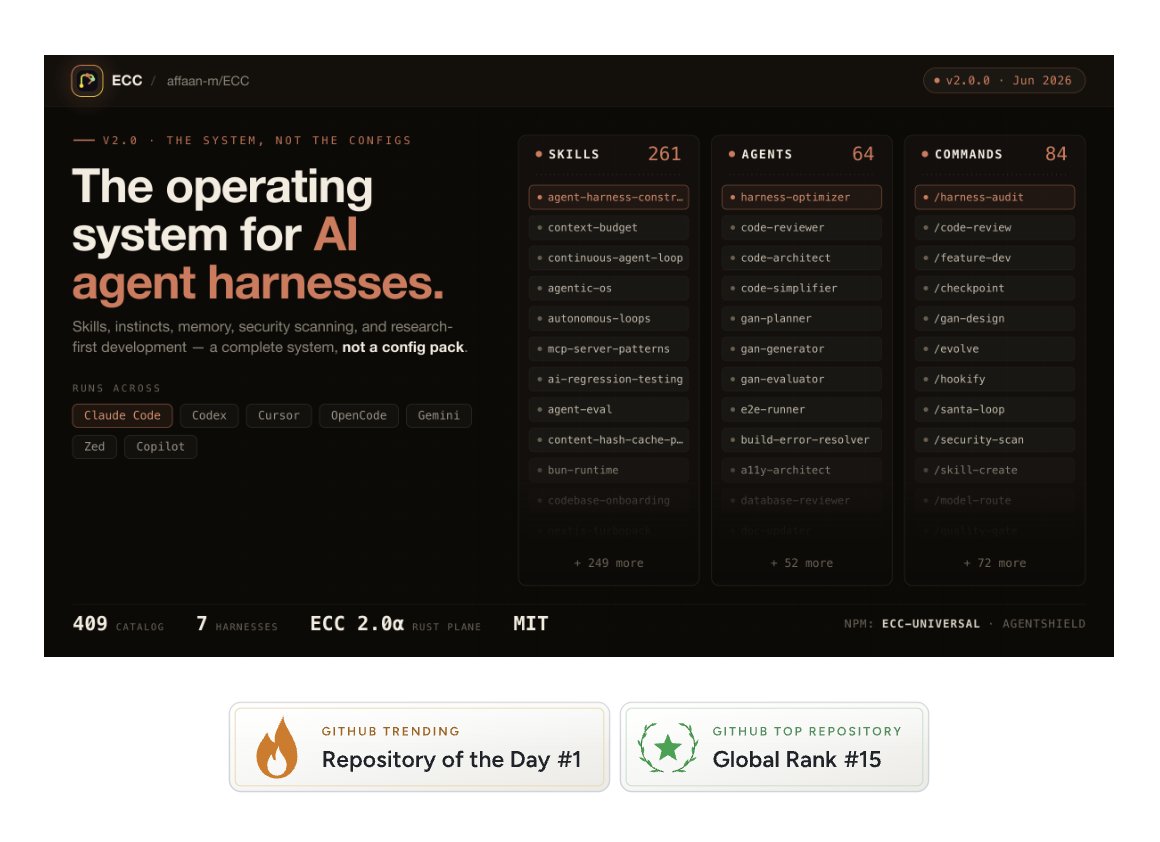
'Everything Claude Code,' an open-source Claude Code configuration and workflow repository highlighted by developer Suraj Sharma (@suraj_sharma14), has captured massive industry attention by crossing over 278,000 stars and 41,000 forks on GitHub. Distributed under the MIT license, the project functions as a comprehensive, installable engineering team setup designed for solo developers and technical teams.
Image source: X @suraj_sharma14 / Suraj Sharma
Rather than serving as a loose collection of disparate prompts, the repository formalizes a repeatable end-to-end software delivery pipeline—spanning planning, implementation, review, verification, and automated security scanning. At the same time, practical discussions across developer communities highlight the necessity of understanding its context overhead and architectural trade-offs before deploying it into production codebases.
Standard Engineering Loop Powered by 71 Agents and 311 Skills
The core architecture of Everything Claude Code centers on enabling an individual developer to emulate the workflows of a full software engineering organization through a modular multi-agent system.
The repository bundles 71 specialized agents dedicated to discrete stages of the software development lifecycle, alongside 311 reusable skills covering everyday practical tasks.
- 71 Specialized Agents: Dedicated agents handle project planning, rigorous code reviews, build and compiler troubleshooting, security vulnerability audits, and system architecture design. These agents coordinate tasks systematically rather than relying on a single monolithic prompt.
- 311 Reusable Skills: The skills library covers test-driven development (TDD), technical research, frontend component implementation, data processing pipelines, machine learning experiments, and automated documentation generation.
- Forced Engineering Loop: The framework enforces a standard 7-stage discipline on the coding agent: 'Plan → Test → Implement → Review → Verify → Remember → Improve.' This structured progression prevents agents from skipping testing or shipping unreviewed code.
- Cross-Harness Compatibility: While optimized primarily for Anthropic's official Claude Code CLI, the repository includes adapters to port its agents, skills, and prompts to other environments such as Codex, Cursor, Gemini, and OpenCode.
Persistent Cross-Session Memory and AgentShield Security Scanner
Beyond bundling specialized tools, the project introduces architectural mechanisms to tackle two persistent pain points in agentic coding: context amnesia across sessions and supply-chain security risks.
- Hook-Based Persistent Memory: Standard coding agents lose operational context once a session terminates or when token compaction occurs, leading to repeated mistakes on identical problems. Everything Claude Code employs custom hooks and a persistent memory layer to log architecture decisions, bug fixes, and dead ends as they happen, carrying that state forward into subsequent sessions.
- Continuous Learning Loop: The framework monitors repeated successful execution patterns, automatically turning them into new, reusable skills to facilitate continuous local self-improvement.
- Built-in AgentShield Scanner: To mitigate security risks inherent in autonomous execution, the project embeds AgentShield. This scanner audits system prompts, hook scripts, Model Context Protocol (MCP) configuration files, and agent definitions, detecting hardcoded secrets, API token leaks, overly broad write permissions, and dangerous shell execution parameters before deployment.
Context Tax Reality and the Practical Cherry-Picking Strategy
Despite the repository's record-setting star count, software engineers and community contributors urge caution regarding the realities of operating large agent ecosystems.
- Context Tax Overhead: Every active skill and agent requires its name and functional description to be loaded into the initial context window. Loading all 311 skills up front consumes substantial prompt token budgets before any actual project code is inspected.
- Trigger Ambiguity: Stacking hundreds of skill descriptions can introduce routing ambiguity for the underlying LLM, leading to accidental trigger activations or conflicting execution paths for similar user requests.
- API Quota Depletion: Multi-agent chains running concurrent tasks can rapidly consume token allowances, risking early exhaustion of weekly API quotas during complex refactoring jobs.
Consequently, Suraj Sharma and experienced practitioners recommend a lean, selective adoption approach: rather than enabling the entire repository simultaneously, developers should cherry-pick the 5 to 10 skills essential to their weekly tasks. Furthermore, engineering teams should establish strict MCP allowlists, restrict hook write access via tools like AgentShield, and thoroughly evaluate multi-agent workflows in isolated test repositories prior to production integration.
Sources
- Suraj Sharma (@suraj_sharma14) on X: Everything Claude Code Setup Announcement and 278k GitHub Stars
- John Rood (@johnroodepic) on X: Cross-Session Memory and Write-Path Analysis