Benchmaxxing Index: Web Tool for Evaluating AI Model Benchmark Overfitting and Community Reputation
Developer @yulmu_coffee has unveiled 'Benchmaxxing Index', a web-based evaluation tool comparing AI model benchmark overfitting against reputation research alon
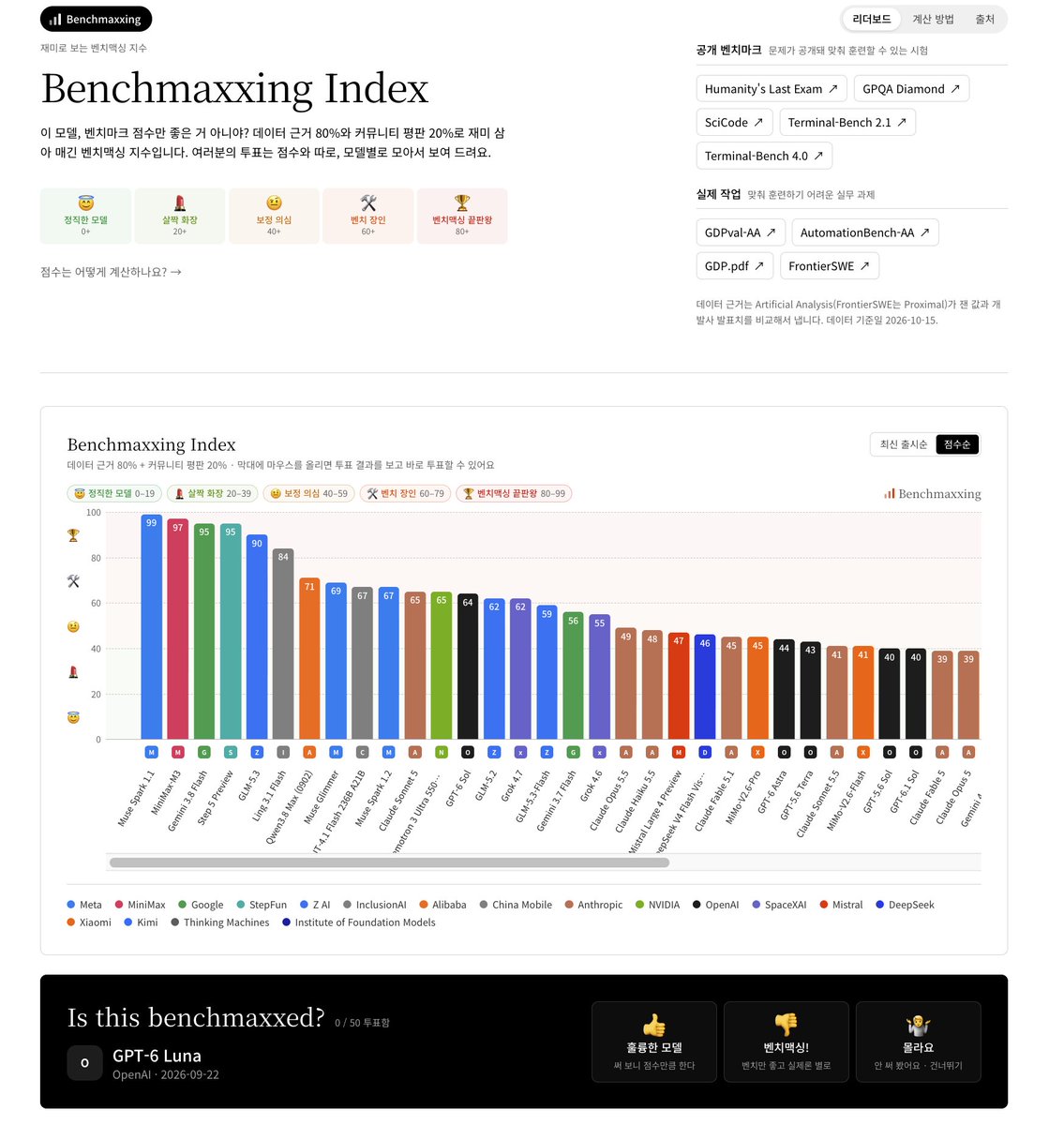
On October 16, 2026, developer YulmuCoffee (@yulmu_coffee) released 'Benchmaxxing Index', an experimental web-based evaluation tool designed to compare artificial intelligence (AI) models by analyzing benchmark overfitting—commonly termed 'benchmaxxing'—alongside community reputation research.
Image source: @yulmu_coffee via X
As major AI labs tout record-breaking state-of-the-art (SOTA) benchmark scores with each model launch, practical developers and community practitioners frequently observe discrepancies between advertised test scores and real-world deployment performance. The Benchmaxxing Index explores this gap, offering a structured dashboard that visualizes whether high scores reflect genuine capability or aggressive optimization on public test suites.
Index Architecture Based on Public Benchmarks and Reputation Research
Rather than conducting proprietary raw hardware benchmarks within an isolated laboratory environment, the Benchmaxxing Index compiles publicly reported benchmark data combined with qualitative community sentiment.
- Public Data Synthesis: The index aggregates published quantitative evaluation results and cross-references them against practitioner reputation findings across global developer channels.
- Top Ranking at Launch: At the time of the public release, the index places 'Muse Spark 1.1' in the number one position across the evaluated model lineup.
- Independent Scoring Logic: The underlying scoring system is completely decoupled from on-site user votes, preventing subjective voting surges from altering the core analytical scores.
Interactive Model Evaluation: 'Great Model' vs. 'Benchmaxxing' Voting
Through the hosted web portal (benchmaxxing-index.vercel.app), visitors can inspect individual model entries and cast their own votes on practical user experience.
- Dual-Action Community Voting: Each model card provides straightforward feedback controls, allowing practitioners to vote either 'Great Model 👍' or 'Benchmaxxing 👎'.
- Separation of Community Sentiment: Because community votes do not factor into the algorithmic score calculation, crowdsourced opinions act as a complementary gauge of user perception without distorting the underlying analytical data.
- Instant Browser Access: Hosted on Vercel, the tool requires no local setup, command-line installation, or account registration, enabling developers to review rankings and sentiment trends instantly.
Limitations and Practical Guidance for Developers
When interpreting the Benchmaxxing Index for model evaluation or workflow planning, developers should account for its distinct design scope and structural caveats.
- Community Reference Rather Than Rigorous Hardware Audit: As noted by the creator, the index represents a synthesized perspective based on public benchmarks and reputation surveys rather than a controlled empirical test suite, serving as an informative and engaging pulse check on industry perception.
- Decoupled Voting Mechanics: The isolation between crowdsourced votes and index ranking prevents coordinated vote manipulation, but also means user ballots will not directly modify a model's calculated standing.
Sources
- Benchmaxxing Index Official Web Tool: benchmaxxing-index.vercel.app
- YulmuCoffee (@yulmu_coffee) Announcement on X: 2026-10-16 Benchmaxxing Index Release Post