Stagehand v4: Open-Source AI Browser Agent SDK with Playwright Compatibility
An analysis of Stagehand v4, an open-source browser agent SDK combining natural language AI primitives with Playwright APIs, auto-caching, and self-healing.
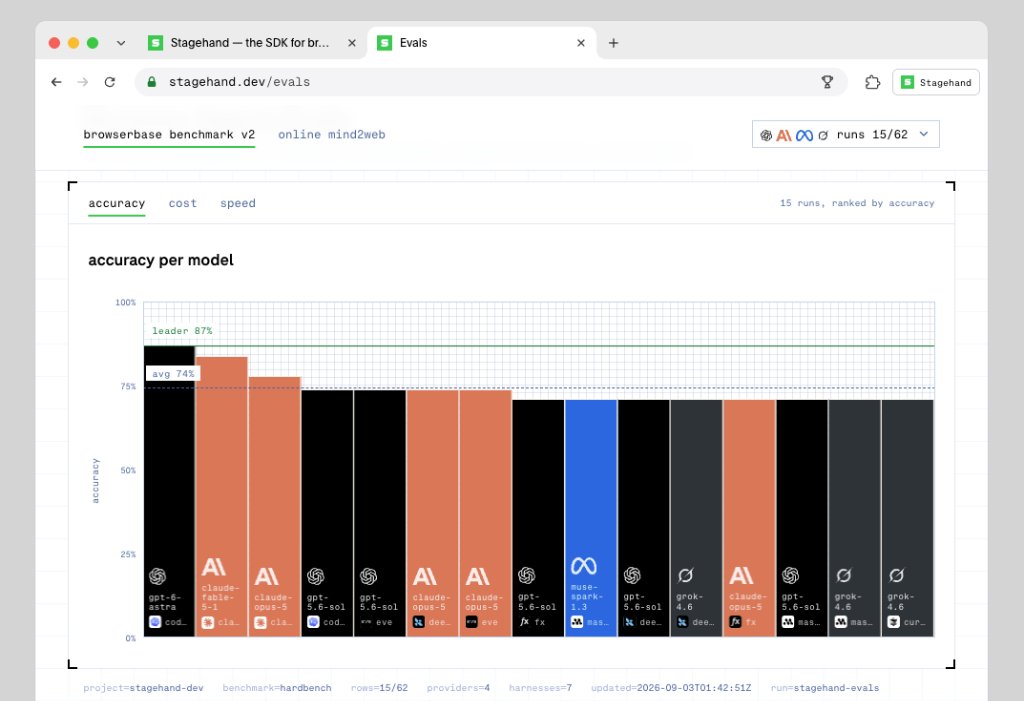
In the rapidly evolving landscape of autonomous browser agents, Browserbase's open-source framework 'Stagehand v4' has emerged as a compelling solution for engineering teams. By combining the deterministic reliability of Playwright with modern LLM-driven natural language primitives, Stagehand introduces built-in auto-caching and self-healing mechanisms that significantly improve production workflow stability.
Image source: @Dontgiveup_26 (X)
Two-Layer Control Architecture: Combining Natural Language Primitives with Playwright
Stagehand v4 was engineered around a simple architectural thesis: Playwright was built for end-to-end web testing, while Stagehand is designed specifically for autonomous AI agents. To reconcile the flexibility of generative models with deterministic execution guarantees, the SDK structures browser control around three core natural language primitives:
- act: Interprets natural language instructions (such as "type the search query into the search input and press Enter") and dynamically maps them to underlying DOM elements without requiring brittle CSS selectors or manually authored XPath expressions.
- extract: Accepts formal type definitions via schemas (such as Zod or Pydantic) to reliably extract structured JSON data from messy, unstructured webpage layouts.
- observe: Analyzes the current viewport and accessibility tree, returning an actionable list of prospective interactions and actionable elements the agent can execute next.
What distinguishes Stagehand from purely prompt-based browser agents is its seamless coexistence with standard Playwright instances. Instead of forcing an all-or-nothing commitment to probabilistic AI actions, developers can interleave deterministic Playwright calls—such as page.goto(), page.locator().click(), and explicit wait conditions—with Stagehand's high-level AI primitives in a single script. Predictable procedures like user authentication and standardized form entry remain deterministic and fast, while ambiguous tasks like closing unexpected modal dialogues or traversing dynamic layouts are delegated to natural language primitives.
Stagehand is distributed under the permissive MIT license and officially provides client SDKs for TypeScript, Python, and Go, allowing it to integrate smoothly into existing test suites, serverless cloud runners, and backend pipelines.
Auto-Caching and Self-Healing: Mitigating Inference Costs and Latency
The most persistent barrier preventing browser agents from reaching commercial production has been compounding operational costs and latency. Generating an LLM completion for every single click or DOM inspection incurs substantial token expenditures and unpredictable network delays. Stagehand v4 tackles this friction directly through native auto-caching and self-healing systems:
- Action Path Auto-Caching: When an
actinstruction successfully navigates and interacts with an element on its initial run, the runtime caches the resolved DOM execution path and selector patterns locally. On subsequent executions where the target page structure remains unchanged, the SDK replays the cached interaction deterministically without triggering additional LLM inference, eliminating recurring LLM token expenditures on stable pages. - Self-Healing Mechanics: If an application undergoes a deployment or layout redesign that invalidates the cached selector, Stagehand detects the failure automatically. It triggers a background LLM re-evaluation to inspect the updated DOM, resolve the new target element, and update the local cache without aborting the entire pipeline.
- In-Page Runtime Optimization: Rather than serializing massive full-page DOM hierarchies and transmitting them across the network to external LLM providers, Stagehand executes close to the browser page. It filters and prunes the browser's native accessibility tree, extracting only the elements necessary for semantic understanding and sharply reducing prompt token payloads.
This hybrid caching model provides a sustainable economic foundation for daily RPA operations, continuous monitoring systems, and recurring E2E validation cycles.
Operational Caveats and Production Considerations
Integrating Stagehand v4 into real-world production environments requires careful navigation of platform policies and architectural trade-offs:
First, social media platforms and bot mitigation systems pose serious operational challenges. Services such as X (formerly Twitter), Instagram, and Meta Threads deploy strict automated behavioral and fingerprinting detection systems. Unregulated automation across these platforms introduces substantial risks of session invalidation, automated CAPTCHA challenges, and permanent account suspension. Teams should isolate automation workloads, implement headless browser fingerprint masking, and manage residential proxy rotation.
Second, engineering teams must actively mitigate LLM non-determinism. While natural language act commands provide exceptional resilience against superficial DOM modifications, LLMs remain inherently probabilistic and cannot provide 100% determinism across every edge case. Mission-critical steps involving financial transactions, irreversible database mutations, or secure credentials should always be implemented using explicit Playwright locators and strict assertion checks.
Third, engineering teams must distinguish between experimental community contributions and official core releases. While recent developer discussions highlight potential performance gains from specialized lightweight routing models or third-party forks, unmerged proposals should not be conflated with official Stagehand core releases. Production pipelines should rely strictly on verified features documented in official Browserbase documentation and official repository release notes.