Six Practical Principles for Optimizing AI Agent Harnesses
A practical framework from engineer Rob (@robiartec) on maximizing AI agent reliability by replacing bloated prompts with evidence-backed rules, aggressive tool
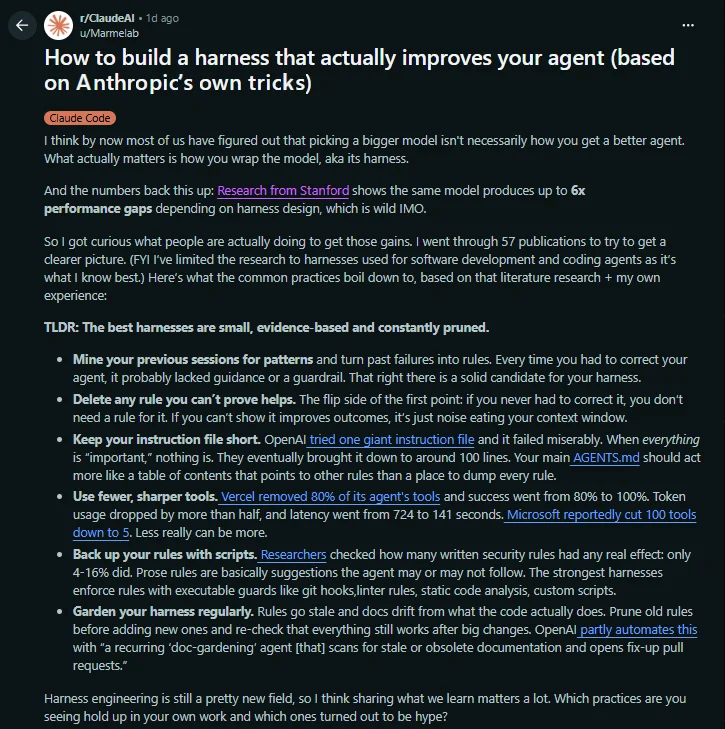
Software engineer and AI practitioner Rob (@robiartec) has shared a structured six-step optimization framework designed to maximize the performance and token efficiency of AI agent runtime environments (harnesses). The core premise drawn from real-world workflow engineering is straightforward: holding the underlying foundation model constant, the structure and discipline of the enclosing harness often dictate whether an autonomous agent succeeds or derails.
Image source: https://x.com/robiartec/status/2117056966153392316
The author notes that this operational system was distilled from an analysis of more than 57 research papers on model wrapping techniques and Stanford research showing up to a sixfold performance divergence between different harnesses wrapping the exact same model. However, because the original post does not include direct links or formal citations to the specific Stanford paper, practitioners should view the cited 6x multiplier as an illustrative demonstration of harness leverage in practice rather than a peer-reviewed academic benchmark.
What Is an Agent Harness?
In modern AI engineering, a "harness" refers to the comprehensive software scaffolding wrapped around a large language model (LLM). Much like a mechanical harness directs and stabilizes an engine's output, an agent harness manages the system prompts, tool interfaces (APIs, terminals, web searchers), execution environments, state persistence, and automated validation gates that govern an agent's runtime loop.
When developers run into recurring agent errors, the instinctive response is often to upgrade to a more expensive frontier model or append hundreds of lines of conditional advice to the system prompt. In practice, bloated instructions saturate the context window, introduce conflicting directives, and dilute the model's attentional focus. The framework outlined below focuses on keeping the agent wrapper compact, verifiable, and strictly enforced.
The Six Harness Optimization Principles
Here is the breakdown of the six core principles, accompanied by practical implementation context for development teams:
Step 1: Squeeze Lessons from Previous Sessions (Exprime tus sesiones anteriores)
"Every time you had to correct your agent, turn that correction into an explicit rule."
The most expensive waste in agent workflows is repeating manual corrections across sessions. Whenever an agent violates a repository convention, guesses a non-existent path, or makes incorrect architectural assumptions, developers should immediately convert the corrective feedback into a clear, single-line rule within the project's persistent instruction store (such as a project-level rules markdown file). Systematically capturing corrections gives the agent working operational memory tailored to the specific codebase.
Step 2: Delete What You Cannot Prove (Borra lo que no puedas demostrar)
"If a rule does not measurably improve outcomes, it is simply noise devouring your context window."
Every token included in a prompt carries a real cost in both inference pricing and attention budget. Teams frequently accumulate well-intentioned guidelines that sound reasonable but have never been shown to reduce error rates. Unless a rule delivers observable, measurable improvements in agent accuracy, remove it. Unsubstantiated guidelines clutter context and introduce unhelpful ambiguity.
Step 3: Keep Primary Instructions Compact (Mantén tus instrucciones cortas)
"Giant prompts fail. Roughly 100 lines that point to dedicated rule sets win."
Monolithic prompts that attempt to cover every edge case and coding standard in a single file degrade instruction-following reliability. The most effective system prompt serves as a concise operational entry point—around 100 lines—that references modular, external rule files only when needed. Delegating depth to structured reference documents keeps the model focused during core reasoning steps.
Step 4: Prune Your Tools Aggressively (Recorta tus herramientas)
"Fewer, sharper tools mean higher hit rates and fewer wasted tokens."
Giving an agent access to dozens of utility tools forces the runtime to inject extensive JSON schemas into every prompt, eating up precious context space. More dangerously, broad toolsets increase the decision branching factor, leading to frequent tool misfires. Stripping away rarely used or overlapping tools in favor of three or four finely tuned, well-documented functions significantly boosts first-attempt accuracy.
Step 5: Back Natural Language Rules with Scripts (Respalda las reglas con scripts)
"Prose is merely a suggestion. Hooks, linters, and test suites are guarantees."
Instructions written in natural language—such as "never commit private API keys" or "always adhere to strict typing"—remain advisory for an LLM under complex task loads. Mission-critical rules must be enforced programmatically through deterministic tooling: pre-commit hooks, static analysis linters, and automated test runners that halt execution immediately upon violation.
Step 6: Tend Your Harness Like a Garden (Cuida tu harness como un jardín)
"Prune obsolete rules regularly and audit the entire system after major architectural shifts."
Codebases and operational requirements evolve continuously. Rules that resolved bugs three months ago may become counterproductive after library upgrades or refactoring. Treating the harness as a living garden means actively pruning obsolete directives and running full-system sanity reviews following significant project milestones.
Practical Implications for Builders
This framework highlights a mature transition in AI development: shifting focus from poetic prompt tweaking to rigorous software engineering and constraint design. If the underlying foundation model represents the vehicle's engine, the harness functions as the chassis, suspension, and steering assembly that translates raw horsepower into reliable traction.
Before swapping models or writing lengthy explanatory paragraphs to fix erratic agent behavior, engineering teams should evaluate their operational scaffolding: prune unneeded tools, replace prose suggestions with deterministic validation scripts, and clear out legacy rules that consume valuable context.
Original source
- Rob (@robiartec) on X: Harness + Opus 5.5 por fin puede no tener límites (2026-11-02)