Jev-ify: Open-Source Library for Vision-Enabled Fast Classifier APIs
FeatherlessAI's Eugene Cheah has open-sourced Jev-ify, a library that transforms Hugging Face models into fast structured classification and scoring APIs.
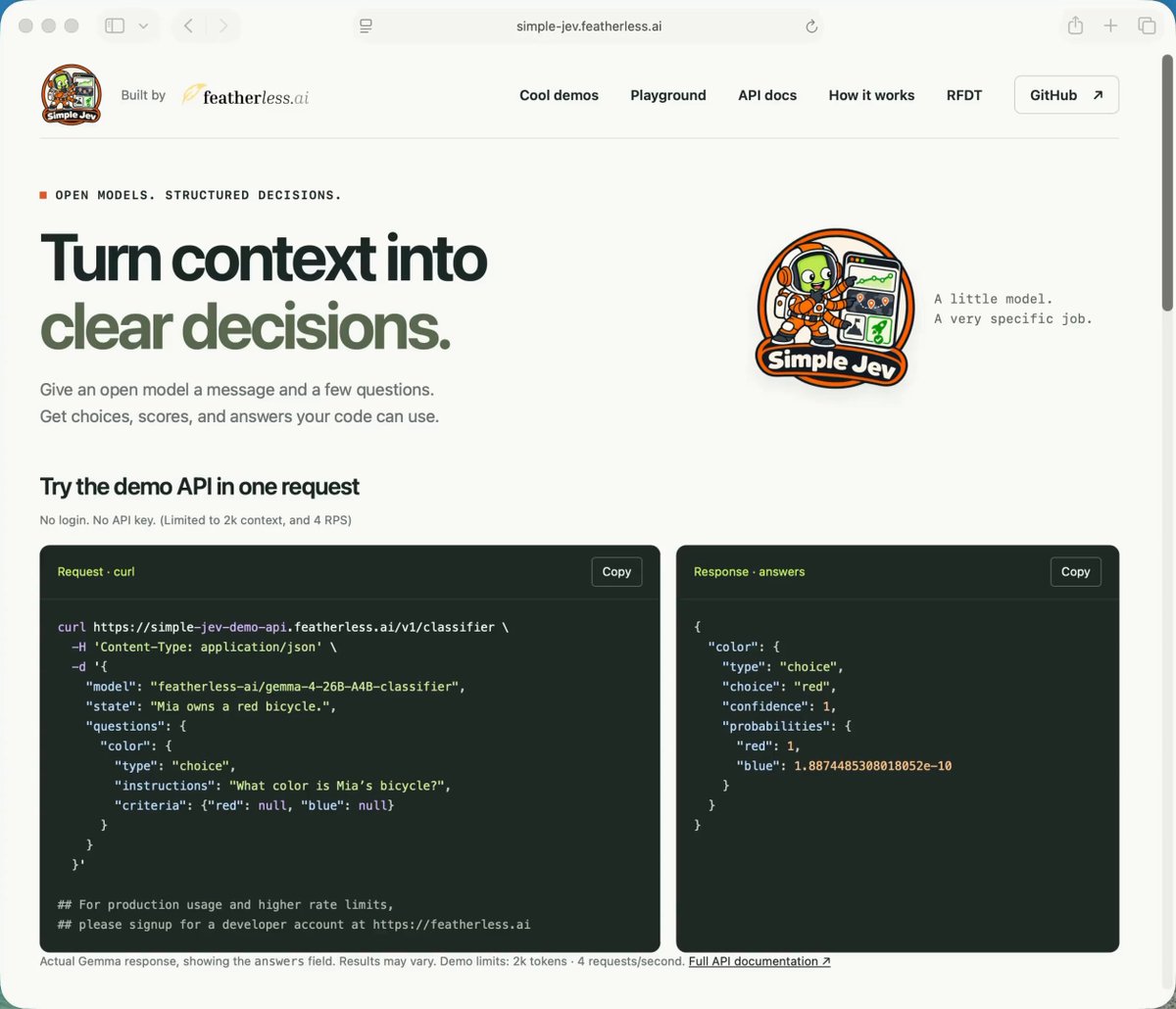
On September 18, 2026, Eugene Cheah (@picocreator), co-founder of FeatherlessAI, officially released Jev-ify, an open-source library that turns compatible open language models on Hugging Face into ultra-fast classification and scoring API endpoints.
Image source: @picocreator
Jev-ify recreates the core decision-making paradigm of existing Jev models as a fully open-source project while adding multimodal vision capabilities that the proprietary alternative lacked.
Logit-Based Structured Decisions Without Decoder Overhead
Jev-ify avoids training custom classification heads and eliminates the latency penalty of forcing language models to autoregressively generate hundreds of tokens of structured JSON.
- Next-Token Logit Extraction: By passing a shared context and a list of questions to the model, Jev-ify reads next-token logits directly to calculate multiple-choice selections, rubric scoring, or truth/support evaluations in a single pass.
- Server-Side Structured JSON Assembly: Instead of the model slowly typing out JSON, the server generates structured JSON responses immediately based on logit scores, dramatically reducing decoding overhead.
- Chat Formatting and Vision Expansion: It supports standard chat formatting in addition to state-based input, enabling classification and evaluation of image inputs through Gemma and Qwen vision models.
Distillation Tuning and Ready-to-Test Endpoints
Jev-ify provides not only source code on GitHub but also tuning workflows and production endpoints for immediate practical use.
- Distillation Tuning: Supports a workflow for distilling prompts and decision data from large foundation models into smaller, lightweight production models.
- API-Key-Free Public Endpoints: Offers public endpoints via the FeatherlessAI platform for immediate testing without API keys, with production hosting starting at $0.03 per million input tokens.