Prompt and Storyboard Workflow for a 17-Second 13-Shot Cinematic Ad in Seedance 2.5
Learn how to anchor character references and master storyboards in Seedance 2.5 to generate a 17-second cinematic video with 13 timestamped shots while maintain
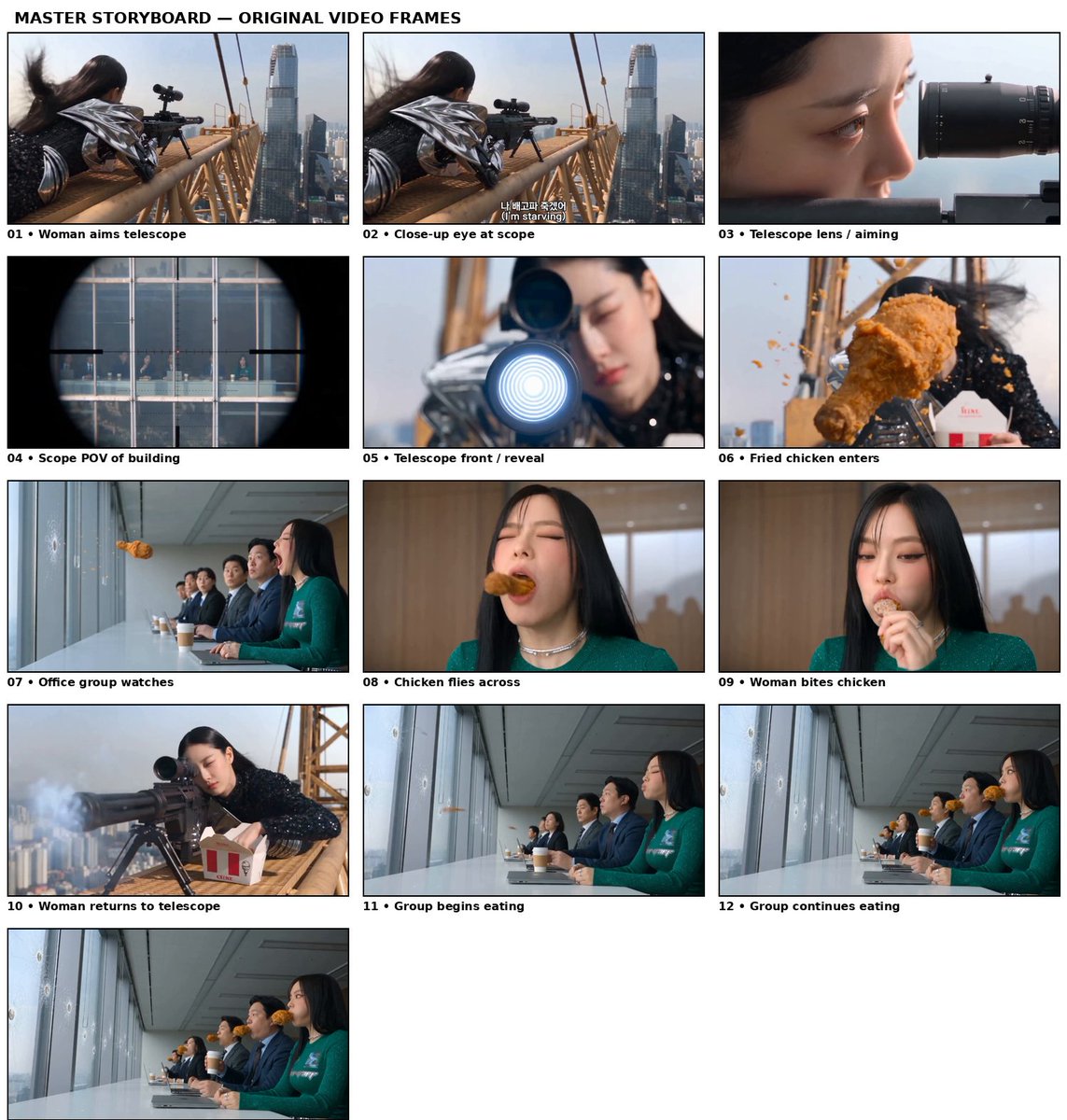
On October 5, 2026, AI video creator Elsa Sofia (@ElsaSofia__AI) published an advanced video generation prompting framework using ByteDance's Seedance 2.5, demonstrating how to generate a seamless 17-second cinematic commercial sequence containing thirteen rapid shot cuts while preserving strict visual continuity.
Image source: X @ElsaSofia__AI
In standard text-to-video and single-image animation pipelines, multi-cut sequences frequently degrade into severe visual drift: facial features warp across scene transitions, character wardrobes shift unpredictably, and background architecture morphs between camera angles. Managing over ten distinct cuts and high-speed comedic action within a single unified generation run typically causes generative video models to lose structural control. Elsa Sofia's production tip resolves this challenge by pairing a dedicated character reference image and a master storyboard grid as rigid visual anchors, coupled with sub-second timestamped prompt directives.
Dual Anchoring: Coupling Character Reference and Master Storyboards
The foundation of Elsa Sofia's approach lies in eliminating autonomous model drift by establishing strict boundary conditions at the very beginning of the prompt.
Rather than relying purely on descriptive prose or freeform camera instructions, this workflow supplies two fixed visual assets to Seedance 2.5—a primary character reference and a multi-panel master storyboard—and imposes explicit generation constraints:
- Strict Storyboard Reproduction: The model is explicitly ordered to recreate the storyboard sequence accurately without altering the planned shot progression or framing.
- Five Invariant Elements: Character identity, environment, props, wardrobe, and narrative flow are locked into non-negotiable stability across all cuts.
- Explicit Prohibition of Hallucinations: In the concluding directive, the prompt strictly forbids the creation of unscripted scenes, sequence alterations, unprompted characters, or extraneous objects and actions.
By bounding the model with both visual reference assets and programmatic negative constraints, Seedance 2.5 maintains coherent spatial memory and physical continuity throughout the entire 17-second timeline.
Complete 17-Second 13-Shot Timeline Prompt Specification
The generated clip depicts a humorous high-end commercial concept: an office worker carefully monitoring a distant building through a heavy telescope, who is suddenly interrupted by a flying piece of fried chicken, catches and bites it with deadpan composure, and casually returns to surveillance. The 17-second duration is divided into thirteen discrete, sequential shots with precise second-level boundaries (from 0.0s to 17.0s).
The shot-by-shot prompt breakdown and camera direction are structured as follows:
- Shot 1 (0.0–1.3s): A woman stands inside an office building and carefully aims a large telescope toward a distant building. (Cinematic medium shot, subtle camera movement, realistic lighting)
- Shot 2 (1.3–2.5s): Extreme close-up of her eye peering through the telescope eyepiece. (Detailed eyelashes, realistic skin texture, focused expression, shallow depth of field)
- Shot 3 (2.5–3.8s): Close-up of the telescope mechanics as she makes precise manual adjustments. (Smooth cinematic camera movement, realistic metal and optical glass reflections)
- Shot 4 (3.8–5.0s): Telescope point-of-view (POV) perspective showing the distant building through the optics. (Clear optical perspective, authentic focal depth, slight lens distortion)
- Shot 5 (5.0–6.3s): Exterior front view of the telescope, maintaining character and environmental consistency. (Builds anticipation with a subtle camera push-in)
- Shot 6 (6.3–7.5s): A piece of golden fried chicken suddenly enters the frame from the side, introducing comedic surprise. (Natural trajectory motion and realistic physics)
- Shot 7 (7.5–8.8s): Cut to an interior office group near the window watching the event with shocked expressions. (Matches the storyboard's character designs and room layout)
- Shot 8 (8.8–10.0s): The fried chicken hurtles across the room toward the woman. (Dynamic tracking camera move with realistic motion blur)
- Shot 9 (10.0–11.4s): The woman naturally catches and takes a bite of the flying chicken. (Tight cinematic framing, believable facial performance, comedic timing)
- Shot 10 (11.4–13.0s): She calmly returns to the telescope eyepiece as though nothing unusual occurred. (Smooth transition, classic deadpan comedy execution)
- Shot 11 (13.0–14.2s): Cut back to the group near the window as they begin eating fried chicken together.
- Shot 12 (14.2–15.8s): The group continues enjoying the meal. (Natural social gestures, subtle reactions, realistic food handling physics)
- Shot 13 (15.8–17.0s): Final cinematic wide shot of the entire ensemble eating together. (Holds briefly for a punchy commercial ending)
Here is the verbatim prompt utilized in the production run:
Create a 17-second cinematic photorealistic video using the provided character reference and the provided master storyboard as strict visual references. Recreate the storyboard sequence accurately without changing the characters, environment, props, wardrobe, or story.

Shot 1 — 0.0–1.3s: A woman stands inside an office/building and carefully aims a large telescope toward a distant building. Cinematic medium shot, subtle camera movement, realistic lighting.

Shot 2 — 1.3–2.5s: Extreme close-up of her eye looking through the telescope. Detailed eyelashes, realistic skin texture, focused expression, shallow depth of field.

Shot 3 — 2.5–3.8s: Close-up of the telescope as she adjusts and aims it precisely. Smooth cinematic camera movement, realistic metal and glass reflections.

Shot 4 — 3.8–5.0s: Telescope point-of-view shot showing the distant building through the lens. Clear optical perspective, realistic depth and slight lens distortion.

Shot 5 — 5.0–6.3s: Exterior/front view of the telescope, maintaining the same woman and location. Build anticipation with a subtle push-in.

Shot 6 — 6.3–7.5s: A piece of fried chicken suddenly enters the frame from the side, creating a humorous surprise. Natural motion and realistic physics.

Shot 7 — 7.5–8.8s: Cut to the group inside the office near the window, watching the situation with surprised expressions. Keep their appearance and environment consistent with the storyboard.

Shot 8 — 8.8–10.0s: The fried chicken flies rapidly across the scene toward the woman. Use dynamic tracking camera movement and realistic motion blur.

Shot 9 — 10.0–11.4s: The woman catches/bites the fried chicken naturally. Close cinematic framing, realistic facial expression, comedic timing.

Shot 10 — 11.4–13.0s: She calmly returns to the telescope and continues looking through it as if nothing unusual happened. Smooth transition, deadpan comedy.

Shot 11 — 13.0–14.2s: Cut back to the group; they begin eating fried chicken together.

Shot 12 — 14.2–15.8s: The group continues eating happily. Natural gestures, subtle reactions, realistic food movement.

Shot 13 — 15.8–17.0s: Final cinematic group shot of everyone eating together. Hold for a brief comedic ending.

Overall style: ultra-realistic cinematic commercial, natural human movement, realistic physics, consistent faces and clothing, detailed food textures, realistic office environment, cinematic depth of field, subtle handheld camera movement, smooth cuts, natural motion blur, believable lighting and shadows, high-end film production quality, 4K photorealism.

Important: Follow the provided storyboard exactly. Do not invent new scenes, do not change the sequence, do not change the characters, and do not add unnecessary objects or actions.
Cinematic Commercial Rendering Style and Strict Sequence Constraints
The closing clauses of the prompt establish the optical and physical quality standards necessary for a broadcast-ready aesthetic, steering the diffusion model away from synthetic artifacts:
- Organic Physics and Textures: Instead of generic buzzwords, the prompt demands natural human biomechanics, realistic projectile physics, crisp fried chicken food textures, and organic camera motion blur, effectively eliminating floating or rubbery movement artifacts.
- Optical Framing Control: Detailed lighting specifications, authentic depth-of-field falloff, and subtle handheld micro-shakes simulate high-end cinema camera optics rather than flat CGI renders.
- Narrative Pacing for Short-Form Video: Shifting from intense spy-thriller stakes to sudden slapstick food delivery creates immediate viewer retention, illustrating how prompt engineering and pre-visualized editing timing can work together in production AI filmmaking.
For creators developing multi-shot narratives in Seedance 2.5, anchoring generations with verified visual storyboards and timestamp-bracketed camera cuts offers a reliable blueprint for producing visually consistent, production-grade commercial video content.