Scenario Unveils GameDev OS: Equipping Coding Agents with 9 Specialists and 64 Skills
Scenario has unveiled GameDev OS, a multi-agent game studio framework for coding agents that provides 9 domain specialists, 64 skills, and ComfyUI pipeline link
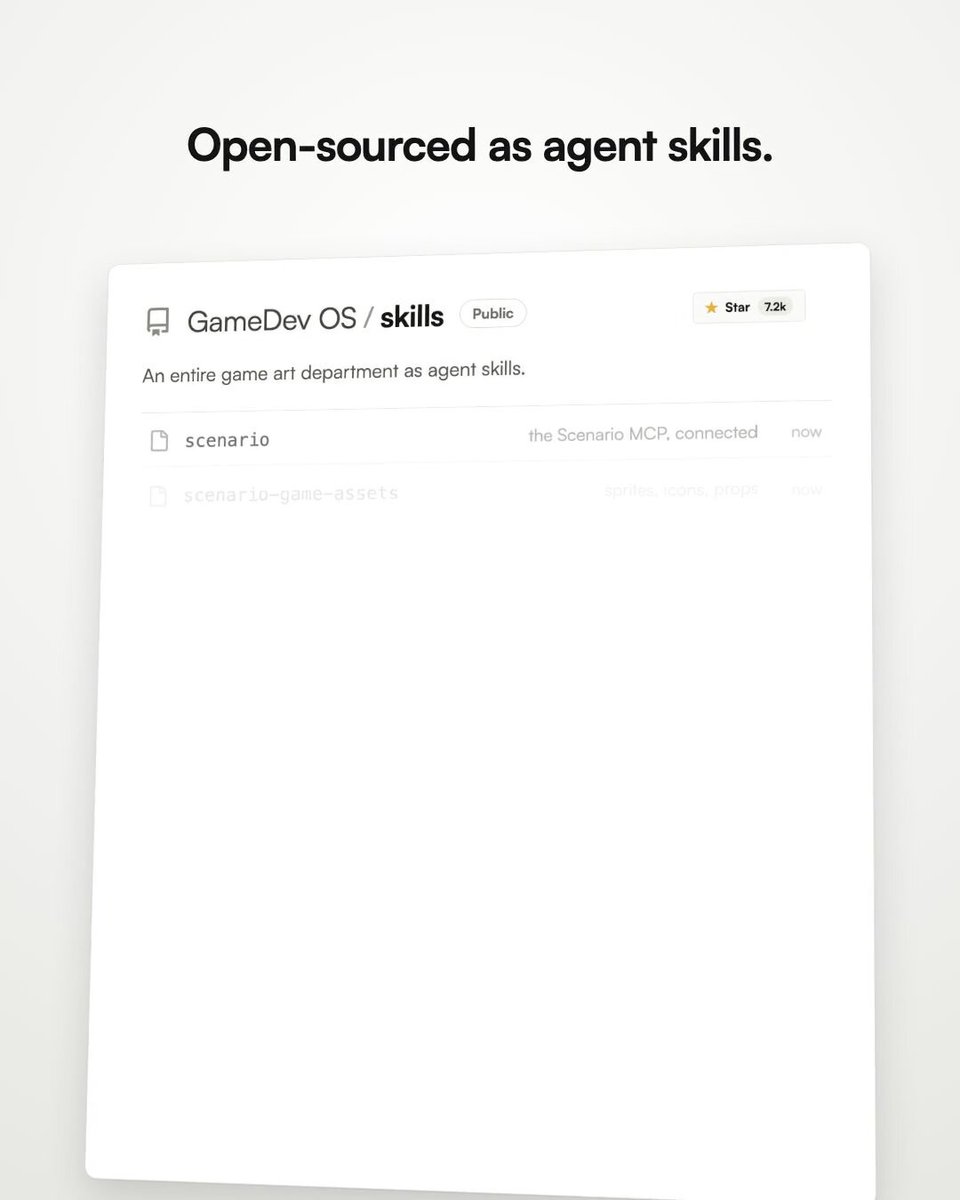
On September 24, 2026, Emmanuel de Maistre, co-founder and CEO of AI game asset platform Scenario, officially introduced GameDev OS, an agentic framework designed to transform a standard coding agent into a full-scale virtual game development studio.
Image source: Emmanuel de Maistre (@emmanuel_2m) / Scenario
GameDev OS organizes game production into a structured multi-agent architecture, combining 9 specialized domain roles with a library of 64 modular skills on top of a single agent harness. Instead of managing disconnected tools manually, developers can issue high-level instructions to orchestrate an automated asset pipeline from initial concept sketches to finished promotional trailers.
Virtual Studio Architecture: 9 Specialists and 64 Modular Skills
At the core of GameDev OS is the translation of traditional game studio departments into explicit, specialized agent roles with modular skill trees. The framework establishes 9 distinct specialist profiles:
- 2D Artist: Generates initial concept sketches, 2D game sprites, and visual effects (VFX) assets.
- 3D Artist: Handles image-to-3D mesh generation, skeletal rigging, and animation retargeting.
- Environment Artist: Crafts surface textures, 360-degree skyboxes, and walkable 3D environments.
- Art Director: Enforces single-character visual consistency across all shots and conducts quality control checks before release.
- Sound Designer: Composes background scores and creates sound effects (SFX) including dynamic gunfire and ambient audio.
- Video Producer: Edits cinematic game trailers and generates formatted captions for distribution platforms.
- Marketing Artist: Produces platform-compliant store banner art and derives promotional advertising assets from hero shots.
- Technical Director: Imports existing ComfyUI workflows and builds custom automated production pipelines.
- Cost Manager: Runs cost-versus-quality model bake-offs and enforces project-level budget ceilings.
These specialists operate through a continuous handoff sequence. In a typical production cycle, the 2D Artist sketches a weapon concept, the 3D Artist models and rigs the 3D mesh, the Environment Artist constructs the game world around it, the Sound Designer layers weapon sound effects, and the Video Producer edits the final teaser trailer.
Generative Model Mapping and ComfyUI Pipeline Integration
Rather than binding users to a single proprietary foundation model, GameDev OS maps domain-specific tasks to leading generative AI architectures:
- Domain-Specific Model Routing: The framework connects specialized generative models across roles, including Seedance for video generation, GPT models for reasoning and script formatting, and Meshy and Rodin for high-fidelity 3D mesh reconstruction.
- ComfyUI Workflow Importing: Through the Technical Director role, developers can import existing node-based ComfyUI workflows directly into the agent's execution harness, bridging visual generation setups into code-driven pipelines.
- Cost Optimization and Benchmarking: The Cost Manager evaluates alternative models to identify the most cost-effective solution for specific visual standards, maintaining real-time tracking of token and API credit expenditure across team budgets.
This unified abstraction allows engineering teams to control complex asset generation pipelines directly within their primary coding agent interface without switching across disparate web interfaces.
Distribution Method and Production Considerations
Scenario positioned the launch as "open-sourcing an entire game studio" that is free to install on personal agent harnesses. However, teams evaluating GameDev OS for production should note several practical distinctions.
First, the distribution model at launch utilizes social channel distribution rather than an immediate public GitHub repository or package manager release. Access to the skill library is currently provided via direct message following comments on the announcement post, requiring teams to verify licensing and repository governance when adopting the skills.
Second, the system specifically targets asset and media production pipelines rather than runtime gameplay mechanics. While GameDev OS produces 2D art, 3D meshes, textures, audio, and marketing collateral, core gameplay systems—including physics engines, collision handling, character controllers, and runtime logic—remain the responsibility of the game engine and developer code.
Third, while the agent harness and skill library are described as free to install, actual generation runs incur upstream model inference costs. Operating high-throughput 3D mesh and video pipelines necessitates active budget monitoring, underscoring the role of the Cost Manager module in commercial projects.