Reverse-Engineering Trading Systems with REA MCP and Opus 5.5: A 6-Step Pipeline for Autonomous Rust Trading Agents
A practical 6-step engineering pipeline combining the Reverse Engineer Anything (REA) MCP and Claude Opus 5.5 to inspect trading system binaries, infer mechanic
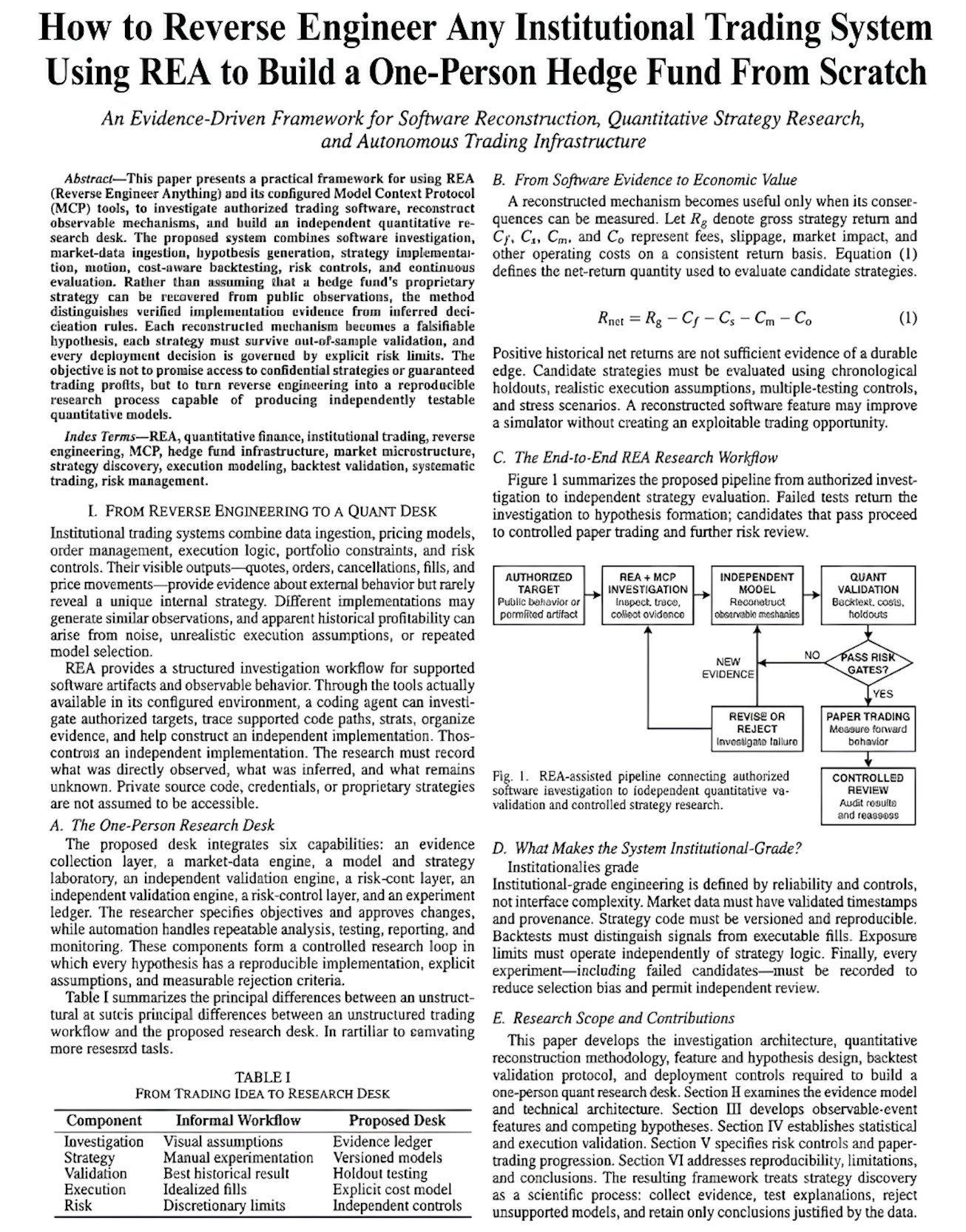
The original author is @RohOnChain (Roan) on X. This practical guide covers a 6-step engineering framework (detailed in a 6-page research paper) that combines the Reverse Engineer Anything (REA) Model Context Protocol (MCP) and Claude Opus 5.5 to inspect trading system source code and binaries, deduce underlying mechanics, and construct custom autonomous trading agents in Rust with rigorous backtesting.
Image source: @RohOnChain via X
Designed for developers and quantitative researchers seeking to systematically dissect trading mechanics and automate agent synthesis, the workflow progresses from structural application analysis to closed-loop autonomous refinement.
Steps 1–3: Inspecting System Behavior to Reconstructing Order Execution
The first phase focuses on deconstructing target systems, tracing execution flows, and extracting runtime market interactions.
- Step 1: REA Workflow (Investigating Behavior and Mapping Dependencies): Analyzes application behavior, traces executable code paths, maps internal and external dependencies, and reconstructs how the trading system operates end-to-end.
- Step 2: Source-Code and Binary Analysis Layer (Examining Functions and Structural Recovery): Confined strictly to authorized targets, this layer inspects function-level logic, recovers control-flow and program structures, and traces underlying implementation details.
- Step 3: Behavioral Analysis Engine (Inferring Mechanics from Event Logs): Evaluates order submissions, cancellations, market-data updates, and real-time execution events to reverse-engineer core trading and order-matching dynamics.
Steps 4–6: Opus 5.5 Hypothesis Modeling, Rust Bots, and Autonomous Backtesting
The second phase leverages foundation model reasoning to formalize findings into quantitative strategies and run automated validation loops.
- Step 4: Opus 5.5 Research Agent (Formulating Hypotheses and Rust Bot Synthesis): Converts empirical observations into Python-based mathematical formulations, trading bots, and testable strategy hypotheses, which are then implemented into high-performance Rust trading agents.
- Step 5: Backtesting Engine (Evaluating Across Historical Data and Slippage): Assesses candidate strategies against historical market data, exchange transaction fees, execution slippage, out-of-sample evaluation periods, and predefined validation criteria.
- Step 6: Autonomous Research Loop (Logging Experiments and Refinement Under Risk Limits): Automatically logs experiment results, audits backtest failures, tracks ongoing performance, and iteratively refines strategy parameters within explicit risk boundaries.
Practical Caveats: Hard Risk Limits and Alpha Mechanics
Discussions within the author's thread and community feedback emphasize several vital technical cautions that must govern real-world adoption:
- Mandatory Hard Size Caps: As highlighted by @velesxbt and reaffirmed by @RohOnChain, autonomous research and execution loops without hard position size limits can rapidly blow up a trading account. Risk configuration remains the single most critical parameter when deploying automation.
- Binary Reversal vs. Alpha Insight: As noted by @shadowaguy, successfully decomposing executable binaries or recovering code structures is distinct from understanding why a strategy possesses genuine economic edge in live markets.
- Out-of-Sample Decay and Overfitting: Even if an extracted strategy fits historical periods closely, decay in out-of-sample data renders complex engineering ineffective; rigorous train-validation separation is non-negotiable.
- Authorization and Scope: Reverse-engineering workflows and binary inspection must strictly be conducted on authorized targets within legitimate legal frameworks.
Original source
- @RohOnChain Original Thread: https://x.com/RohOnChain/status/2109708114698408422
- @RohOnChain Research Paper: Access The Research Paper (Google Drive)