15 Open-Source Repositories for AI Agent 3D Production Pipelines
A curated collection of 15 open-source GitHub repositories bridging AI coding agents with 3D workflows: from asset generation and USD scenes to game engine cont
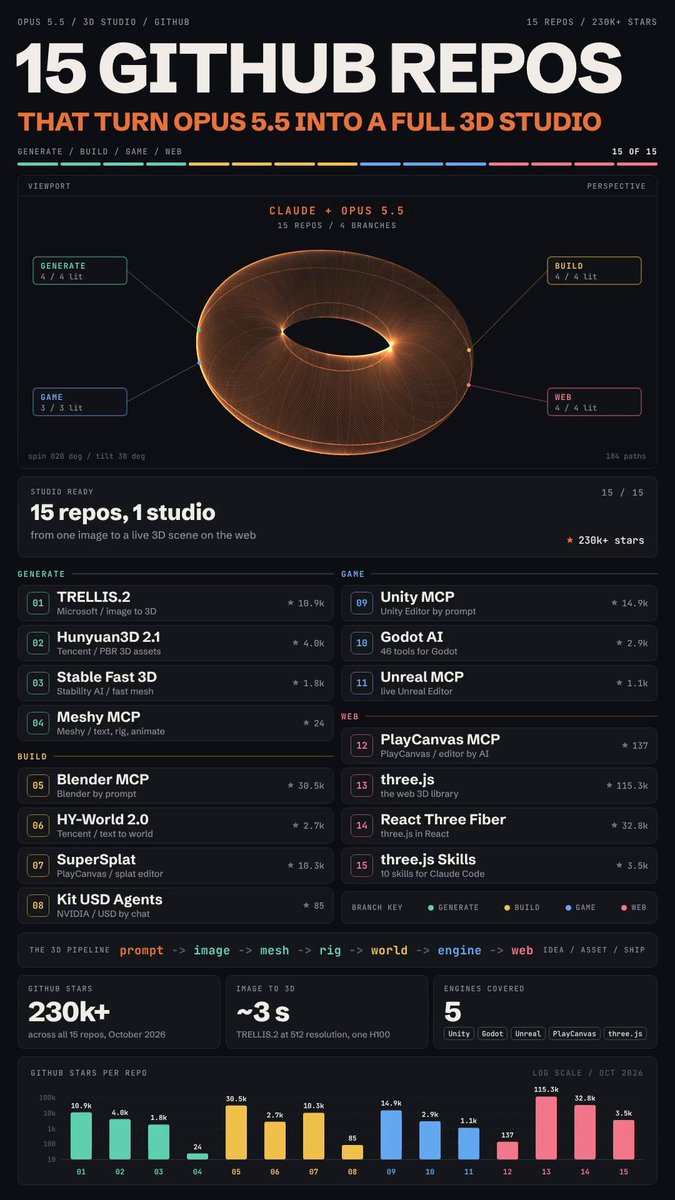
Curated by Mnimiy (@Mnilax) on X, this guide organizes 15 essential open-source GitHub repositories into an end-to-end 3D production pipeline that bridges advanced AI coding agents, such as Claude Opus 5.5 and Claude Code, with 3D asset generation, scene assembly, game engines, and WebGL rendering.
Image source: Mnimiy (@Mnilax) via X
As frontier LLMs evolve beyond pure text coding toward multimodal perception and complex software tool orchestration, integrating AI agents with Digital Content Creation (DCC) software and interactive engines via the Model Context Protocol (MCP) has gained significant momentum. The 15 repositories assembled here map out the complete journey from initial single-image synthesis to real-time interactive game deployment.
3D Asset Generation: Extracting Meshes and PBR Textures from Single Images and Prompts
The opening stage of the pipeline focuses on converting raw 2D reference images or natural language prompts into production-ready 3D polygonal geometry and material maps.
- 01. Microsoft TRELLIS.2 (microsoft/TRELLIS.2): Produces a fully textured 3D asset from a single reference image in approximately 3 seconds on an NVIDIA H100 GPU, offering remarkable throughput for rapid prototyping.
- 02. Tencent Hunyuan3D-2.1 (Tencent/Hunyuan3D-2): Generates high-fidelity 3D assets equipped with complete Physically Based Rendering (PBR) texture sets, designed specifically for professional DCC workflows.
- 03. Stability AI stable-fast-3d (Stability-AI/stable-fast-3d): Built for ultra-fast inference, converting a single photograph into a clean, UV-unwrapped polygonal mesh suitable for immediate downstream texturing.
- 04. Meshy meshy-mcp-server (meshy-ai/meshy-mcp-server): Wraps text-to-3D and image-to-3D generation services inside an MCP server, empowering AI agents to programmatically remesh, retexture, rig, and animate character models.
Scene and World Building: Controlling Blender, OpenUSD, and 3D Gaussian Splats
Once individual assets exist, constructing cohesive spatial environments requires placing objects, configuring lighting and cameras, and orchestrating complex scene hierarchies.
- 05. mcp-for-blender (ahmad-m-al-m/mcp-for-blender): Connects an AI agent directly to a live, running Blender instance to execute prompt-driven geometric modeling, object placement, and parameter modifications.
- 06. Tencent HY-World-2.0 (Tencent/HY-World): Synthesizes fully navigable, spatial 3D virtual environments directly from text prompts or single reference viewpoints.
- 07. PlayCanvas supersplat (playcanvas/supersplat): A lightweight, browser-based tool to inspect, edit, clean up, optimize, and publish 3D Gaussian Splatting point cloud datasets without native software overhead.
- 08. NVIDIA Omniverse kit-usd-agents (NVIDIA-Omniverse/kit-usd-agents): Provides a natural language interface for authoring OpenUSD scenes within NVIDIA Omniverse, backed by dedicated MCP servers for Omniverse Kit and the Isaac Sim robotics platform.
Game Engine Integration, Web 3D, and Real-World Production Challenges
The final stages connect agent workflows into commercial game engines and web runtimes, enabling programmatic scene composition and automated interaction testing.
- 09. unity-mcp (unity-mcp/unity-mcp): Drives the Unity Editor using plain English commands, handling scene hierarchies, C# script authoring, asset imports, automated unit testing, and release builds.
- 10. godot-ai (godot-ai/godot-ai): Exposes 46 dedicated tools to control a live Godot editor, covering scene nodes, GDScript generation, signal connections, UI layouts, and particle simulations.
- 11. unreal-engine-mcp (unreal-engine-mcp/unreal-engine-mcp): Connects agents to a running Unreal Engine editor to place actors, manipulate transforms, build landscapes, and assemble visual Blueprints.
- 12. PlayCanvas editor-mcp-server (playcanvas/editor-mcp-server): Allows an AI coding agent to programmatically build PlayCanvas web scenes and verify their runtime execution in a headless or browser environment.
- 13. three.js (mrdoob/three.js): The industry-standard JavaScript 3D engine with over 115k GitHub stars, providing the rendering bedrock for web-based spatial applications.
- 14. react-three-fiber (pmndrs/react-three-fiber): A declarative React wrapper for Three.js that enables developers to construct dynamic 3D viewports as modular, reusable components.
- 15. threejs-skills (threejs-skills/threejs-skills): A specialized suite of 10 Three.js skills tailored for Claude Code, guiding agents through custom GLSL/WGSL shaders, lighting setups, and post-processing stacks.
Engineering Bottlenecks: The Generate-Inspect-Repair Loop
As highlighted by 3D engineers such as Alex Vainshtein (@Alex_Vainshtein) following the original thread, the primary hurdle in practical production is rarely generating the initial mesh. Rather, the true bottleneck lies in post-generation geometry cleanup, non-manifold repair, UV unwrapping verification, material alignment, and skeletal rigging.
Moving beyond impressive one-shot demos toward commercial game development requires establishing an automated generate → inspect → repair pipeline. Furthermore, engineering teams must evaluate open-source licensing models and verify reliable data handoffs across standardized interchange formats like OpenUSD and glTF to prevent lossy pipeline translation.
Original source
- Mnimiy (@Mnilax) on X: https://x.com/Mnilax/status/2109716261160538324