Puter Releases 'Builder': An Open-Source AI App Builder Alternative to Lovable and v0
The Puter team has open-sourced 'HeyPuter/builder', an Apache 2.0-licensed AI app builder enabling natural language web development as an alternative to Lovable
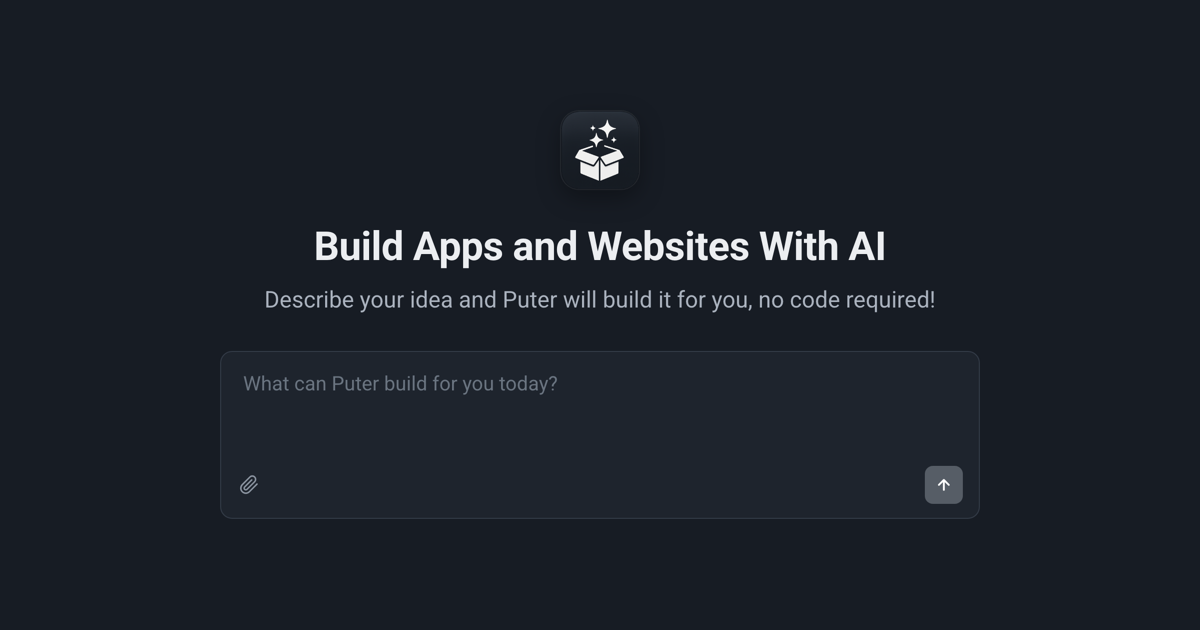
The Puter team (@HeyPuter), known for developing cloud desktop environments and browser-based operating systems, has officially released 'HeyPuter/builder', an open-source AI builder designed to create complete websites and interactive web applications from natural language prompts without manual coding. Announced across Puter's official X channel and released on GitHub, the project introduces a self-hostable, permissive open-source alternative to commercial closed-source generators such as Lovable, Replit, and v0.
Image source: Puter (@HeyPuter) / GitHub
While prevailing commercial AI website and application builders confine users to proprietary cloud runtimes and credit-metered execution plans, Puter's new builder emphasizes complete developer autonomy, full code visibility, and self-hosted infrastructure control.
Natural Language App Generation and Challenging Closed AI Ecosystems
The core capability of HeyPuter/builder is enabling developers and non-technical creators alike to scaffold interactive websites and functional web applications using conversational natural language instructions.
The modern web development landscape has seen rapid adoption of AI coding assistants and visual generators such as Lovable, Vercel's v0, Replit Agent, and Bolt.new. Despite their velocity, these proprietary platforms introduce structural constraints:
- Platform Lock-in and Proprietary Runtimes: Generated applications often depend heavily on the host vendor's proprietary cloud environment, complicating migration to independent server setups or custom deployment pipelines.
- Opaque Generation Pipelines: Internal prompt orchestration and code scaffolding layers remain proprietary, limiting developer visibility into error causes or code quality regressions.
- Credit Caps and Subscription Costs: Usage-based token metering and recurring subscription tiers can scale steeply for active prototyping or multi-developer organizations.
HeyPuter/builder addresses these friction points by providing an open application that developers can run and host independently. Users can deploy the builder within their preferred environment without being tied to commercial service quotas or proprietary billing structures.
Apache 2.0 Permissive Licensing and Complete Architectural Extensibility
A defining attribute of the HeyPuter/builder release is its permissive licensing structure and structural openness.
The repository, encompassing its core orchestration engine, sub-projects, modules, and internal components, is released under the Apache License 2.0 (with bundled third-party libraries and fonts retaining their respective notices). This permissive framework grants organizations and individual developers broad legal rights to fork, adapt, integrate, and commercially distribute customized variations.
- Unrestricted Customization and Forking: Engineering teams can clone the repository to incorporate internal component design systems, integrate specialized framework templates, or tune prompt workflows to adhere to proprietary coding standards.
- Auditable Security and Dependency Posture: Because the entire codebase is publicly available on GitHub, development teams can inspect the scaffolding mechanisms and audit third-party dependencies before introducing generated artifacts into production pipelines.
- Flexible Ecosystem and Standalone Deployment: While natively compatible with the browser-based Puter desktop environment, the builder is engineered to operate across standard desktop environments and private cloud infrastructure.
The strong community interest following the project's open-source release underscores developer demand for an unencumbered, permissive foundation in a segment previously dominated by proprietary SaaS platforms.
Practical Considerations: Platform Integration and Production Code Audits
While HeyPuter/builder offers substantial architectural freedom, teams considering adopting it for serious development workflows should account for several practical requirements:
- Puter Platform Integration and Hosting Configuration: Self-hosting or deploying the repository requires configuring the Puter environment and underlying hosting setup, with generation responsiveness and hosting performance directly tied to the target infrastructure.
- Early-Stage Code Review and Refactoring: As with early open-source releases, complex business logic, distributed state transactions, and robust data persistence layers require careful developer oversight and manual refactoring rather than relying solely on automated generation.
- Focus on Prototyping and Internal Utilities: At this stage, the tool delivers the highest immediate leverage for rapid MVP construction, interactive prototyping, and internal departmental utilities rather than replacing enterprise production engineering from scratch.
Puter's 'Builder' provides a transparent, customizable foundation that shifts agency back to the developer community, establishing a viable open-source alternative in an AI tooling market increasingly dominated by closed ecosystems.