Production-Ready AI Agents: The 13-Step Workflow and Governance Architecture
Beyond simple tool demos, building reliable production AI agents requires a robust 13-stage execution loop and comprehensive governance guardrails ensuring cont
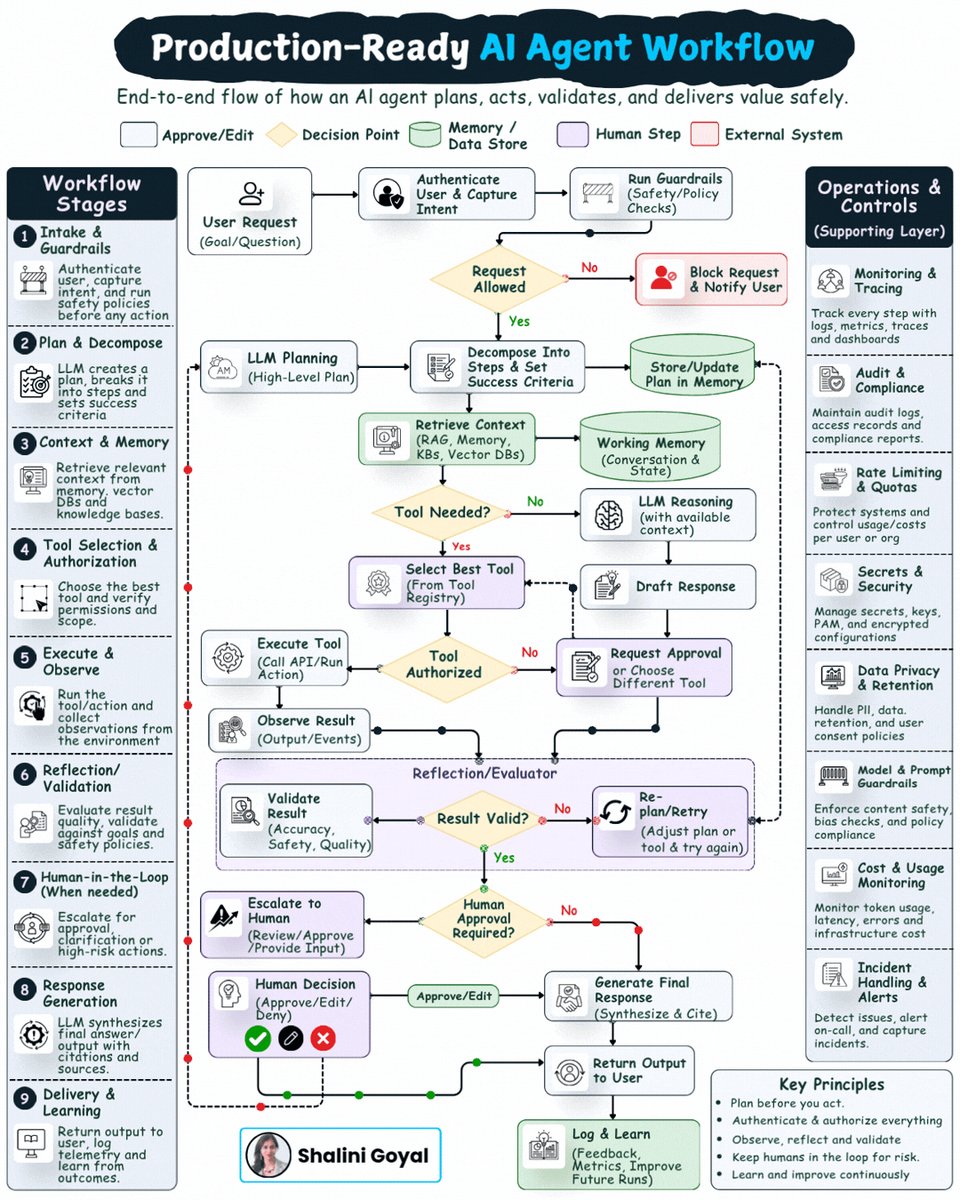
On October 4, 2026, Shalini Goyal (@goyalshaliniuk) published an architectural framework addressing the critical divide between prototype demonstrations and enterprise software: a comprehensive 13-stage execution workflow reinforced by seven foundational governance and operational pillars.
Image source: Shalini Goyal (@goyalshaliniuk) / X
While connecting a large language model (LLM) to a few external APIs is straightforward in a controlled sandbox demo, deploying autonomous agents into real-world production environments presents entirely different engineering demands. In live production settings, agents encounter ambiguous user inputs, unpredictable network latencies, flaky third-party endpoints, sensitive corporate data boundaries, and strict regulatory compliance standards. As Goyal highlights, building an agent that teams can genuinely trust requires moving far beyond naive prompt-and-call loops into a disciplined architectural lifecycle engineered to plan, act, validate, recover, and escalate safely.
The 13-Stage End-to-End Agent Execution Pipeline
The proposed end-to-end workflow establishes an explicit sequence of 13 checkpoints spanning the entire lifecycle from initial user input to post-execution telemetry. This structured progression balances flexible probabilistic model reasoning with strict deterministic boundaries.
- Capture the user request and intent: Parse the initial prompt, identify target parameters, and establish the functional scope of the user's objective.
- Authenticate the user and run safety checks: Verify the caller's identity and apply inbound defensive screening against prompt injection, jailbreaks, or malicious payloads.
- Decide whether the request is allowed: Enforce organizational policies, access control lists, and entitlement scopes to confirm authorization before allocating resources.
- Plan the task and break it into clear steps: Deconstruct the overarching objective into an ordered sequence of discrete, verifiable subtasks with explicit dependencies.
- Retrieve context from memory, RAG, vector databases, or knowledge bases: Hydrate the execution context with relevant short-term history, long-term memory records, and grounded enterprise knowledge.
- Decide whether a tool is needed: Evaluate whether the current subtask can be resolved through internal reasoning or strictly demands external tool interaction.
- Select the right tool and verify permissions: Choose the target API or function contract from the tool registry and validate runtime permissions for the requested parameters.
- Execute the action and observe the result: Invoke the designated tool within an isolated environment and capture the raw operational output as an empirical observation.
- Validate accuracy, safety, and output quality: Evaluate the tool response against expected schemas, business rules, and safety criteria to detect hallucinated or degraded outputs.
- Re-plan or retry when the result fails: Handle network timeouts, API error codes, or invalid responses using intelligent retry policies, backoff mechanisms, or dynamic re-planning.
- Escalate risky or ambiguous actions to a human: Enforce a human-in-the-loop gate whenever state-altering actions, high-value transactions, or high ambiguity thresholds are detected.
- Generate the final response: Synthesize validated observations and intermediate outputs into a concise, well-formatted, and helpful response for the user.
- Log feedback, metrics, and outcomes for improvement: Record end-to-end latency, token consumption, success metrics, and user satisfaction signals into telemetry stores for continuous optimization.
Seven Governance and Infrastructure Pillars Surrounding the Loop
Goyal emphasizes that what surrounds the core execution loop is just as vital as the loop itself. An autonomous agent cannot operate safely in an enterprise without a robust supporting perimeter that provides observability, security, and administrative control.
- Monitoring and Tracing: Distributed tracing and telemetry pipelines make non-deterministic model paths, agent trajectories, and tool calls fully inspectable in real time.
- Audit Logs: Comprehensive, tamper-resistant event logs preserve an immutable record of authorizations, data access, and downstream side effects for compliance auditing.
- Rate Limits: Fine-grained throttling mechanisms control computational abuse, prevent runaway recursive loops, and maintain predictable API token expenditure.
- Secrets Management: Centralized vault services isolate and inject API credentials and database tokens dynamically without exposing keys to prompt contexts.
- Privacy Policies: Systematic governance rules define permissible data handling boundaries, enforcing PII masking and automated data retention lifecycles across vector indexes.
- Model and Prompt Guardrails: Bidirectional safety layers evaluate both inbound prompts and outbound completions to neutralize security threats and toxic content.
- Incident Handling: Resilient circuit breakers and escalation playbooks ensure on-call engineering teams can immediately intervene when upstream model providers or external tools fail.
Controlled Autonomy and Production Engineering Principles
A frequent misstep among engineering teams is treating maximum autonomy as the ultimate benchmark of agent performance. In production software engineering, the true objective is 'controlled autonomy'—enabling agents to operate independently only within clearly demarcated boundaries established by verification gates, observability, and human oversight.
Practitioner feedback across the engineering community underscores that real-world agent reliability is primarily a systems engineering problem rather than a model capability bottleneck. Critical architectural details include maintaining state freshness—confirming that permission snapshots and resource locks remain valid when a planned action actually fires—and implementing robust defensive handlers for edge cases where tools return empty results. By combining deterministic verification wrappers with probabilistic reasoning, organizations can successfully bridge the gap between fragile prototypes and resilient, enterprise-grade AI agents.
Original source
- Shalini Goyal Official X Post: Shalini Goyal (@goyalshaliniuk) - Production-Ready AI Agents