OpenAI Releases GPT-6 Sol and Luna with 50% API Token Price Reductions
OpenAI has launched GPT-6 Sol ($2/$10) and Luna ($0.10/$0.50), cutting API token rates by 50% or more versus GPT-5.6 while maintaining 1M context and benchmark
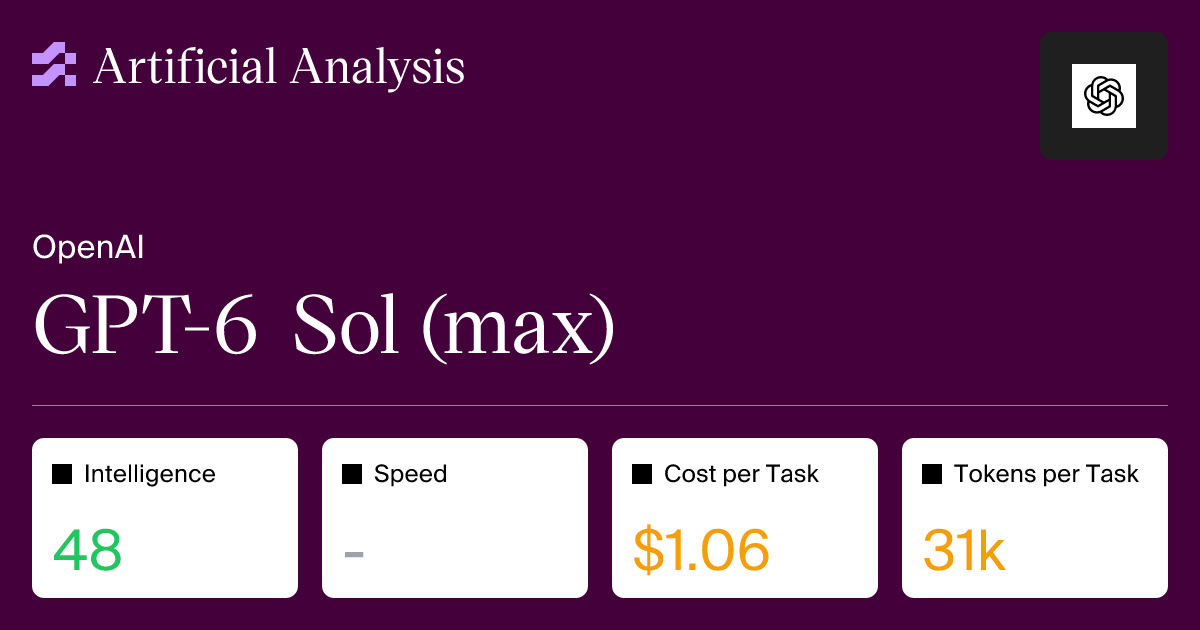
On September 22, 2026, OpenAI officially introduced GPT-6 Sol and GPT-6 Luna, adding mid-tier and lightweight models to its frontier GPT-6 lineup. Expanding on the architecture and caching optimizations of the flagship GPT-6 Astra tier, this release centers on an aggressive, permanent 50% price reduction across commercial API token rates.
Image source: https://artificialanalysis.ai/models/gpt-6-sol
The newly deployed models are available immediately through the OpenAI API under the model identifiers gpt-6-sol and gpt-6-luna, while also integrating directly into ChatGPT Work and Codex on paid tiers. Featuring a massive 1-million-token (1M) context window and a 90% prompt caching read discount, the release reconfigures production token economics for developers, autonomous coding agents, and high-throughput enterprise pipelines.
Permanent 50% API Token Reductions: Token Economics of Sol and Luna
The defining highlight of this launch is the steep drop in API pricing. OpenAI credits sustained inference stack refinements and enhanced caching layers for enabling this pricing restructuring across both input and output tokens.
- GPT-6 Sol Pricing: Set at $2.00 per million input tokens and $10.00 per million output tokens. Compared against GPT-5.6 Sol's promotional rate of $4.00 input and $20.00 output, this marks an exact 50% reduction in both directions.
- GPT-6 Luna Pricing: Priced at $0.10 per million input tokens and $0.50 per million output tokens. Against GPT-5.6 Luna ($0.20 input and $1.20 output), input costs drop by 50% while output rates plunge by 58.3%, creating substantial compounding savings on output-heavy generative tasks.
- Confirmed Permanent Baseline Rates: In statements confirmed to VentureBeat, an OpenAI spokesperson explicitly confirmed that these Sol and Luna rates are permanent list prices rather than temporary introductory discounts.
- 1M Context Window and Prompt Caching: Both models support a 1-million-token (1M) context window by default, accompanied by a 90% discount on prompt cache reads to encourage multi-turn agent persistence and document grounding.
Functionally, GPT-6 Sol is targeted at complex reasoning, large-scale codebase exploration, and autonomous agent loops, whereas the lightweight GPT-6 Luna is optimized for structured data extraction, document classification, and low-latency utility routing.
Artificial Analysis Benchmark Findings: Halved Task Costs and Preserved Intelligence
Independent AI testing organization Artificial Analysis published real-world evaluation metrics and cost benchmarks immediately following the release, validating OpenAI's efficiency claims.
- 50% to 60% Execution Cost Drops: Measuring end-to-end task execution on the Artificial Analysis Intelligence Index, GPT-6 Sol (max) registered a cost of $1.06 per typical task, down approximately 50% from GPT-5.6 Sol (max) at $1.99. GPT-6 Luna (max) demonstrated an even steeper reduction, costing $0.07 per task compared to $0.18 for GPT-5.6 Luna (max), representing an approximate 60% cost savings.
- 30% Faster Latency (TTFT): Time to first token response was shortened by roughly 30% on both models compared to the previous 5.6 generation, delivering noticeable interactive responsiveness in real-time developer workflows.
- Intelligence Metric Parity: GPT-6 Sol (max) maintained performance parity with GPT-5.6 Sol on both the Intelligence Index and the Coding Agent Index, staying within 1 point of the older model. It achieves this parity while operating at roughly half the task execution cost of the 5.6 generation.
The benchmark data underscores that Sol and Luna were engineered not for revolutionary leaps in pure academic reasoning, but as cost-optimized, high-throughput engines designed to slash production total cost of ownership (TCO).
Production Pipeline Implications: API Cost Savings vs Subscription Quotas
Deploying GPT-6 Sol and Luna in production environments requires clear separation between programmatic API consumption and end-user subscription tiers.
- Client Availability: The models are accessible programmatically via
gpt-6-solandgpt-6-luna, as well as within ChatGPT Work and paid Codex environments. Free tier users on the desktop application can directly access GPT-6 Luna for routine queries. - API Discounts Do Not Alter Consumer Subscriptions: As highlighted across developer discussions (including feedback from @dummerspast39), the 50% price reduction applies exclusively to metered API token billing. It does not reduce monthly subscription rates for ChatGPT Plus or Pro, nor does it automatically double the message quotas or rate limits allocated within subscription accounts.
- Benchmark Profiles and Tiering Strategy: While automated terminal workflows in Terminal-Bench 2.0 showed distinct gains, specialized evaluations such as GPQA Diamond and LiveCodeBench exhibited flat or marginally lower scores compared to top-tier models. Teams building agent architectures should therefore reserve flagship models for complex single-shot reasoning, while routing multi-turn feedback loops, tool-calling passes, and high-volume parsing to Sol and Luna.
Ultimately, the release of GPT-6 Sol and Luna confirms a strategic inflection point across frontier AI labs: shifting competition from raw benchmark escalation to practical unit economics, where inference cost efficiency determines which models become sustainable backbones of real-world software.
Sources
- Artificial Analysis: GPT-6 Sol Model Benchmark and Cost Analysis
- The New Stack: OpenAI releases GPT-6 Sol and Luna — and cuts token prices in half
- VentureBeat: OpenAI releases GPT-6 Sol and Luna models, slashing API costs 50% or more
- X (@dummerspast39): Community Discussion on GPT-6 Sol and Luna Subscription Quotas