Building a 24/7 Five-Agent AI Research Team with OpenAI Dots: Workflow and Safety Ladder
A practical guide to building an always-on AI research team with OpenAI Dots, distributing literature review, repro fix PRs via Codex Cloud, data analysis, sign
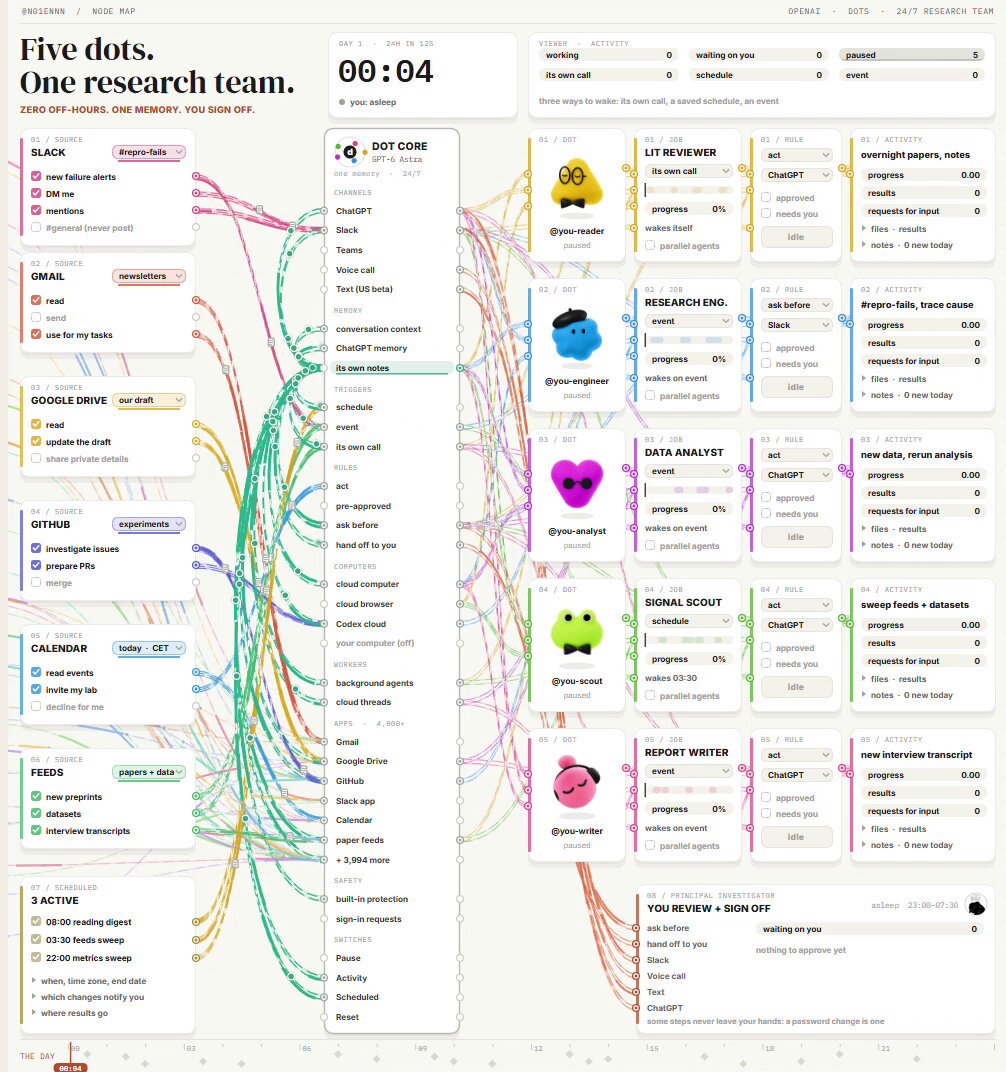
Drawing on real-world practices shared by OpenAI engineers, AI creator @N01ennn on X has outlined a practical workflow for configuring a 24/7 automated research team powered by OpenAI Dots, the always-on agent platform.
Image source: @N01ennn on X
The core architecture delegates continuous background research tasks—including reviewing preprints, diagnosing failed experiment reproductions, updating data visualizations, and drafting weekly reports—across five specialized agent roles, while enforcing strict permission ladders so that no code merges or external communications occur without explicit human sign-off.
Five Specialized Agent Roles for 24/7 Research Operations
Rather than assigning broad, undefined tasks to a single agent, this workflow splits continuous operations across five discrete seats, each equipped with dedicated triggers and clear boundaries:
- Literature Reviewer (
you-reader): Regularly scans and reads overnight preprints and newly published papers. It automatically flags any novel findings or theoretical claims that conflict with or reinforce the researcher's active draft manuscripts. - Research Engineer (
you-engineer): Monitors overnight experiment runs for reproduction failures. When a failure occurs, it traces the error logs, runs isolated fixes in the Codex cloud environment, and prepares a draft Pull Request complete with test verification results. - Data Analyst (
you-analyst): Triggers whenever fresh datasets or experimental metrics arrive. It reruns the analysis pipeline, updates chart figures, and highlights anomalies or surprising trends (such as unexpected distributions in Figure 3) for morning inspection. - Signal Scout (
you-scout): Sweeps relevant research feeds, repositories, and benchmark datasets, comparing them against prior literature and surfacing actionable proposals on whether a new follow-up experiment is warranted. - Report Writer (
you-writer): Consolidates meeting transcripts, interview recordings, and rough laboratory notes into weekly executive summaries matching the researcher's authentic voice, continuously refining its phrasing based on iterative edits.
The 4-Tier Permission Ladder and Unified Memory Architecture
To ensure autonomous background agents operate safely without risking unauthorized codebase mutations or hallucinated disclosures, the system integrates a unified context layer with granular execution boundaries:
- Unified Memory Backbone: Maintains a single persistent context layer across ChatGPT, Slack, Microsoft Teams, voice calls, and text channels, ensuring all five roles operate with synchronized research awareness.
- Flexible Wake Mechanisms: Agents wake autonomously via self-calls, scheduled cron jobs, or reactive event hooks triggered by new data or failed build pipelines.
- 4-Tier Permission Ladder:
- Act: Directly executes zero-side-effect actions such as read-only searches, data collection, and local mathematical computations.
- Pre-approved: Executes routine low-risk actions strictly confined within predefined boundary rules.
- Ask before: Requires explicit human confirmation prior to initiating any state-altering operations.
- Hand off: Surfaces complex edge cases, sensitive evaluations, or high-ambiguity dilemmas directly to the human researcher with fully compiled context.
- Locked Sign-Off Desk: A draft PR generated by the research engineer agent at 5:00 AM sits safely in a pending review queue until the researcher signs off at 9:00 AM. Nothing merges and nothing publishes without direct human authorization.
Original source
- @N01ennn on X: 5 Dots agents research team workflow