OpenAI's $20 Billion Revenue Gap Explained: Cloud Partner Accounting, Not Fundamental Decline
The $20 billion gap between OpenAI's reported $70 billion ARR and its actual $50 billion investor briefing figure stems from differing cloud partner revenue acc
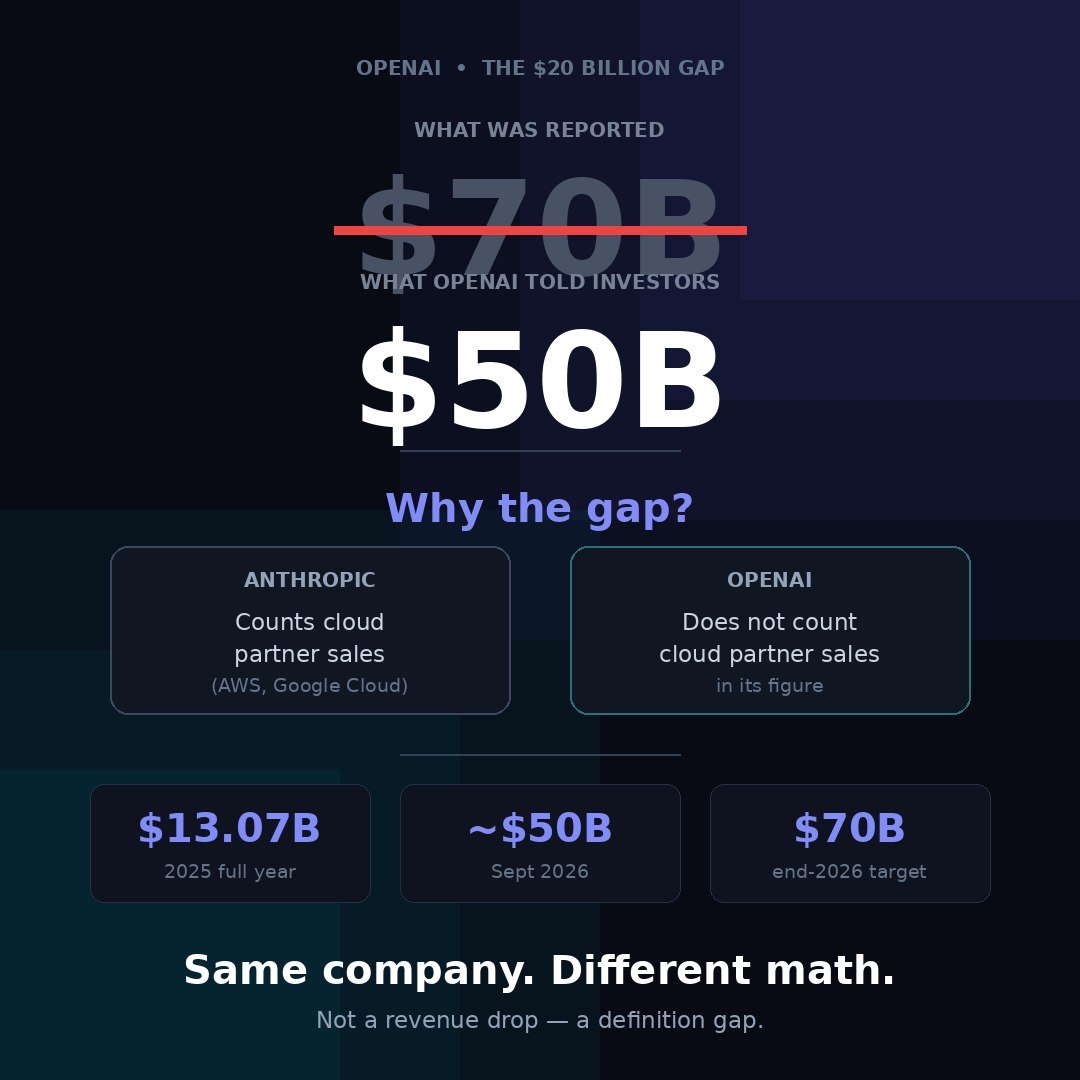
A widely circulated $20 billion gap between media reports claiming OpenAI had reached $70 billion in annualized run-rate (ARR) and internal investor disclosures citing roughly $50 billion has sparked intense market discussion. According to investor briefing details and social market analysis shared on October 13, 2026, the variance does not reflect operational deterioration or fundamental revenue loss, but rather a discrepancy in how cloud partner sales are counted compared to competitor Anthropic.
Image source: @not_4n_ai on X
The $20B Discrepancy: $70B Media Reports vs $50B Investor Briefings
In September 2026, widespread media coverage reported that OpenAI's annualized revenue had hit the milestone of $70 billion. However, recent investor communications from OpenAI clarified that the actual annualized figure stood closer to $50 billion.
The emergence of a $20 billion spread between published estimates and actual disclosures triggered immediate volatility, with the Nasdaq dropping more than 300 points amid investor panic. Observers initially questioned whether OpenAI was facing an abrupt deceleration or customer attrition, but the underlying numbers point to an accounting discrepancy rather than financial distress.
Accounting Methodologies: Anthropic Cloud Partners vs OpenAI Direct Sales
The primary source of the $20 billion divergence lies in differing reporting standards across frontier AI labs.
- Anthropic's Accounting Standard: Anthropic includes distribution revenue generated through cloud partners, specifically Amazon Web Services (AWS) and Google Cloud, alongside its direct customer sales.
- OpenAI's Internal Baseline: OpenAI's direct disclosure figures, by contrast, focus solely on its own direct revenue streams, without including indirect cloud partner sales channels.
Investors adjusted OpenAI's raw revenue figures to mirror Anthropic's inclusive accounting methodology and reported those adjusted estimates as fact, creating the apparent $20 billion gap and subsequent market confusion.
From $13.07B in 2025 to ~$50B in September 2026: A ~4x Growth Trajectory
The verified disclosures shared with investors indicate that OpenAI's operational growth remains on a steep trajectory.
- Full-Year 2025 Revenue: $13.07 billion
- September 2026 Annualized Revenue: ~$50 billion (direct run-rate)
- Year-End 2026 Target: $70 billion
Expanding from $13.07 billion in full-year 2025 to roughly $50 billion annualized in September 2026 represents approximately 4x growth in a year. The widely publicized $70 billion figure reflected investor adjustments matching Anthropic's methodology as well as OpenAI's target for the end of 2026, rather than an achieved real-time direct revenue milestone.
Caveats and Private Market Accounting Nuances
The market reaction highlights the risks of interpreting unaudited metrics from private artificial intelligence leaders.
- Unaudited Private Market Disclosures: These figures reflect investor briefings and analysis shared by @not_4n_ai on X rather than officially audited financial statements.
- Cloud Distribution Recognition Variance: Gross versus net revenue recognition across cloud partnerships such as AWS and Google Cloud can lead to substantial interpretation differences when making direct cross-company comparisons.
Market panic surrounding the $20 billion variance was driven by misaligned external estimates rather than a deterioration in OpenAI's core commercial performance.
Sources
- Not An AI (@not_4n_ai on X): OpenAI Revenue and ARR Discrepancy Breakdown (2026-10-13)