OpenBMB Unveils MiniCPM-V 4.7: On-Device MLLM Running in 3GB Memory
OpenBMB has officially released MiniCPM-V 4.7, an open-source multimodal model series featuring Lookahead Expert Scheduling (LES). The 35B-A3B model delivers on
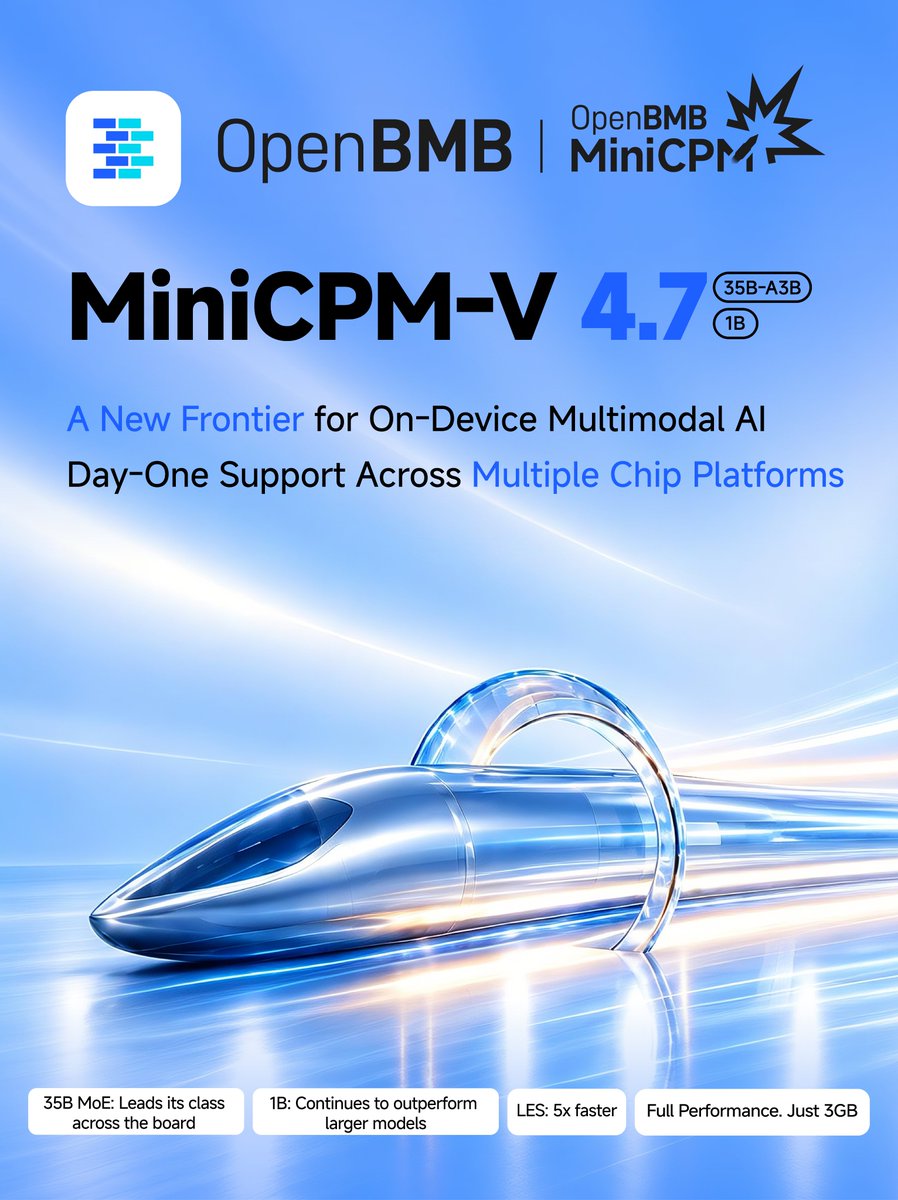
On October 12, 2026 (UTC), open-source AI research team OpenBMB officially announced the release of MiniCPM-V 4.7, a new on-device multimodal large language model (MLLM) series engineered for mobile, PC, and edge devices, publishing full model weights across its official X handle (@OpenBMB) and open-source repositories.
Image source: @OpenBMB via X
The MiniCPM-V 4.7 release targets a critical frontier in local AI deployment: running powerful Mixture-of-Experts (MoE) architectures on resource-constrained consumer devices without sacrificing speed or reasoning precision. The lineup introduces two models—the flagship 'MiniCPM-V 4.7 35B-A3B' and the lightweight 'MiniCPM-V 4.7 1B'—powered by a new storage prefetching technique and high-ratio visual token compression.
Lookahead Expert Scheduling (LES): Accelerating MoE Offloading in 3GB Memory
Running a 35B MoE architecture locally on edge hardware has historically been constrained by limited unified RAM. While offloading inactive expert weights to flash storage (SSD) reduces memory consumption, loading those weights on demand typically stalls token generation, creating severe latency bottlenecks.
MiniCPM-V 4.7 tackles this challenge with Lookahead Expert Scheduling (LES), a coordination layer that synchronizes storage I/O and neural compute:
- Cross-Layer Routing Prediction: LES forecasts which experts the subsequent network layer will require and asynchronously preloads them from flash storage in parallel with ongoing layer computation.
- Compute Scheduling Prioritization: The engine prioritizes computations for experts that are already resident in RAM, processing their activations while pending experts transfer in the background to eliminate processor stalls.
- Mathematically Lossless Inference: Predictions guide preloading and scheduling order only; actual token computation is strictly governed by the model's original token-level router. This design guarantees byte-for-byte identical outputs compared to uncompressed execution, requiring no additional fine-tuning or retraining.
- Storage-Layout Optimization: Layer-wise mixed-precision quantization combined with contiguous expert weight memory layouts minimizes fragmented flash reads and maximizes sequential NVMe throughput.
With LES enabled, MiniCPM-V 4.7 35B-A3B operates within a compact 3GB runtime memory footprint while achieving a 5× speedup on an iPad Pro M4 (16GB), generating over 17 tokens per second (17+ tokens/s), and delivering over 13 tokens per second (13+ tokens/s) on an iPhone 17 Pro Max.
Model Lineup: 35B-A3B Capabilities and 16× Hybrid Visual Compression
The MiniCPM-V 4.7 series provides two targeted tiers tailored to different deployment footprints:
1. MiniCPM-V 4.7 35B-A3B
The flagship on-device model demonstrates competitive results across 34 benchmarks evaluating multimodal comprehension, STEM reasoning, OCR, and long-video analysis. To handle high-resolution visual inputs efficiently, it incorporates 4× and 16× hybrid visual token compression. Even under aggressive 16× compression, the 35B-A3B model scores 90.4 on OCRBench, outperforming Qwen3.6 35B-A3B by 5.2 points.
2. MiniCPM-V 4.7 1B
Engineered for ultra-low-power edge systems and rapid mobile deployment, the 1B variant provides lightweight multimodal processing for scenarios where memory and compute budgets are strictly constrained.
Self-Replay Fine-Tuning and Cross-Platform Deployment Ecosystem
To address capability degradation during downstream adaptation—where fine-tuning on domain-specific data often erodes a model's broad general intelligence—OpenBMB introduced Self-Replay Fine-Tuning. This technique enables targeted low-cost customization while preserving general reasoning and multimodal performance.
The release also features extensive cross-platform compatibility out of the box:
- Hardware Adaptation: Offers Day-0 support for Apple Silicon, Intel, AMD, Arm, and Rockchip platforms, with additional support for Chinese domestic platforms (including Huawei, Hygon, Moore Threads, and Kunlunxin) via FlagOS.
- Inference Engines: Supported across SGLang, vLLM, llama.cpp, mlx-vlm, and Ollama.
- Quantization and Fine-Tuning Tooling: Compatible with GGUF, BNB, AWQ, GPTQ, and FP8 quantization formats, alongside training support through SWIFT and LLaMA-Factory.
- Repositories and Demos: Weights are available on GitHub, Hugging Face, and ModelScope, accompanied by interactive web demos and dedicated mobile applications.
Practical Considerations: Flash Storage Bandwidth and Real-World Evaluation
While the ability of MiniCPM-V 4.7 35B-A3B to operate within 3GB of RAM marks a significant milestone for mobile multimodal AI, practical deployments must account for underlying hardware dependencies.
First, achieving high-throughput inference within 3GB of RAM depends heavily on continuous flash storage offloading and asynchronous prefetching. On consumer hardware with lower sequential SSD read speeds or under concurrent background storage I/O workloads, actual token throughput may diverge from headline benchmark figures.
Second, detailed benchmark figures for the 1B model were abbreviated in the initial release announcement thread. Developers deploying the ultra-compact variant will want to examine follow-up technical documentation and independent community benchmarks to gauge its accuracy on specialized vision tasks.
Sources
- OpenBMB Official X (@OpenBMB): MiniCPM-V 4.7 Release Announcement
- OpenBMB GitHub Repository: OpenBMB/MiniCPM-V
- OpenBMB Hugging Face: OpenBMB Model Collection