Exploring NVIDIA Auto Ontology: A Semantic Framework for AI Agent Data Reasoning
An overview of NVIDIA Auto Ontology, an open-source Python framework that builds business ontologies from enterprise metadata, validates generated text-to-SQL q
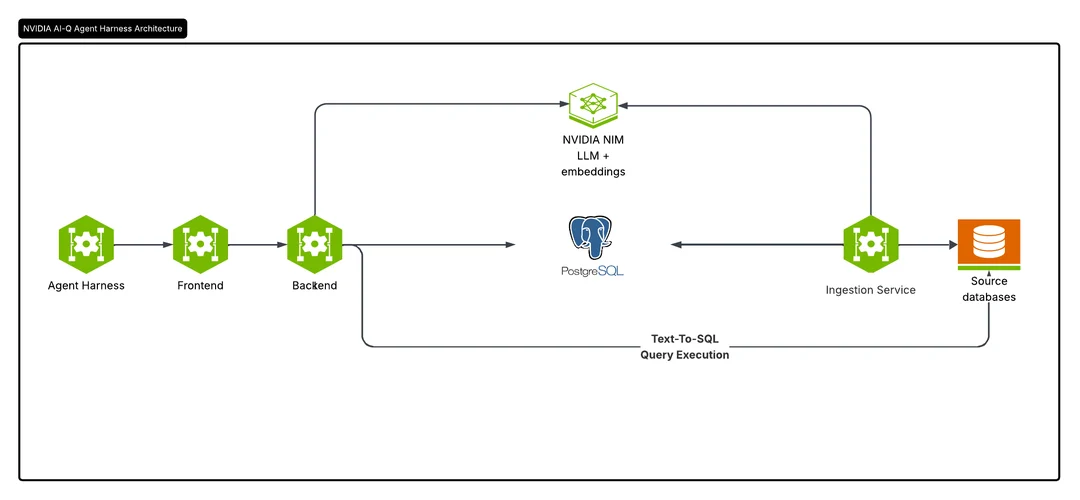
Maintained as an open-source project by NVIDIA, Auto Ontology is a Python-based framework designed to establish semantic, graph-based reasoning layers over structured enterprise data. Created in April 2026 and updated since, the library provides LLM agents querying relational databases with a context layer for business meaning, certified definitions, and data lineage.
Image source: https://github.com/NVIDIA/auto-ontology
Reliability remains a key challenge for agentic analytics and Text-to-SQL tasks. When disparate enterprise databases define revenue, customers, or transactions differently, an agent-generated SQL query may be syntactically valid yet business-critical figures remain flawed. NVIDIA Auto Ontology reconciles definitions across sources and serves governed context directly to agent harnesses through MCP, CLI, and API.
Automated Enterprise Ontology Generation and Query Verification
Auto Ontology presents five core capabilities: Discover, Ground, Validate, Expose, and Learn.
- Discover and Ground: Generates enterprise ontologies from metadata, connects existing ontologies and semantic models, builds AI-ready knowledge graphs, and reconciles inconsistent definitions across systems.
- Query Validation and Provenance: Cross-checks agent-generated SQL queries against certified definitions and data lineage, returning the SQL and processing steps along with the answer.
- Unanswerable Query Detection: When confronted with questions outside database coverage—such as asking for return on ad spend against a sales database lacking marketing cost tables—the framework calculates coverage metrics and prompts the user for clarification instead of guessing.
- Continuous Learning: Certified corrections and usage are folded back into the ontology so the shared context improves with each question.
Full-Stack Architecture and NVIDIA NIM Inference Triplet
Auto Ontology is packaged as a multi-service stack with a web user interface and ingestion worker, deployable through Docker Compose or a Kubernetes Helm chart.
- Frontend (Port 3000): Built on Next.js 16 (React 19, TypeScript, and Tailwind CSS 4), integrating Better Auth for authentication and RBAC, alongside Prisma.
- Backend API (Port 3001): Combines FastAPI (Python 3.12+) and LangChain to power interactive chat, NL-to-SQL translation, catalog management, and data source connectivity.
- Ingestion Worker (Port 3002): A standalone FastAPI service that ingests tabular data and writes vector embeddings.
- Postgres with pgvector (Port 5432): Houses application metadata, catalog definitions, the compiled business ontology, and vector embeddings within a unified storage layer. HashiCorp Vault can optionally be integrated for secure credential storage.
For model inference, Auto Ontology integrates with NVIDIA NIM endpoints, supporting both the hosted NVIDIA API catalog (integrate.api.nvidia.com) and self-hosted NIM instances. Default configurations include:
- Primary Reasoning & Chat (LLM):
nvidia/nemotron-3.5-lightning-30b-a3b - Text Embeddings:
nvidia/nemotron-3-embed-1b - Retrieval Reranking:
nvidia/llama-nemotron-rerank-vl-1b-v2
Model configurations use a structured triplet pattern (<PREFIX>_ENDPOINT, <PREFIX>_API_KEY, and <PREFIX>_MODEL), allowing granular overrides for reasoning, extraction, embedding, and reranking roles while falling back to shared DEFAULT_MODELS_* values.
Quickstart Deployment and Licensing Guidelines
Local evaluation can be set up using Docker Compose v2 and uv alongside Microsoft's Wide World Importers sample sales database.
- Repository Setup and Configuration: Clone the repository, copy
.env.exampleto.env, and provide a valid NVIDIA API key (DEFAULT_MODELS_API_KEY), database passwords, and an application authentication secret. - Database Initialization: Launch the Postgres container via Docker Compose and execute the seed script from the accompanying evaluation repository (
auto-ontology-eval) to populate the sample database. - Stack Deployment: Run
docker compose up -d --buildto build and start the frontend, backend, and ingestion worker containers, then navigate tohttp://localhost:3000. - Semantic Compilation: Access Settings to enable Semantic Compilation. Ingestion runs at startup, and the ontology is ready for natural-language queries when compilation reports Semantic compilation is ready.
Auto Ontology is distributed under the Apache License 2.0. The repository also states that it is currently not accepting external contributions.
Sources
- GitHub: NVIDIA/auto-ontology