LangChain Outlines Production Agent Infrastructure and SmithDB Architecture
LangChain leadership delivered a 43-minute technical talk detailing the Deep Agents harness, live-announced LangSmith Sandboxes, and the SmithDB storage engine.
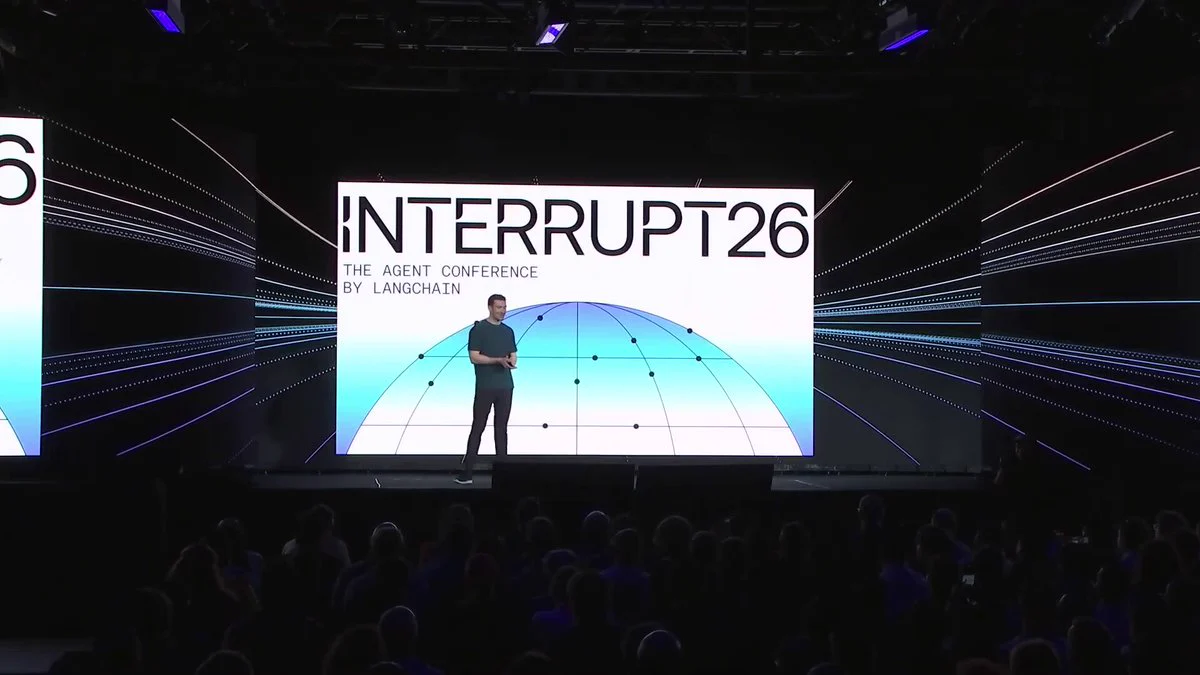
LangChain's CEO and CTO took the stage for a comprehensive 43-minute presentation detailing the execution harness, development lifecycle, and infrastructure foundation required for AI agents to reliably survive in production. The session contrasted traditional software engineering with agent orchestration and examined the runtime and data tiers behind modern autonomous systems.
Image source: slash1sol on X (@slash1sol)
The presentation directly addresses engineering teams and platform architects scaling autonomous agents beyond simple single-turn prompts into mission-critical production pipelines. As agent loops execute longer and integrate more tools, managing trace payloads and execution safety becomes a core infrastructure challenge.
Deep Agents Harness and LangSmith Sandboxes
The first core pillar covers the execution harness layer dubbed 'Deep Agents', alongside the live announcement of 'LangSmith Sandboxes'.
The speakers explained that building production agents diverges fundamentally from writing standard software due to non-deterministic execution paths, volatile state transitions, and long-running context loops. Deep Agents serves as the harness governing these execution boundaries.
- Isolated Execution: LangSmith Sandboxes provides secure, isolated runtime environments for agents executing code and handling external tooling.
- Defined Agent Lifecycle: The session formalized the operational lifecycle spanning prototyping, offline evaluation, guardrailed execution, and production monitoring.
The harness forms the initial tier of LangChain's three-layer agent infrastructure, establishing predictable bounds for autonomous reasoning and tool use.
SmithDB Architecture for Expanding Trace Payloads
A significant technical hurdle highlighted in the session is the continuous expansion of agent trace payloads. Multi-step reasoning chains, multimodal contexts, and verbose tool outputs quickly overwhelm generic logging backends.
To address this volume, LangChain outlined the architecture of 'SmithDB', an internal data layer purpose-built for high-volume agent trace ingestion and inspection. SmithDB optimizes state serialization and indexing so engineering teams can inspect complex multi-turn execution traces without incurring prohibitive storage latencies.
The presentation also showcased enterprise implementations, detailing how companies such as Clay and Vanta run their production agent workflows on top of the SmithDB engine.
Operational Considerations and Verification
This breakdown reflects the verified topics and technical roadmap shared during the 43-minute technical stage talk. Specific deployment timelines for LangSmith Sandboxes, full public availability, and standalone performance benchmarks for SmithDB remain subject to upcoming documentation updates. Teams planning adoption should evaluate current trace instrumentation pipelines against the proposed architecture.
Sources
- slash1sol on X: LangChain CEO/CTO Production Agent Infrastructure Session