Meta Announces Global AI Developer Hackathon with $1M Prize Pool and $150 in Free Model API Credits
Meta Superintelligence Labs has unveiled a 10-day virtual AI hackathon open worldwide. Featuring a $1M cash prize pool and free entry, every participant receive
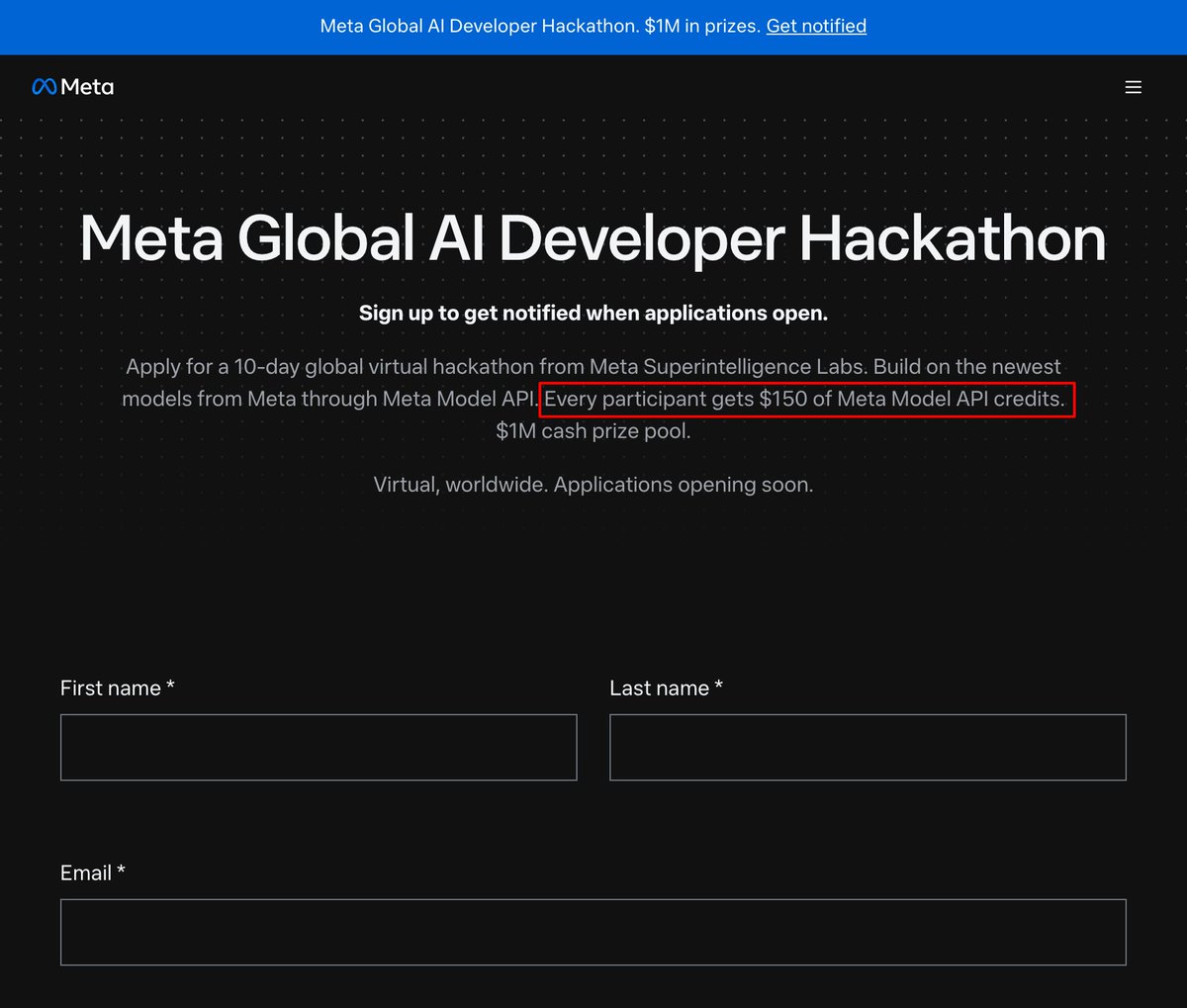
On October 2, 2026, Meta Superintelligence Labs officially announced the Meta Global AI Developer Hackathon, a 10-day virtual competition open to builders worldwide. With free registration, the event features a $1 million cash prize pool divided across two competitive tracks—Indie Developers and Startup Teams—alongside hands-on technical workshops conducted directly by Meta researchers and engineers.
Image source: @StudentOffersHQ / Meta
The hackathon is designed to encourage developers to build production workflows using Meta Model API, the company's first-party cloud infrastructure, and its latest Muse reasoning model series. Over the course of the 10-day event, participants will have access to technical guidance from Meta's core AI teams while competing for substantial funding to launch or scale their projects.
A $1M Cash Prize Pool and $150 in Universal Model API Credits
The centerpiece developer incentive for the hackathon is a universal allocation of $150 in Meta Model API credits granted to every registered participant.
- Worldwide Virtual Participation Across Two Tracks: Open to developers globally with zero entry fees. Projects will be evaluated under two distinct tracks: an Indie Developers track for solo builders and small experimental projects, and a Startup Teams track for commercial, scalable applications.
- $1 Million Cash Prize Pool: Winning projects across both tracks will share a total of $1,000,000 in non-dilutive cash prizes.
- Immediate $150 API Allocation: All confirmed participants receive $150 in direct Meta Model API credits, allowing teams to prototype, benchmark, and deploy without upfront infrastructure costs.
The Meta Model API Lineup: From Muse Spark 1.3 to SAM 3.1
The allocated $150 credit pool grants access to Meta's full suite of foundation models. Meta Model API provides out-of-the-box compatibility with both the OpenAI SDK (Chat Completions and stateful Responses API) and Anthropic SDK (Messages format), ensuring seamless drop-in integration with existing agent harnesses and client tools.
- Muse Spark 1.3 (Standard Tier): Meta's flagship reasoning model engineered for long-horizon agentic workflows and complex coding tasks, featuring a 1-million-token context window. Priced at $1.25 per 1M input tokens and $4.25 per 1M output tokens, a $150 credit yields approximately 35 million output tokens under standard rate limits (3,000 RPM and 4,000,000 TPM).
- Muse Spark 1.3 Contributor Tier (Discounted Tier): A cost-efficient tier offering steep discounts in exchange for allowing prompts and completions to be used in training future Meta models. Billed at $0.10 input and $0.20 output per 1M tokens, the $150 credit enables roughly 750 million output tokens for high-volume experimentation (rate limits: 100 RPM and 3,000,000 TPM).
- Multimodal and Vision Suite: The catalog also includes Muse Image for image generation, Muse Voice Transcribe (billed per minute of processed audio), and Segment Anything Model 3.1 (SAM 3.1) for zero-shot object segmentation across images and video frames.
Registration Roadmap and Developer Considerations
Pre-registration is currently live on Meta's developer portal (dev.meta.ai), where builders can sign up to receive notifications when formal applications open.
Key considerations for participating teams include:
- Data Governance on Model Tiers: While the Contributor tier dramatically reduces token burn, it shares prompt and generation data with Meta for model training. Projects handling proprietary IP, enterprise workflows, or confidential data should utilize the Standard tier instead.
- Regional Endpoint Availability: While the hackathon is a global virtual event, local developers should verify their network connectivity and endpoint access against regional compliance policies ahead of project kickoff.
Sources
- Meta Official Hackathon Portal: Win $1M: Meta Global AI Developer Hackathon
- Meta Horizon OS Developers Blog: Meta Connect Recap: Models, Tooling, and Global AI Developer Hackathon
- Meta Model API Documentation: Pricing and Rate Limits - Meta Model API
- Student Offers on X (@StudentOffersHQ): Meta Global AI Hackathon Announcement & Credit Details