Meituan Releases LongCat-2.5, a 1.6 Trillion-Parameter Multimodal AI Model for Agents
Chinese tech company Meituan has launched LongCat-2.5, a native multimodal Mixture-of-Experts model with 1.6 trillion total parameters and roughly 48 billion ac
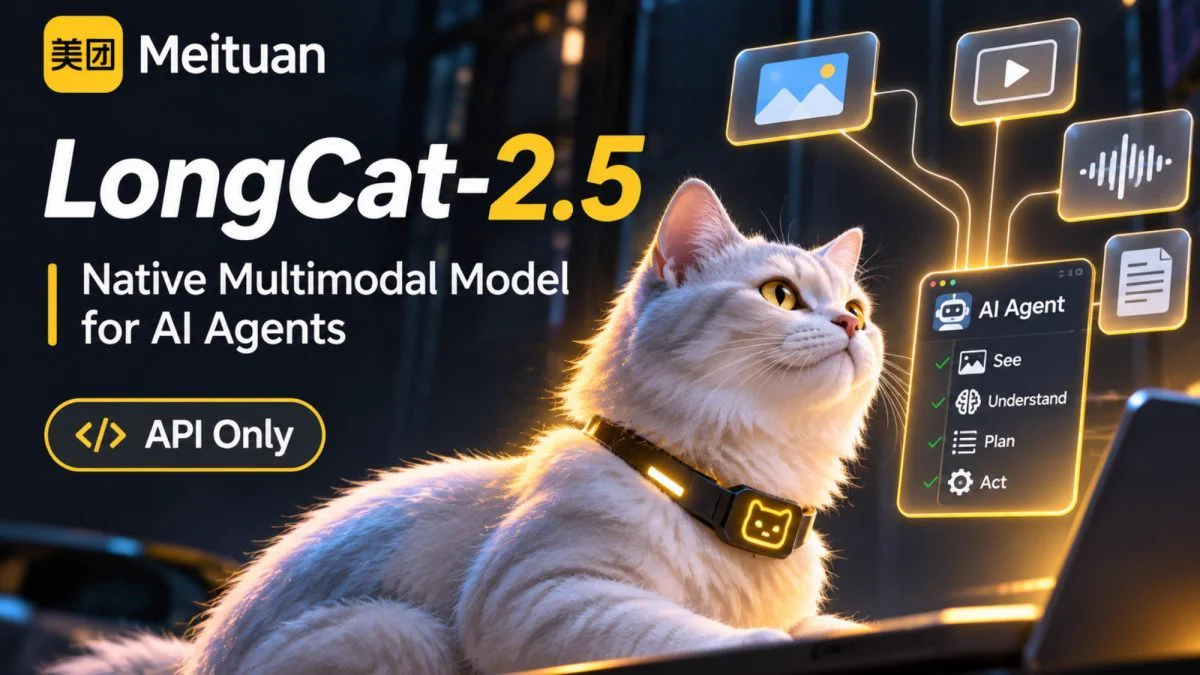
On November 2, 2026, Chinese technology company Meituan's LongCat AI team introduced LongCat-2.5, a native multimodal artificial intelligence model built for complex, multi-step AI agent workflows. The model contains approximately 1.6 trillion total parameters while activating around 48 billion parameters per token during inference through a Mixture-of-Experts (MoE) architecture. Whereas its predecessor, LongCat-2.0—released in June 2026—centered on large-scale language tasks and agentic coding, LongCat-2.5 integrates native visual understanding alongside extended planning and execution capabilities.
Image source: https://lapaasvoice.com/meituan-releases-longcat-2-5-a-1-6-trillion-parameter-multimodal-ai-model-for-agents/
Native Multimodal Architecture and Failure-Driven Reinforcement Learning
Rather than bolting a separate vision encoder onto a text backbone, LongCat-2.5 uses a unified token-based architecture that represents visual inputs as multi-level discrete tokens. Processing images and text within the same token stream allows the model to connect visual context directly with instructions and multi-step reasoning. Meituan highlights four primary application areas enabled by this design: visual coding to generate websites and user interfaces from visual requirements, creative interactive design, 3D development, and visual reasoning. As demonstrations, the company showcased interactive fluid simulations, 3D digital exhibitions, and miniature city environments built as functional outputs rather than static descriptions.
To handle long-horizon engineering tasks—such as navigating an existing codebase, diagnosing bugs, and editing multiple files—Meituan scaled its reinforcement learning (RL) pipeline across data synthesis, environment construction, and multi-framework agent training. A notable mechanism in this pipeline converts failed real-world agent attempts into reproducible training examples paired with verifiable tests, enabling the model to learn directly from execution errors instead of relying solely on successful demonstrations. For developer integration, LongCat-2.5 supports established agent harnesses including Claude Code, Codex, and Hermes, allowing teams to test the model inside existing coding workflows.
Domestic Infrastructure Optimization and W4A4 Quantized Inference
Meituan stated that LongCat-2.5 was trained entirely on domestic computing infrastructure in China to reduce reliance on foreign AI hardware. During its mid-training phase, the team trained on sequences of up to one million tokens, which places heavy strain on device memory and inter-chip communication. By optimizing memory utilization, accelerator communication, and parallel processing, Meituan reported in its technical documentation an 86% increase in per-device throughput over a Distributed Data Parallel (DDP) baseline on tested long-sequence supervised fine-tuning workloads.
For inference, Meituan adopted W4A4 quantization, compressing both model weights and activations to 4-bit precision to cut computational overhead. In the company's internal online benchmarks against a W8A8 (INT8) baseline, LongCat-2.5 showed roughly 40% gains in both input processing throughput and token generation throughput, an approximately 16% reduction in time to first token, and about a 20% reduction in subsequent token generation latency. All training throughput and inference speed figures come from Meituan's own testing and have not yet been independently verified.
Commercial Deployment and Open-Weight Roadmap
Beyond external developer access, LongCat-2.5 ties directly into Meituan's core food delivery and local-services operations in China. The company deploys the LongCat model family inside Miaoshou, an AI-powered business operations workspace that helps merchants analyze performance, diagnose operational bottlenecks, and execute tasks across authorized systems. According to Meituan, brands including Guming, Xushengji, and Yihe Tang already use Miaoshou for store management, business analytics, and customer acquisition, giving Meituan an internal production testbed alongside its public API.
Developers can currently access LongCat-2.5 through Meituan's API service, while general users can try it on the LongCat website. However, this launch is API- and web-only: downloadable model weights have not been released, though Meituan stated that GitHub and Hugging Face releases are expected to follow. Independent evaluations on sustained coding and multimodal benchmarks, along with API pricing details and the timing of the promised open-weight release, remain the key milestones to watch.