A Solution for Hallucination-Free Local MCP Agents: System 1 Agents and Inkling 2 Mini Quantization Guide
Achieving 0% value fabrication by abandoning free text generation in favor of deterministic compilers and multiple-choice selection, paired with H100 benchmarks
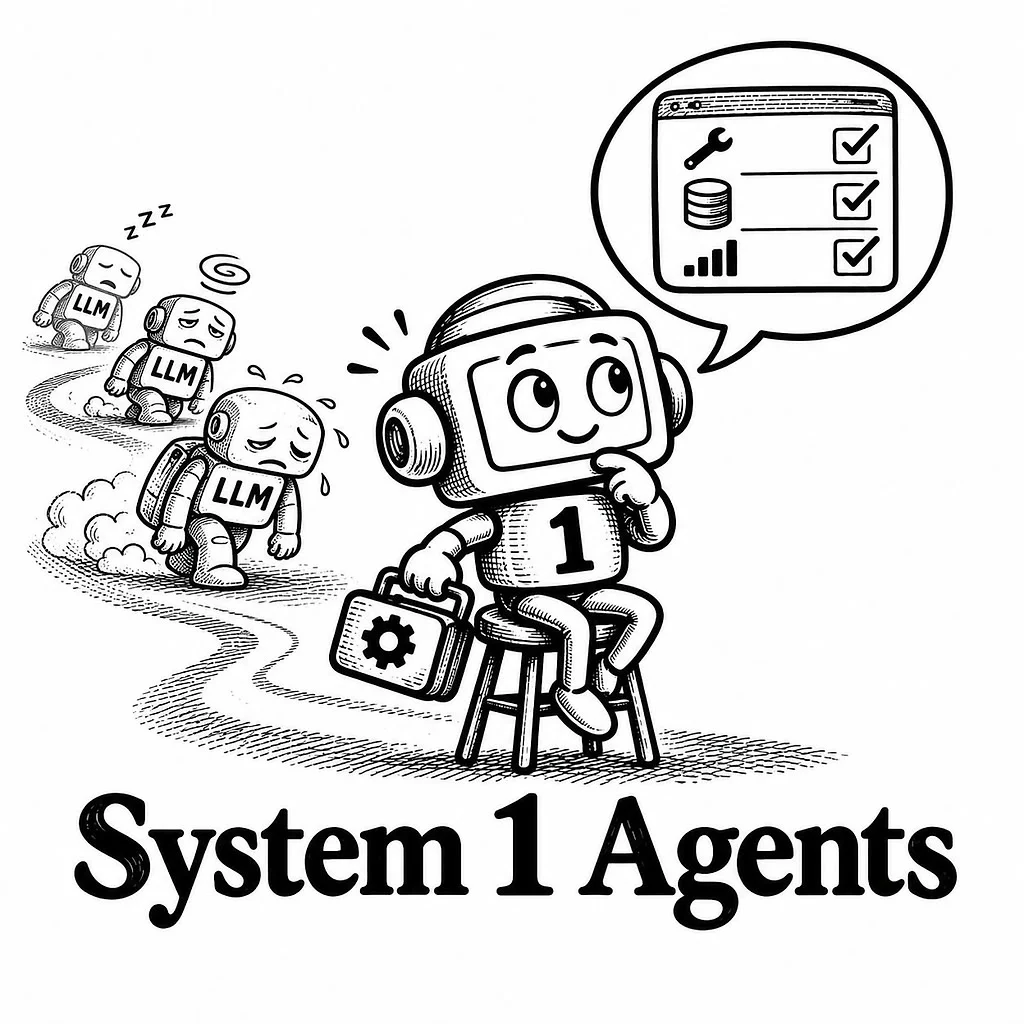
On November 21, 2026, the Hugging Face community introduced a novel architectural approach designed to structurally eliminate hallucinations—the tendency of language models to generate plausible yet false information—in Large Language Model (LLM) agents. The introduction of the local 'System 1' agent, designated as eltzanis/SystemOneAgents, along with hardware benchmark results for the lightweight language model 'Inkling 2 Mini', has drawn significant attention from the developer community.
Image source: https://discuss.huggingface.co/t/system-1-agents-a-method-for-local-reliable-and-fast-agentic-ai/192267
The newly released research and empirical data address the core unreliability of AI agents when invoking external tools or APIs (Application Programming Interfaces). Instead of relying on free-form text generation, this approach entirely discards open text generation in favor of a deterministic compiler combined with a multiple-choice selection mechanism. This development offers a practical solution to overcome the reliability bottlenecks that have historically hindered agents in production environments.
System 1 Agents and MCP Tool Invocation Without Text Generation
Traditional AI agents rely on the model itself to parse user intent and generate both natural language text and tool invocation commands simultaneously. This process frequently introduces parameter drift, formatting errors, or outright hallucinations where non-existent arguments are invented. In contrast, the newly unveiled System 1 agent does not generate a single character of free-form natural language text during tool execution.
Instead, the model operates exclusively within a multiple-choice selection interface coupled with a deterministic compiler based on pre-defined rules. Here, MCP (Model Context Protocol) serves as an open, standardized protocol that enables AI models to interact securely with external data sources and developer tools. Because the agent selects precise argument combinations from permitted choices rather than constructing free-form text strings, grammatical errors and arbitrary parameter tampering are structurally prevented.
Achieving 0% Value Fabrication Across 10,888 Invocations
This architectural shift is backed by compelling benchmark metrics. According to the published validation results, across a rigorous test run of 10,888 tool invocations, the system achieved a remarkable 0% parameter value fabrication rate.
Furthermore, the overall tool selection accuracy reached 97.0%. This demonstrates that the unpredictable malfunctions—which previously prevented probabilistic text-generation agents from meeting strict enterprise requirements—can be systematically eliminated. Developers can now integrate agents into automated pipelines with confidence, knowing they will not return corrupted data or pass unauthorized arguments to underlying systems.
Inkling 2 Mini GGUF Dynamic Quantization and H100 Benchmarks
To maximize execution efficiency, the benchmark report also detailed the quantization performance of the 'Inkling 2 Mini' model. Quantization is a technique that reduces the precision of a large language model's weights, significantly shrinking its memory footprint while accelerating inference speed and hardware efficiency. Built in the GGUF format (a unified file format designed for efficient local LLM execution across CPU and GPU architectures), Inkling 2 Mini was tested across seven dynamic quantization variants ranging from 6.88GB to 27.74GB.
Conducted on NVIDIA H100 accelerators (high-performance graphics processing units optimized for large-scale deep learning training and high-speed inference), these empirical benchmarks establish clear performance baselines across various memory sizes and precision tiers. This data serves as vital reference material for engineering teams exploring secure, high-speed on-premise agent deployments.
Practical Implications and Considerations
The release of the System 1 agent framework and the Inkling 2 Mini quantization guide establishes a new paradigm for enhancing AI agent reliability. By eliminating arbitrary text generation in favor of deterministic compiler controls, this methodology clears a viable path for deploying AI agents safely into mission-critical workflows where system failures carry severe consequences.
Nevertheless, performance metrics and resource utilization will vary depending on hardware configurations, specific prompt setups, and the complexity of the invoked MCP tools. Engineering teams planning production adoption should conduct thorough pre-benchmarking and validation within their own infrastructure environments.
Sources
- Hugging Face Discussions: System 1 Agents: A method for local, reliable, and fast agentic AI