Local LLM Serving on a Single GPU: Benchmarking vLLM vs. llama.cpp Under 32 Concurrent Requests
A benchmark comparing vLLM and llama.cpp serving Qwen3.5 models on an RTX 3090 24GB single GPU, evaluating 32 concurrent requests, VRAM usage, startup overhead,
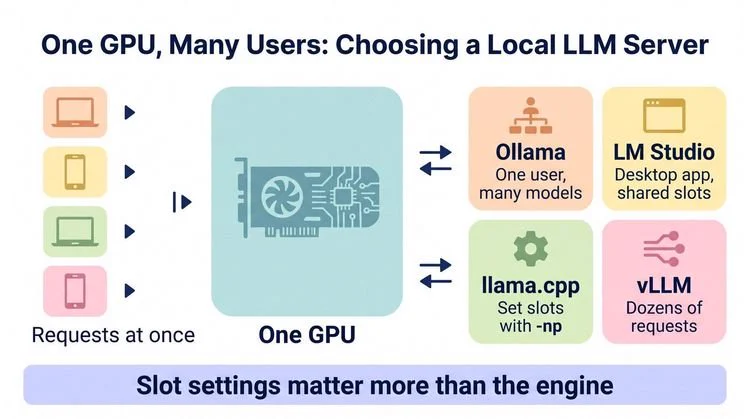
As research laboratories and independent developers increasingly build local infrastructure to run advanced artificial intelligence models on-premise, optimizing hardware utilization has become a primary focus. When multiple users or autonomous AI agents simultaneously send requests to a locally hosted language model, how efficiently the serving engine allocates hardware resources and maintains throughput directly dictates the user experience. A newly published benchmark directly compares vLLM and llama.cpp, two of the most prominent engines used for local large language model (LLM) serving.
Image source: https://tooltechblog.com/serving-a-local-llm-to-several-users-ollama-lm-studio-llama-cpp-and-vllm-benchmarked
The benchmark was conducted on a single consumer-grade high-end GPU setup: an NVIDIA GeForce RTX 3090 with 24GB of VRAM (Video RAM). Using Alibaba's recent open-source model lineup—specifically the Qwen3.5 9B and 27B models—the evaluation measured throughput, memory consumption, and execution behavior under a heavy load of 32 concurrent requests.
Throughput Under 32 Concurrent Requests: vLLM's 2.5x Advantage
In multi-user environments where multiple clients invoke the model simultaneously, token throughput (measured in tokens per second, or tok/s) serves as the definitive performance metric.
According to the benchmark results, under a concentrated load of 32 concurrent requests, vLLM achieved a processing speed of 1,730 tokens per second (1,730 tok/s). In contrast, llama.cpp recorded 679.4 tokens per second (679.4 tok/s). Numerically, vLLM delivered roughly 2.5 times the processing speed, demonstrating a clear performance edge in parallel multi-request scenarios.
The primary driver behind vLLM's superior throughput lies in its sophisticated memory management architecture, which minimizes memory waste through paging mechanisms and efficiently batches incoming requests. For environments where multiple clients connect concurrently and maintain distinct conversation contexts, vLLM's parallel processing efficiency proves invaluable.
The Resource Trade-Off: 92% VRAM Pre-emption and 173-Second Startup Overhead
However, vLLM's impressive performance comes with notable resource trade-offs that must be managed on a single-GPU setup.
During the benchmark, vLLM aggressively pre-empted 92% of the available VRAM upon initialization. In a single 24GB VRAM environment, dedicating the vast majority of memory strictly to model hosting and multi-request handling leaves very little headroom for running concurrent background tasks or hot-swapping larger model variants.
Furthermore, the initial cold start overhead cannot be ignored. vLLM required 173 seconds of initialization time to allocate memory pools and complete its internal optimizations upon startup. In development environments where servers are frequently restarted or rapid iterations are required, this startup delay can become an inconvenience. Conversely, llama.cpp starts up lightweight and maintains flexible memory control, resulting in a more manageable resource footprint.
Structural Improvements in llama.cpp: Fixing Qwen3+ Boundary Misinterpretations
While trailing in raw throughput, llama.cpp has significantly improved overall ecosystem stability through recent updates—most notably via the introduction of a token-level chat parser.
In legacy local serving environments, parsing prompt structures or conversation markers for specific large language models often led to misinterpretations of conversation boundaries (start and end markers). This caused models to occasionally lose context mid-generation or ignore system instructions.
By incorporating a rigorous token-level chat parser, llama.cpp successfully resolved the boundary misinterpretation issues previously observed during inference with the latest Qwen3+ model family. For single-user workflows, development agents, or scenarios prioritizing precise syntax parsing, lightweight resource utilization, and rapid startup times, llama.cpp remains a compelling and stable alternative.
Conclusion
This comparative benchmark highlights how crucial it is to match your serving engine to your specific deployment goals when building local single-GPU infrastructure. If your use case involves backend web services handling numerous concurrent client requests, vLLM's 2.5x throughput advantage easily justifies its heavier VRAM pre-emption and startup delay. On the other hand, if you require lightweight resource management, quick reboots, and precise structural parsing for single-agent tasks, llama.cpp stands out as the practical choice.