Kling 4.0 Video API Pricing Compared: Up to 2.8x Cost Difference Across Platforms for Identical 5-Second Clips
A benchmark of Kuaishou's Kling 4.0 video generation costs across platforms reveals that 5-second 1080p clips range from $1.00 on native subscriptions to $2.83
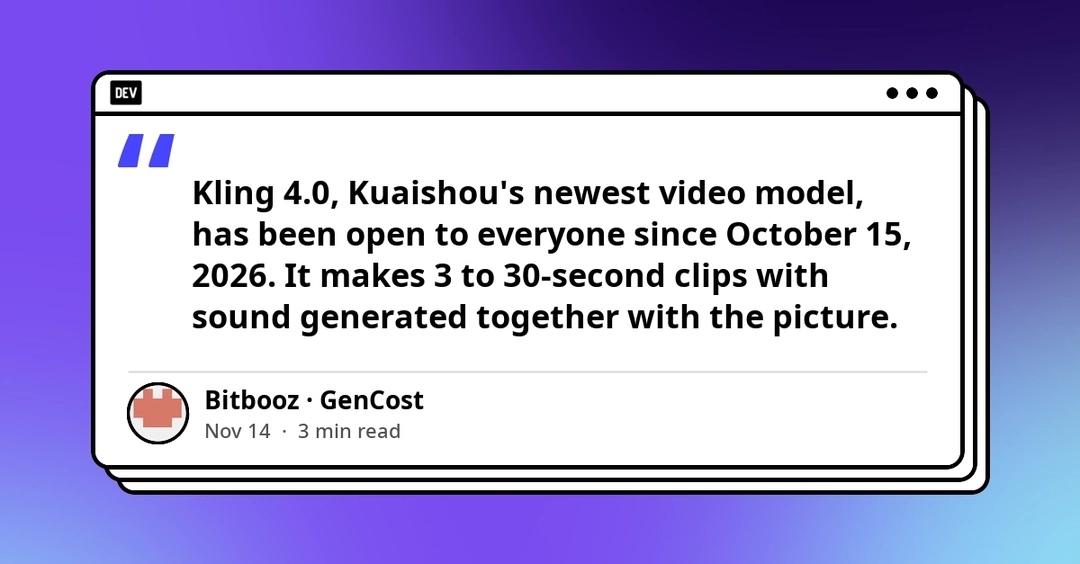
A benchmark across platforms running Kuaishou's flagship AI video generation model, Kling 4.0, reveals price gaps of up to 2.8 times for generating identical 5-second clips depending entirely on where users execute the request.
Image source: https://dev.to/bitbooz/where-is-kling-40-cheapest-every-platform-compared-prices-checked-nov-14-2026-o7a
According to tracking data published on November 14, 2026, by AI pricing monitor GenCost, producing a 5-second 1080p clip ranges from $1.00 to $2.83 across various native, SaaS, and pay-as-you-go providers. Kling 4.0 was released globally to the public on October 15, 2026, generating synchronized video and sound clips spanning 3 to 30 seconds in duration. Today, creators can access the model directly inside Kuaishou's native Kling application, via third-party creative software such as Runway, Luma, Pika, and Higgsfield, or through pay-per-second API providers like fal.ai and Segmind.
Standard Plan Costs: Native Kling vs. Third-Party SaaS
When comparing entry-level paid monthly plans, generating a 5-second 1080p clip with Kling 4.0 is cheapest inside Kling's own ecosystem. Under the Kling AI Standard tier ($8.80 per month, or $6.60 billed annually for 660 credits), the model consumes 15 credits per second for 1080p, bringing the cost of a 5-second clip to approximately $1.00 (or $0.67 for 720p at 10 credits per second). These consumption rates reflect measured app usage rather than figures explicitly published on Kling's marketing rate card.
When accessing Kling 4.0 through third-party video suites, markup overhead and differing credit structures increase the per-clip expense substantially:
- Runway Standard: Priced at $15 per month for 625 credits, Runway charges 118 credits for a 5-second 1080p Kling 4.0 generation, translating to roughly $2.83 per clip. This represents a 2.83x premium over Kling's native plan, making it the most expensive option among benchmarked tiers. A 720p option is not listed.
- Higgsfield Starter: At $19 monthly for 270 credits, a 5-second 1080p generation consumes 37.5 credits, working out to approximately $2.64 per clip ($1.76 for 720p at 25 credits).
- Pika Starter: At $10 per month for 600 credits, a 1080p 5-second clip costs 118 credits, equating to roughly $1.97.
- Elyum Plus: At $9 monthly for 900 credits, 5-second generations cost approximately $1.25 for 1080p (25 credits per second) and $0.85 for 720p (17 credits per second).
- Luma Plus: Priced at $30 per month for 10,000 credits, Luma charges 395 credits for 1080p (about $1.19 per 5 seconds) and 265 credits for 720p (about $0.80), marking it as the most economical third-party SaaS integration.
No-Subscription Pay-As-You-Go APIs: fal.ai and Segmind
For engineering teams and developers who prefer on-demand API endpoints over recurring platform subscriptions, dedicated cloud inference routers provide direct per-second billing.
fal.ai delivers the lowest entry point without an upfront monthly commitment. Charging $0.157 per second for 720p and $0.235 per second for 1080p, fal.ai produces a 5-second clip for approximately $0.79 at 720p and $1.18 at 1080p. This pricing allows developers to build production workflows close to Kling's native subscription unit economics without committing to fixed credit bundles.
Segmind offers a closely matched alternative, pricing 720p at $0.166 per second ($0.83 for 5 seconds) and 1080p at $0.249 per second ($1.24 for 5 seconds). While slightly higher than fal.ai, Segmind's pay-per-second rates still sit well below half the cost of running identical generations through entry-level Runway or Higgsfield subscriptions.
Volume Discounts on Higher Tiers and Routing Strategy
Subscribers on higher-tier plans receive steeper volume discounts, shifting unit economics across tools.
For high-throughput workloads, Kling Premier lowers 720p clip costs to approximately $0.51. Luma Pro drops 1080p clips to roughly $0.89 ($0.60 for 720p), while Luma Ultra pushes 1080p down to about $0.79 ($0.53 for 720p), outperforming standard pay-per-second API rates. Runway Max similarly reduces 1080p 5-second clips to about $1.18, cutting the cost by more than half compared to Runway Standard ($2.83). Higgsfield Ultra reaches approximately $1.61 for 1080p ($1.08 for 720p), and Pika Fancy delivers 1080p clips at about $1.31.
The wider AI video ecosystem has also seen recurring subscription fee cuts. On November 9, 2026, Pictory Professional lowered annual billing from $35 to $29.50. On November 10, InVideo Max dropped monthly rates from $250 to $150 (and annual billing from $250 to $75). On November 12, Higgsfield reduced yearly plans for Plus from $47 to $35 and Ultra from $99 to $65.
These price spreads show that in video generation pipelines, routing decisions matter as much as prompt engineering. Teams handling sporadic generation can avoid wasted credits using per-second APIs like fal.ai, whereas studios operating predictable, heavy monthly pipelines can capture significant margin by utilizing high-tier subscriptions or native Kling accounts.
Sources
- DEV Community (GenCost / bitbooz): Where Is Kling 4.0 Cheapest? Every Platform Compared (Prices Checked Nov 14, 2026)
- GenCost Official Guide: Cheapest Way to Use Kling 4.0 (2026)