Kling 4.0 Flash vs. Seedance 2.5 Flash Video API Pricing: Input Video Billing Traps and Rate Comparison
An API pricing breakdown comparing Kling 4.0 Flash and ByteDance Seedance 2.5 Flash, examining 720p base rates, Kling's 2x duration rule for reference video inp
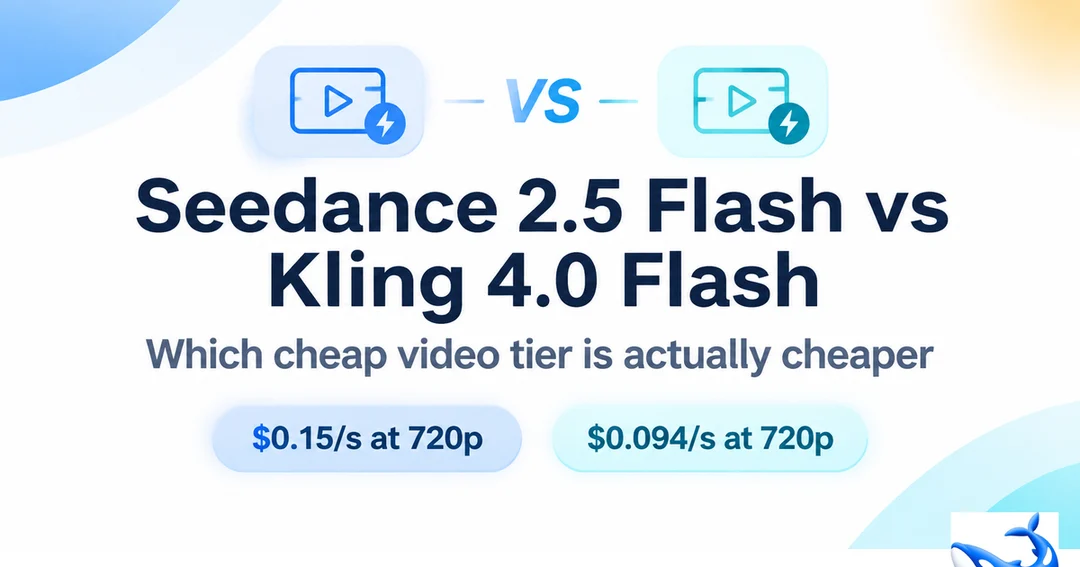
According to a video generation API pricing comparison published by AI model routing platform OrcaRouter on November 15, 2026, ByteDance's Seedance 2.5 Flash and Kling 4.0 Flash take sharply different approaches to billing mechanics and specification transparency despite both being positioned as lightweight, low-cost Flash tiers.
Image source: https://www.orcarouter.ai/blog/seedance-2-5-flash-vs-kling-4-0-flash
Kling 4.0 Flash reached general availability on November 4, 2026, while Seedance 2.5 Flash (model ID: dreamina-seedance-2-5-flash-261115) launched on Runway on November 13 before appearing on BytePlus's API pricing schedule on November 15. Both models strip away resource-heavy features from their respective flagship versions to lower generation costs, yet their billing rules behave in opposite ways once reference footage enters the pipeline.
The 720p Rate Inversion and BytePlus's Missing Spec Sheet
Comparing the two models at 720p text-only generation—the sole resolution both tiers list in common—reverses the assumption that Seedance 2.5 Flash is the cheaper option. Kling 4.0 Flash charges $0.094 per second at 720p, bringing a 5-second clip to $0.47 and a 10-second clip to $0.94. Seedance 2.5 Flash is priced at $0.15 per second at 720p, costing $0.76 for 5 seconds and $1.52 for 10 seconds—roughly 60% more per second than Kling at the same resolution.
Beyond the headline per-second rate, the two offerings differ sharply in documentation completeness. Kling 4.0 Flash launched with a published capability table specifying what stays and what was cut:
- Kling 4.0 Flash Supported Features: Retains text, image, and video inputs, Omni Reference (allowing up to 15 combined input assets), and native audio generation included at no extra per-second charge.
- Kling 4.0 Flash Removed Features: Caps output at 720p and 3 to 20 seconds (defaulting to 10 seconds), and drops first-and-last-frame generation, multi-keyframe control, voice cloning, and element-bound voice.
- Seedance 2.5 Flash Documentation Gap: As of November 13, BytePlus's published pages listed pricing rows for 480p ($0.07 per second, or $0.34 for 5 seconds) and 720p, but omitted duration limits, reference asset budgets, audio behavior, editing or extension capabilities, output formats, and frame rates.
While the parent Seedance 2.5 model documents 4 to 30 seconds of duration, 50 reference assets (30 images, 10 videos, and 10 audio files), joint audio-video generation, and 24 fps output in mp4 and mov formats, BytePlus has not confirmed which of those capabilities carry over to the Flash tier. As OrcaRouter notes, an undocumented tier forces developers to spend paid API calls just to test basic boundaries.
Kling's 2x Billed-Duration Rule on Reference Video Inputs
Evaluating Kling 4.0 Flash solely on its text-to-video per-second rate overlooks a major billing rule triggered whenever a reference video is supplied. While BytePlus scales its rate upward with a moderate premium based on reference clip length, Kling doubles or adds the input duration to the billed time.
Specifically, when an input reference video is shorter than or equal to the target output duration, Kling 4.0 Flash bills twice the output duration. When the input video is longer than the output, it bills the combined sum of input plus output duration:
- 5-second 720p output with a 3-second input video: Because the 3-second input is shorter than the 5-second output, Kling bills 10 seconds at $0.063 per second for a total of $0.63. Under the same setup,
Seedance 2.5 Flashstarts at $0.84 at the low end of its input pricing range. - 10-second 720p output with a 10-second input video: Kling bills 20 seconds of generation time, bringing the cost to $1.26 rather than $0.63.
- 5-second 720p output with a 30-second input video: Because the input exceeds the output duration, Kling bills 35 combined seconds at $2.21, compared to $3.25 on
Seedance 2.5 Flash.
In reference-heavy workflows, this billing multiplier narrows the effective price gap between the two models compared to the 60% spread seen in text-only generation, even though BytePlus remains higher on its published long-input examples.
Iteration Economics and Resolution Ceilings in Production
Lightweight video tiers are primarily used for rapid creative iteration—running twenty draft generations before committing to a final shot—rather than rendering finished masters. Running twenty 10-second 720p text-to-video drafts costs $18.80 on Kling 4.0 Flash versus $30.00 on Seedance 2.5 Flash, a difference that compounds quickly for teams generating dailies.
Resolution ceilings further separate how each model fits into a production pipeline, as neither Flash tier lists 1080p support:
- 720p Deliverables with Native Audio: When a project requires 720p clips under 20 seconds with native audio and predictable constraints,
Kling 4.0 Flashprovides both lower cost and documented boundaries. However, Kling does not document a draft-to-1080p enhancement path for the Flash tier. - 480p Animatics and Social Rough Cuts: When 480p previews are sufficient—such as animatics or early shot exploration that will be replaced later—
Seedance 2.5 Flashis the only option of the two offering 480p at $0.07 per second ($0.34 for 5 seconds). Its parent model includes a draft workflow that renders a 480p preview and enhances it at the 1080p rate, though BytePlus has not stated whetherSeedance 2.5 Flashinherits that capability. - 1080p Master Output: Neither Flash tier reaches 1080p. Teams needing 1080p output must step up to full
Kling 4.0(roughly $0.157 per second at 720p and $0.235 at 1080p) or fullSeedance 2.5(roughly $0.23 per second at 720p and $0.569 at 1080p).
Until BytePlus publishes a complete specification sheet for Seedance 2.5 Flash, the comparison pits a clearly bounded $0.094/sec 720p tier against a $0.15/sec tier whose undocumented limits make Kling 4.0 Flash the more predictable choice for 720p work, while reserving Seedance 2.5 Flash for low-cost 480p draft runs.