Kimi-K3 Released: 2.8T Parameter, 1M-Token Open MoE Agent Model
Moonshot AI's 2.8T open-weight MoE model Kimi-K3 has launched on Alibaba Cloud, featuring a 104B active parameter architecture and native 1M context for autonom
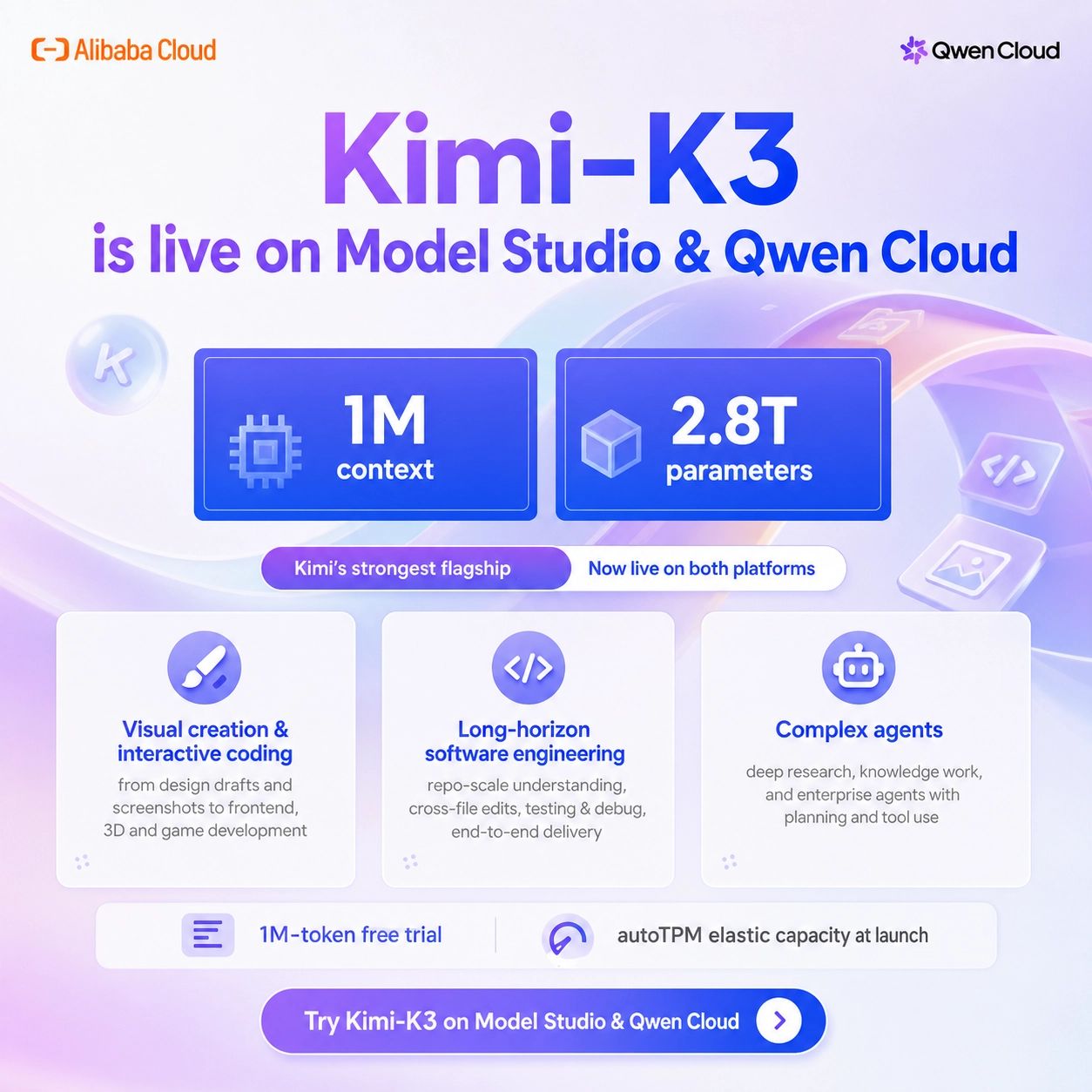
In September 2026, Kimi-K3—a 2.8-trillion-parameter open-weight agentic model with a native 1-million-token context window developed by Moonshot AI—went live across Alibaba Cloud and official Kimi platforms.
Image source: @alibaba_cloud on X / Moonshot AI
Documented by Moonshot AI as the first open model to reach 3T-class scale, Kimi-K3 is engineered to ingest extensive software repositories within a single active session and orchestrate terminal development tools with minimal human supervision. By pairing open model weight distribution with managed hosted APIs on platforms such as Alibaba Cloud Model Studio and the Kimi API, the release broadens access to frontier-grade agentic reasoning that was previously confined to proprietary, closed-source ecosystems.
2.8T MoE Architecture with 104B Active Parameters: KDA and Gated MLA
The central architectural breakthrough of Kimi-K3 lies in balancing massive parameter capacity with practical inference throughput using a Mixture-of-Experts (MoE) design.
The network comprises 93 layers in total, organized as an initial dense layer followed by 92 MoE layers. While aggregate parameters reach 2.8 trillion, dynamic routing directs each token through only 16 selected experts out of 896, alongside 2 dedicated shared experts. This strategy caps active parameters at 104 billion per token, keeping latency and serving overhead within manageable limits.
The attention layers are similarly structured to prevent throughput degradation across million-token sequences:
- Hybrid Attention Composition: The architecture alternates 69 layers of Kimi Delta Attention (KDA) with 24 layers of Gated Multi-Head Latent Attention (MLA), significantly reducing key-value (KV) cache memory pressure.
- Dimensional Specifications and Activation: Kimi-K3 configures an attention hidden dimension of 7168 across 96 attention heads, a latent MoE dimension of 3584, and a per-expert hidden dimension of 3072. Enhanced by SiTU-GLU activation functions and Attention Residuals (AttnRes), the model preserves gradient flow across long compute graphs and supports a 160K vocabulary.
Native 1M-Token Context and Autonomous Repository Engineering
With a native 1,048,576-token context window, Kimi-K3 operates across enterprise-scale software projects without relying on lossy RAG retrieval or heuristic file chunking.
Software teams can load entire monorepos containing hundreds of source files directly into memory to perform repository-scale analysis, cross-file edits, build verification, and test debugging. In long-horizon coding tasks, the agent sustains multi-step engineering cycles, exploring directories, running terminal commands, and iterating based on execution feedback.
Verified application areas detailed in Moonshot AI's technical report include:
- Systems and Hardware Engineering: Beyond standard application development, Kimi-K3 handles GPU kernel optimization, custom compiler construction, runtime bug isolation, and automated chip design workflows.
- Vision-in-the-Loop Development and Knowledge Work: Processing text, imagery, and video within a single native multimodal architecture, the model validates visual rendering loops in game development, assists with CAD scripting, and autonomously synthesizes interactive dashboards, widgets, and motion graphics.
Deployment Paths, Hardware Caveats, and 1M-Token Free Promotion
To support diverse production environments, Moonshot AI and cloud partners provide multiple access channels.
Researchers and open-source practitioners can inspect the technical report on GitHub and download model weights via Hugging Face (moonshotai/Kimi-K3). For teams requiring managed infrastructure, the model is accessible through Kimi Web, Kimi Code, the Kimi API, and Alibaba Cloud Model Studio. Launch incentives include a 1-million-token free trial.
Key production considerations include:
- Self-Hosting Infrastructure Overhead: Deploying a 2.8-trillion-parameter MoE model (even with 104B active parameters per token) on private or on-premises infrastructure demands multi-node GPU clusters with massive high-bandwidth VRAM.
- Proprietary Frontier Comparison: While Moonshot AI's technical report demonstrates class-leading results among open models, overall benchmark performance continues to trail top closed frontier systems such as Claude Fable 5 and GPT-5.6 Sol.
- Post-Promotion API Expenditure: Once the 1M-token promotional tier is consumed, continuous repository analysis and prolonged multi-turn agent sessions incur standard token-based API charges, making context caching and session management vital for cost control.