Karpathy's Tips for Understanding LLM Outputs: From ASD-STE100 Precision Writing to Bespoke Video Explainers
Andrej Karpathy shares practical prompting techniques and output formats to digest complex LLM outputs: applying aerospace maintenance standard ASD-STE100 for c
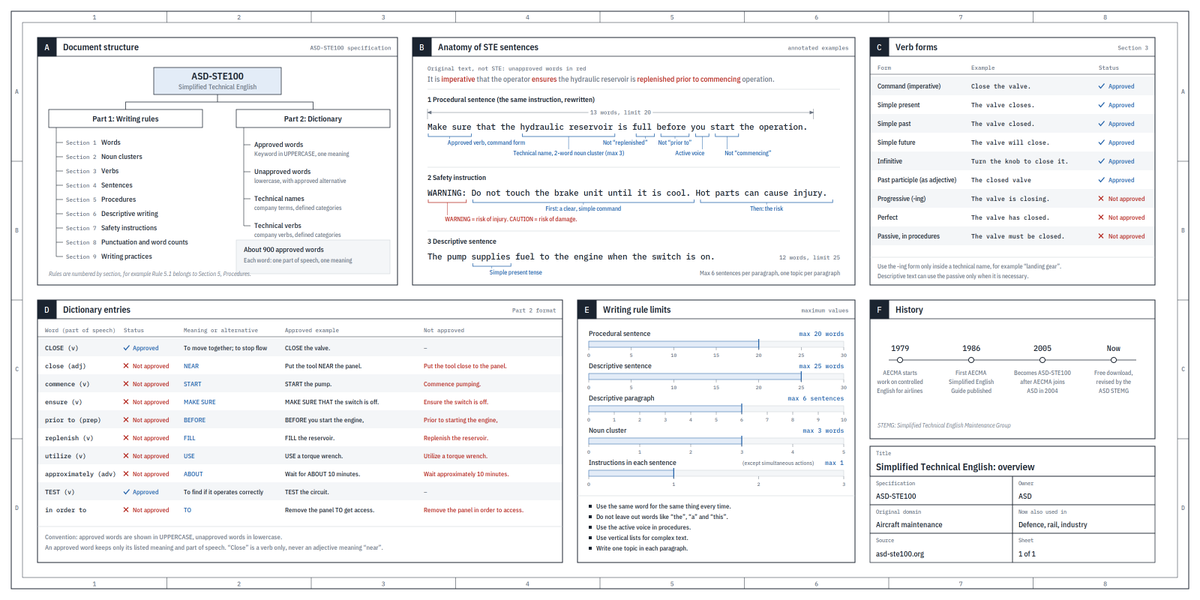
AI researcher, former Tesla Director of AI, and OpenAI co-founder Andrej Karpathy (@karpathy) has shared a concise set of practical prompting tips and recommended output formats designed to help users quickly and accurately understand complex language model outputs.
Image source: Andrej Karpathy (@karpathy / X)
Karpathy noted that as language models and autonomous agents continue to advance, practitioners will spend far less time doing raw manual execution and significantly more time reviewing, parsing, and understanding what models generate. To minimize cognitive load and maximize comprehension speed, he outlined a four-tier prompting framework and a core mental model shift.
1. Eliminating Text Fluff: Aerospace Standard ASD-STE100
To transform verbose, rambling LLM explanations into crisp, unambiguous text, Karpathy recommends grounding the model in a dedicated technical specification.
- Specifying ASD-STE100: Prompt the model with:
"Ask your LLM to explain something in ASD-STE100". - Background and Mechanics: ASD-STE100 (Simplified Technical English) is a controlled natural language standard developed for aerospace and defense maintenance documentation to eliminate ambiguities that could lead to fatal errors. It enforces strict vocabulary constraints (one approved meaning per word), active voice, and short sentences.
- Effect on LLMs: Because frontier language models are thoroughly trained on technical manuals and specifications, they excel at ASD-STE100. Requesting this format strips away conversational filler, decorative preambles, and hedge phrases, yielding exceptionally clean and readable text.
- Softening Constraint: For everyday tasks where the full standard is overly restrictive, Karpathy suggests prompting for
"80% of the way to ASD-STE100"to balance conciseness with natural flow.
2. Moving Beyond Plain Text: Diagrams and Interactive Web Pages
Converting text into visual structures significantly reduces mental parsing overhead.
- Diagrams and Visual Overviews: Instead of requesting lengthy prose, ask the LLM to generate a diagram or structured architectural map. Visual layouts make dependencies and logical flows far easier to process and digest at a glance.
- Interactive HTML Web Pages: Prompt the model to return its output
"in HTML". Modern LLMs possess sophisticated frontend capabilities, capable of producing clean, self-contained single-page applications with layout styling and interactive animations. Interacting with a dynamic widget enables faster intuition-building than reading static paragraphs.
3. Bespoke Explainer Videos: 3b1b-Style Animations and Narration
The output format Karpathy is most bullish on is fully custom, on-demand explainer videos generated for arbitrary subjects.
- Prompt Pattern:
Create a 3b1b style video explainer on [Topic]. Use my ElevenLabs API key for audio narration. - Audio and Pipeline Options: Users can connect an ElevenLabs API key for studio-grade voiceover or instruct the model to locate and configure open-source, local-compute alternatives.
- Practical Viability: Combining algorithmic mathematical animation code (such as Manim popularized by 3Blue1Brown) with automated TTS narration has reached a viable threshold, generating functional visual explanations on demand.
4. Paradigm Shift: The Era of Discardable Software Artifacts
Karpathy concluded his recommendations with two foundational observations on how engineering workflows are evolving:
- Upward Shift in Abstraction: As LLMs autonomously handle more foundational implementation work, human responsibilities shift up the abstraction ladder into high-level oversight, validation, and conceptual understanding.
- Abundant, Discardable Software Artifacts: With compute and code generation becoming increasingly abundant, developers can now request large, custom, discardable software artifacts—such as standalone web apps or tailored explainer videos built solely to explain a single concept once and be thrown away—that were previously cost-prohibitive to produce. Pushing beyond traditional output formats unlocks entirely new ways of learning and debugging.
Original source
- Andrej Karpathy Official X (@karpathy): Original Post on Tips and Tricks for Understanding LLM Outputs