Andrej Karpathy's AI Learning Method: Visualizing Complex Concepts and Code as Interactive Disposable HTML
How to prompt AI agents to generate clickable, interactive HTML explainers instead of reading dense technical docs, enabling faster structural comprehension and
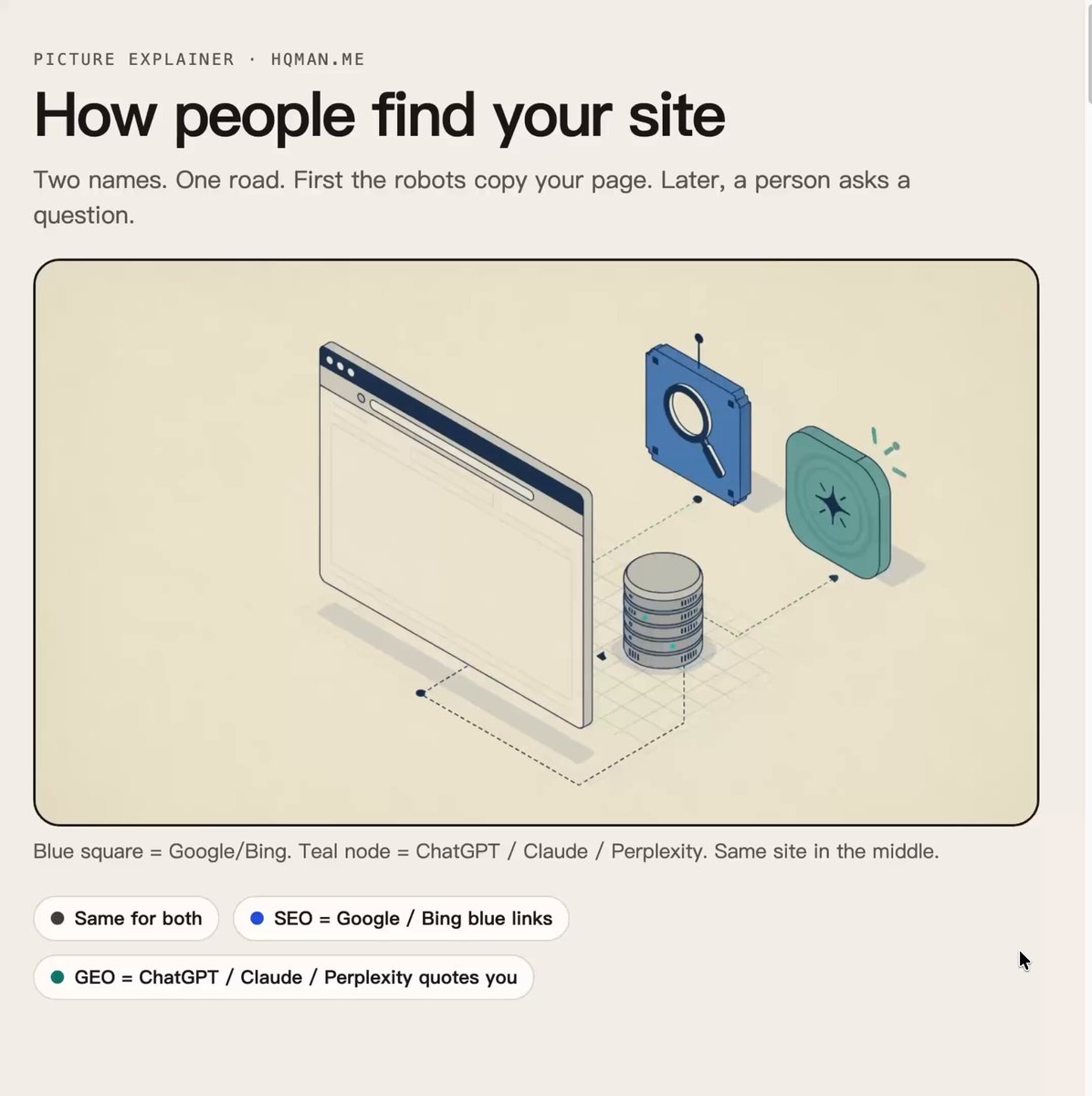
AI engineer Kai (@hqmank) shared on October 5, 2026, a practical prompting workflow inspired by OpenAI co-founder and former Tesla AI Director Andrej Karpathy (@karpathy), detailing how to transform dense technical concepts and complex codebases into interactive, single-page HTML web applications for accelerated learning.
Image source: @hqmank / @karpathy (X)
Karpathy's foundational thesis centers on the declining cost and growing abundance of machine intelligence and automated code generation: tasks that once required prohibitive development overhead can now be converted into "large, custom, discardable software artifacts"—such as bespoke web apps and explainer videos created solely for temporary understanding. Kai noted that he frequently uses this method when learning something new or trying to understand complex code, and shared an example of applying it to search engine optimization (SEO) and generative engine optimization (GEO), reporting significantly faster comprehension of the core ideas than from reading static documentation.
Andrej Karpathy's 4-Tier Output Strategy
Karpathy highlighted that as language models handle an increasing share of autonomous execution, human responsibilities will ascend the abstraction ladder into oversight and verification. Rather than reading verbose paragraphs of generated prose, users can instruct models to shift their output format across four distinct tiers:
-
Controlled Language (ASD-STE100):
- Request explanations formatted in
ASD-STE100, a controlled language standard originally developed for aerospace maintenance documentation. - The specification restricts vocabulary to a controlled dictionary and enforces constraints on clean writing style, removing syntactic ambiguity and improving scannability.
- For technical topics requiring specialized vocabulary, users can soften the prompt to
"80% of the way to ASD-STE100"because the specification is quite stringent.
- Request explanations formatted in
-
Diagrams and Visual Schema:
- Instruct the LLM to output structured diagrams instead of raw text. Visual structures accelerate structural parsing and cognitive processing.
-
Interactive Web Pages (HTML):
- Ask for output
"in HTML"to generate single-file web pages. - Modern frontier models possess strong frontend proficiency, capable of rendering polished card layouts, expandable accordion panels, and state-driven animations with no external runtime dependencies.
- Ask for output
-
Custom Explainer Videos:
- Instruct agents to generate bespoke explainer animations (e.g., in the visual style of 3Blue1Brown), pairing script generation with ElevenLabs API narration or local compute-driven speech synthesis alternatives.
Practical Implementation: Turning Complex Code and Concepts into Clickable Dashboards
Among Karpathy's four output modalities, Kai singled out interactive HTML pages as the most actionable technique for daily technical study.
- Conceptual Mapping via Clickable Nodes: When learning multi-variable systems like SEO and GEO, Kai prompted the agent to structure core ideas into an interactive web interface with clickable elements rather than reading through lengthy documentation.
- Codebase Architecture Exploration: When deciphering intricate codebases, requesting a visual HTML page allows developers to explore structural relationships interactively instead of parsing raw prose explanations.
- Active Navigation vs. Passive Reading: Engaging directly with clickable components creates an active cognitive feedback loop, accelerating comprehension compared to linear document review.
Reusable Prompt Template for Interactive HTML Explainers
This prompt can be deployed in AI coding agents (Claude Code, Codex, Cursor) or standard frontier chat interfaces:
Please build a single-file, responsive, interactive HTML explainer to help me quickly understand [CONCEPT / CODEBASE].

[Requirements]:
1. Package everything into a standalone HTML file that opens immediately in any modern browser without npm installs or server setups.
2. Place a high-level visual block diagram or component grid at the top representing key architectural layers or concepts.
3. Make each component clickable so selecting it displays underlying mechanisms, key parameters, and practical code examples in an inspection panel below.
4. Apply clean, modern dark-mode styling with card layouts and intuitive hover states.
5. Include verified source citations and documentation links alongside every technical assertion to guard against unverified claims.

[Content to Explain]:
(Insert complex technical documentation, algorithm details, or codebase snippets here)
Community Insights: Structural Benefits and Critical Pitfalls
Following Kai's post, developers and researchers on X examined the systemic tradeoffs of substituting markdown text with generated HTML:
-
Structural Forcing Function (@proxy_vector):
- Requiring an agent to produce an interactive visual UI forces the model to commit to explicit spatial and logical hierarchies.
- When a model lacks full understanding of a topic, gaps manifest visually as empty containers, mismatched layout blocks, or omitted flows—making hallucinated or incomplete reasoning immediately apparent.
-
The "Feels Checked" Visual Illusion (@asmirkn):
- A polished, beautifully animated user interface can create an artificial impression of factual rigor.
- In speculative or rapidly evolving disciplines like GEO, developers must strictly require the prompt to anchor every visual block to verified citations and source references.
-
Token Consumption and Vocabulary Constraints (@hugo_kemnitz):
- Generating verbose HTML, CSS styles, and JavaScript event listeners consumes substantially more output tokens than lightweight markdown.
- Additionally, rigid compliance with ASD-STE100 restricts allowed vocabulary, which can impede accurate representation of specialized, domain-specific programming terminology.
Original source
- Kai (@hqmank) post on X: https://x.com/hqmank/status/2106945748461928655
- Andrej Karpathy (@karpathy) quoted post on X: https://x.com/karpathy/status/2105819303471976479