Beyond One-Off Prompts: Designing the Autonomous 24/7 AI Employee System Loop
Moving beyond simple prompt-and-wait interactions: how Andrej Karpathy's agentic engineering principles and an 8-pillar, 7-stage system loop turn LLMs into reli
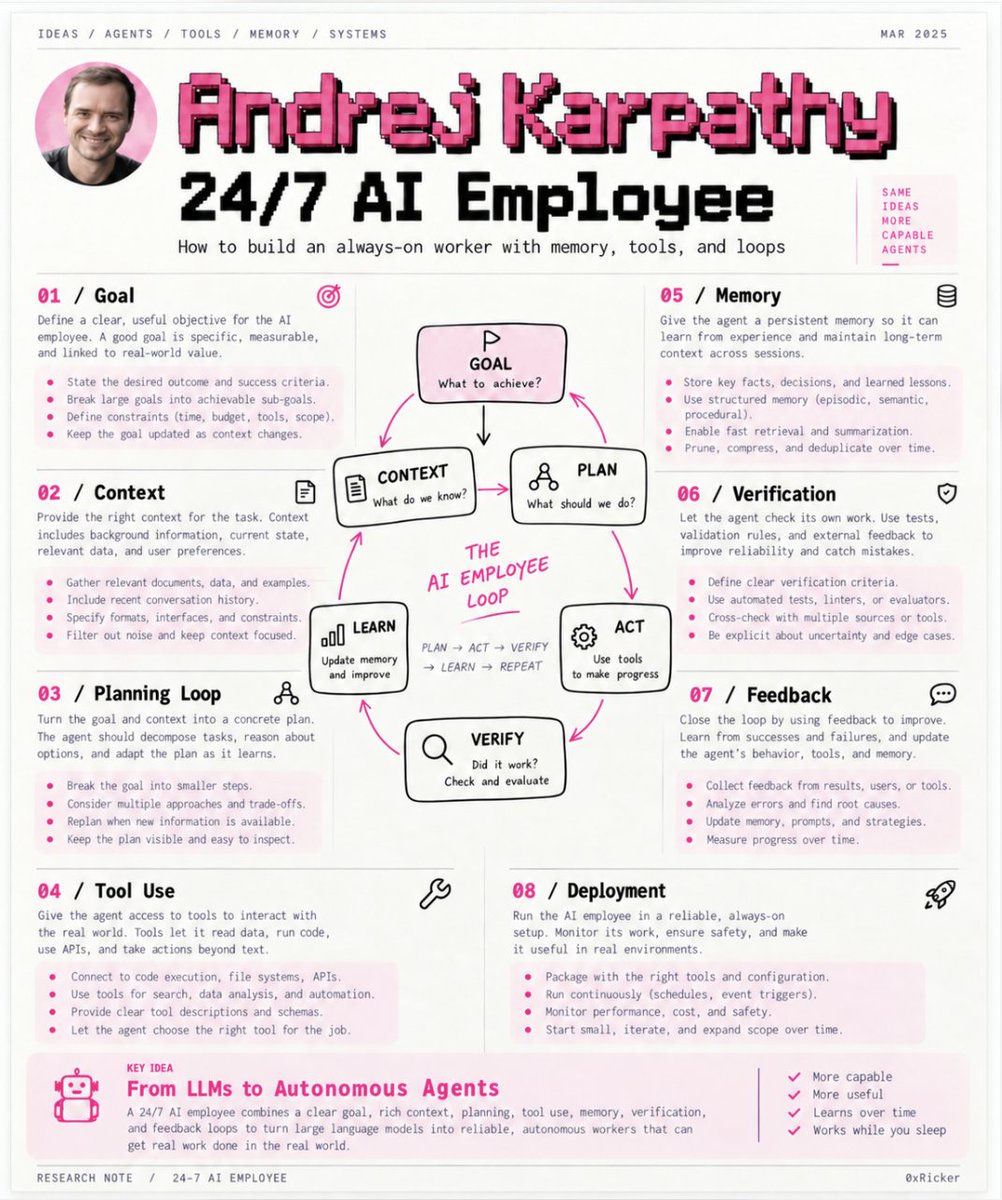
On October 5, 2026, creator Ricker (@0xRicker) published an operational framework synthesizing Andrej Karpathy's agentic engineering philosophy, outlining how moving beyond single-turn prompt interactions toward an 8-pillar system architecture and a 7-stage execution loop enables truly autonomous, 24/7 AI employees.
Image source: X @0xRicker
Most developers and practitioners remain stuck in a "prompt-and-wait" mindset—assigning an isolated task to a large language model and manually inspecting its output before deciding the next move. However, building a genuine, always-on AI worker capable of progressing through complex projects while human supervisors sleep requires an interconnected system rather than a clever prompt. The framework below breaks down the structural mechanics required to transform a conversational chatbot into an autonomous operator.
Shifting from Chatbot Prompting to System Engineering
In conventional workflows, teams stop at "give the model a task." Because this approach lacks autonomous error recovery and state awareness, human engineers must supervise every turn, defeating the core economic value of persistent background automation.
Andrej Karpathy's perspective on Software 3.0 and agentic engineering frames foundation models not as chat endpoints, but as interpreters inside an agent runtime. For a model to execute work reliably over hours or days, the stability and invariants of the surrounding orchestration harness matter far more than the specific wording of any single prompt.
The 8 Core Pillars of an Always-On AI Worker
A robust, continuous agent architecture rests upon eight foundational components:
- A Clear Goal: Supplying explicit definitions of done and deterministic constraints rather than micro-managing procedural steps.
- The Right Context: Precise context engineering that injects relevant project contracts, system guidelines, and environmental state without flooding the model with extraneous tokens.
- A Planning Loop: Enforcing an upfront decomposition phase where the model maps dependencies and breaks broad objectives into concrete milestones before touching code or tools.
- Tool Use: Giving the agent direct interfaces to manipulate files, run shell commands, interact with databases, and query external APIs.
- Memory and State Persistence: Storing what was attempted, what failed, and what remains to be done in durable files or structured databases, allowing tasks to resume seamlessly after unexpected interruptions.
- Verification Gates: Establishing automated, deterministic test suites, linters, and compilers so the model never grades its own homework.
- Feedback Integration: Automatically parsing errors from failed verification runs and routing structured diagnostics back into the planning phase for self-correction.
- Deployment Infrastructure: Production runtime orchestration equipped with session monitoring, process restarts, and reliable execution environments.
The 7-Stage Autonomous Loop: Goal, Context, Plan, Act, Verify, Learn, Repeat
The operational engine tying these eight pillars together is a closed, sequential loop:
- Goal: Define the exact deliverable, invariants, and boundaries for the upcoming work unit.
- Context: Retrieve only the load-bearing source files, documentation, and interface schemas required for that specific goal.
- Plan: Synthesize an actionable implementation strategy, anticipating failure modes and identifying verification criteria.
- Act: Execute concrete tool calls—editing files, compiling source code, or invoking external endpoints.
- Verify: Run deterministic checks against the system boundaries to evaluate whether the change satisfied the contract.
- Learn: Record discovered constraints, edge cases, and failure patterns into project state files for subsequent turns.
- Repeat: Transition autonomously to the next pending item in the plan until the overarching objective is reached.
When this feedback loop is closed and deterministic, an AI agent ceases to be an intermittent chatbot and begins operating as a persistent, unattended software operator.
Key Engineering Invariants and Implementation Caveats
The most frequent defect in agentic system design is self-grading. When asked to evaluate its own work without external tools, an LLM often hallucinates correctness or suppresses edge cases. Rigorous verification must always be offloaded to independent compilers, typecheckers, unit tests, and runtime assertions.
Furthermore, teams should keep Karpathy's core maxim in mind: "You can outsource your thinking, but not your understanding." Mechanical tasks—writing boilerplate, restructuring data, running test suites, and resolving localized errors—are prime candidates for agentic delegation. However, identifying which problem needs solving, maintaining the architectural vision, and enforcing quality standards remain the non-negotiable responsibility of human engineers.
Original source
- Ricker (@0xRicker) X post: Andrej Karpathy’s ideas on 24/7 AI employee system loop