Hugging Face's Multi-Harness RL Architecture: Preventing Agent Overfitting Across Coding Interfaces
How Hugging Face and Liquid AI use OpenEnv, Harbor, and TRL to train models across Claude Code, Codex, OpenCode, and Mini-SWE-Agent without single-harness overf
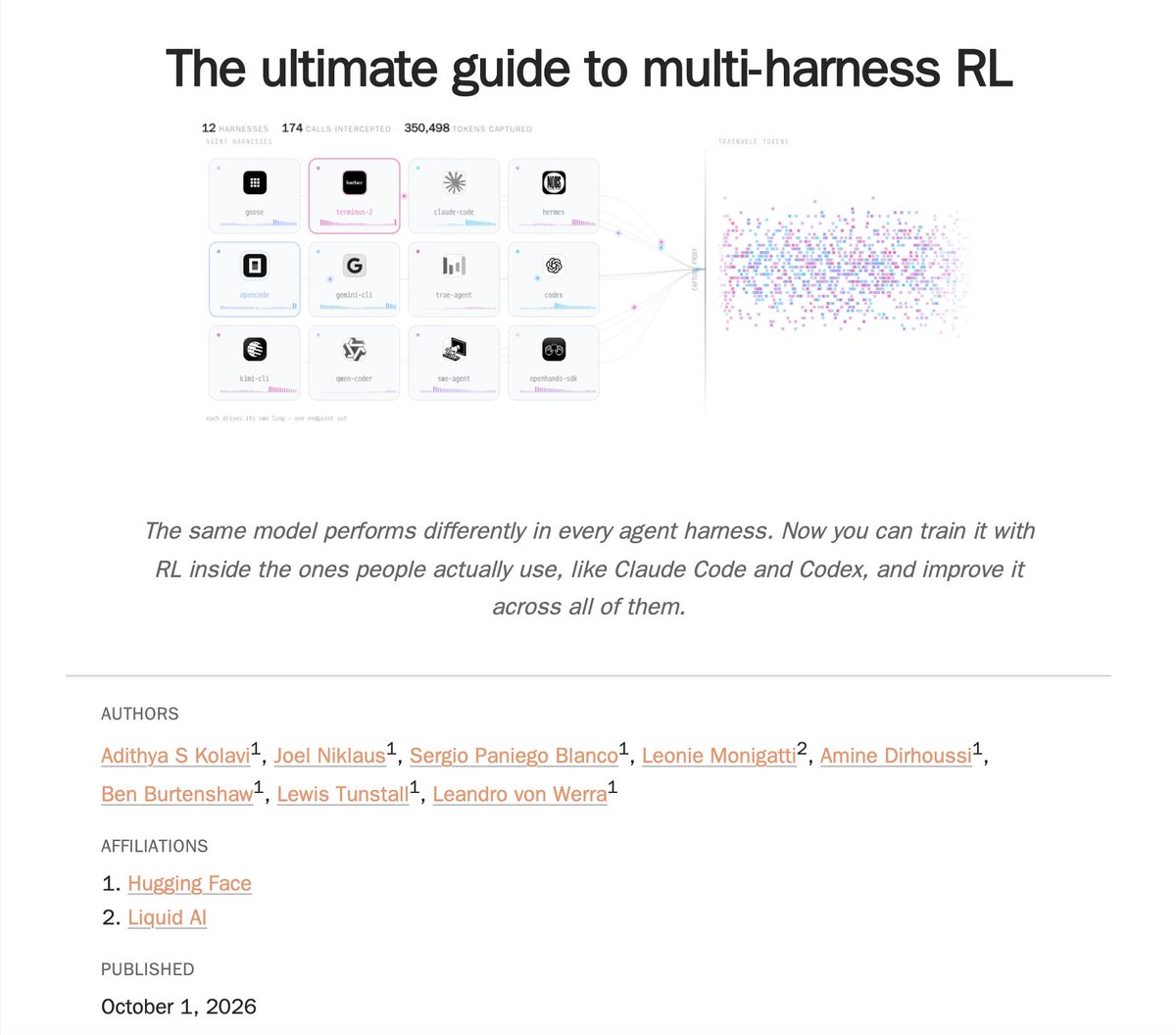
Akshay Pachaar (@akshay_pachaar) shared on October 4, 2026, an architectural breakdown of 'The ultimate guide to multi-harness RL', published jointly by Hugging Face's post-training team and researchers at Liquid AI. The guide addresses an acute friction point in autonomous coding agent engineering: an open-weight language model can deliver solid results inside one execution harness, yet sharply degrade or generate invalid tool calls when transferred to another.
Image source: @akshay_pachaar via X
In production environments, developers frequently observe that fine-tuning or post-training an agent model inside a single user interface causes the weights to overfit to that specific environment's quirks rather than mastering general programming reasoning. By bridging three open-source systems—OpenEnv, Harbor, and TRL—Hugging Face and Liquid AI established an end-to-end reinforcement learning framework that preserves native harness environments while enforcing true cross-interface portability.
The Single-Harness Overfitting Problem in Agentic Workflows
An agent harness is the runtime scaffold surrounding an inference model: Claude Code, Codex, OpenCode, and Mini-SWE-Agent are prominent examples. The harness controls the outer execution loop, structures prompt templates, manages conversational context, provisions accessible tool definitions, intercepts tool errors, and determines termination conditions.
When a model undergoes post-training or reinforcement learning solely inside one agent harness, two major failure modes emerge:
- Interface-Specific Overfitting: The model memorizes exact tool signatures, expected output formats, context structures, and retry behaviors unique to that harness. It effectively learns how to operate the harness rather than how to solve the underlying programming task.
- Runtime Portability Collapse: Transferring the model to an alternative harness causes immediate syntax errors, invalid JSON argument parsing, or conversational deadlocks because subtle differences in formatting break the model's brittle assumptions.
This single-harness bias creates a tight, fragile coupling between the base foundation model and the specific runtime harness in which it was trained.
Three-Pillar Architecture: Connecting OpenEnv, Harbor, and TRL
To eliminate this deployment friction, Hugging Face and Liquid AI designed a multi-harness training pipeline that trains models simultaneously across four real-world agent environments: Claude Code, Codex, OpenCode, and Mini-SWE-Agent. This is achieved by combining three modular open-source systems:
- OpenEnv: Serves as the standardized bridge connecting agent harnesses, reinforcement learning execution environments, and downstream trainers. Its capture proxy sits transparently between the harness client and the model inference server, recording the exact token sequences and generation probabilities needed for policy updates without disrupting the interactive loop.
- Harbor: Executes agent tasks inside containerized sandboxes. Harbor decouples the task specification, the harness configuration, and the runtime sandbox, allowing researchers to evaluate the same task across diverse agent harnesses without rebuilding isolated container environments.
- TRL (Transformers Reinforcement Learning): Hugging Face’s open-source library for post-training and alignment. TRL ingests the multi-harness interaction trajectories recorded by OpenEnv and updates model parameters through reinforcement learning.
The fundamental architectural advantage is where training data is harvested. The researchers do not attempt to simulate, mock, or simplify harness behaviors inside the reinforcement learning trainer. Instead, each harness retains its genuine system prompts, tool schemas, context management, and execution loops. OpenEnv simply observes genuine API calls streaming through live harnesses and converts them directly into reproducible training trajectories.
Benchmark Results on LFM2.5-2.6B: 54.2% Solve Rate and 31% Fewer Tool Calls
The research team trained the compact open-weight model LFM2.5-2.6B across all four harnesses and evaluated performance against held-out benchmark tasks.
- Substantial First-Attempt Solve Gains: Across all four harnesses, the average share of held-out tasks solved on the very first attempt rose from 42.2% with the base model to 54.2% with the multi-harness trained model, showing consistent gains across every individual harness.
- 31% Reduction in Tool Calls on Solved Tasks: On tasks successfully completed by both the base and trained checkpoints, the multi-harness model required 31% fewer tool invocations to reach verified solutions. This reflects improved tool efficiency on tasks successfully completed by both models.
- Portability versus Specialization: Training exclusively inside OpenCode improved the model as well, but most of that gain remained concentrated within OpenCode. In contrast, multi-harness training distributed performance improvements across all four client interfaces.
Experimental Caveats and Why Harness Portability Matters
While multi-harness reinforcement learning demonstrates a clear path toward robust agent deployment, the researchers noted key experimental limitations that provide context for real-world adoption:
- Single Task Family and Single Seed: The evaluations relied on a single task family and a single training seed, meaning the reported metrics should not be interpreted as a universal ranking.
- Unequal Data Exposure: The training setups involved unequal data exposure across configurations, which must be taken into account when evaluating comparative gains.
- Deployment Trade-Offs: If an enterprise deploys an agent model strictly through a single, proprietary internal CLI harness, specialized single-harness training may yield higher peak performance for that closed system. However, for open-source model creators targeting heterogeneous developer ecosystems, cross-harness generalization is essential.
Ultimately, open-source model developers cannot safely assume that end users will operate inside any single agent harness. For autonomous coding models to remain dependable across modern IDEs, terminal CLI assistants, and automated CI/CD pipelines, interface portability must be incorporated directly into the reinforcement learning post-training pipeline.