Goutoujunshi: Open-Source Codex Skill for Chat Log Analysis and Relationship Strategy
Goutoujunshi is an open-source Codex skill with 2,600+ GitHub stars, offering chat analysis, psychology-grounded reply drafts, and relationship profiling.
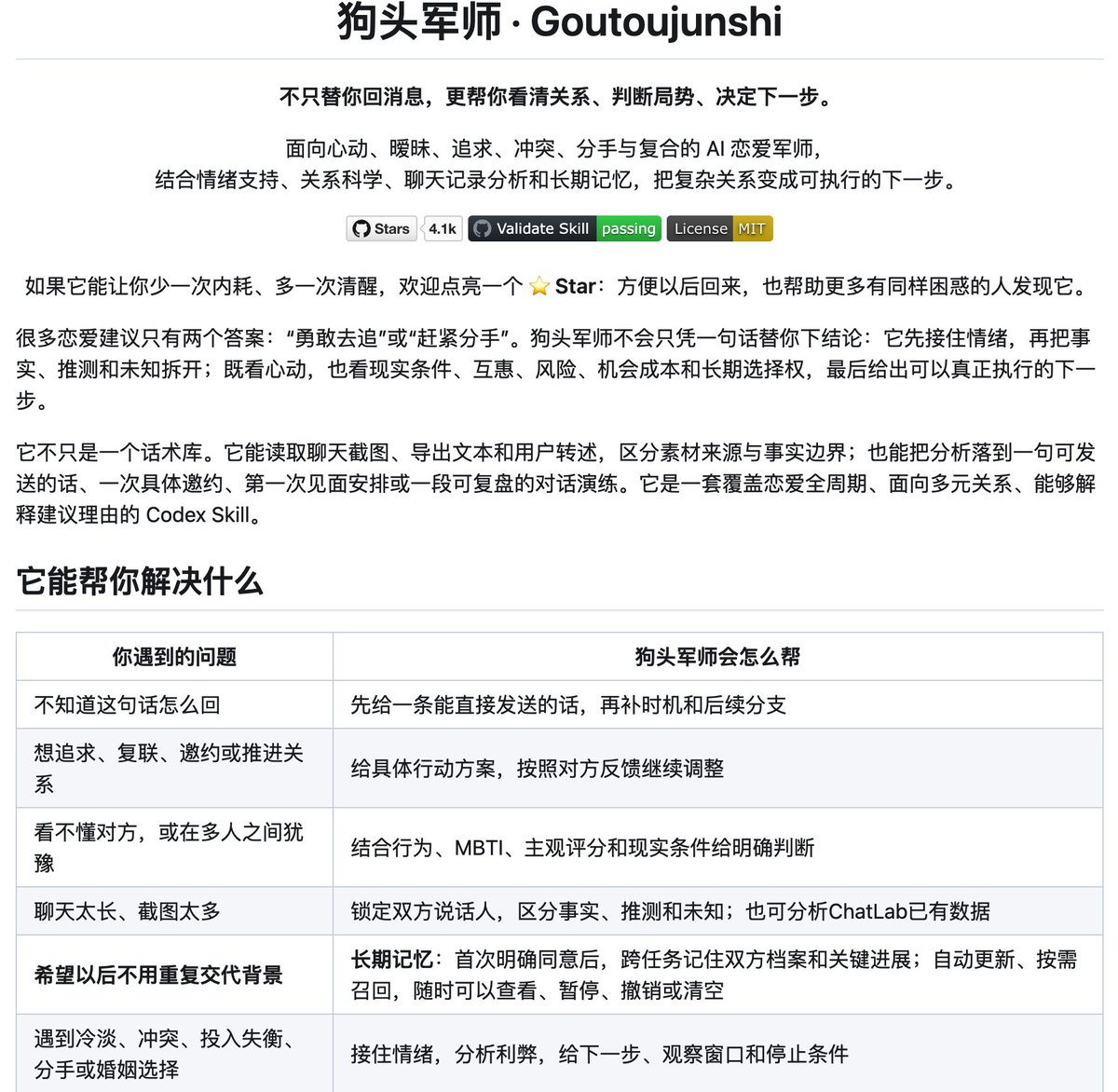
An open-source project designed to diagnose communication hurdles and formulate actionable relationship strategies using artificial intelligence has gained significant traction. Published by the open-source community shengjidaguai-china, the Codex-based relationship strategy skill 'Goutoujunshi' (狗头军师) has surpassed 2,600 stars and 300 forks on GitHub. Rather than generating generic pickup lines, the tool parses unstructured chat screenshots and exported chat logs into structured relationship dossiers, delivering concrete reply scripts and timing recommendations grounded in psychological frameworks.
Image source: @fhwofjow51260 on X
As LLM-driven coding agent environments expand beyond programming into everyday reasoning and personal workflow augmentation, Goutoujunshi transitions conversational advice from one-off prompts into a disciplined agent skill workflow. Here is an architectural and functional teardown of Goutoujunshi's core capabilities, psychological foundations, and extensibility.
Three-Tier Information Parsing and Screenshot Processing Architecture
A key technical highlight of Goutoujunshi is how it systematically deconstructs chaotic inputs—such as messenger screenshots, exported text logs, and emotional user narratives—into quantified, structured variables. To counteract emotional cognitive distortions and subjective projections often present during relationship crises, the skill strictly separates information into three distinct analytical layers:
- Observable Facts: Strictly verified and provable data extracted directly from transcripts, including exact message wording, timestamp intervals, initiation and closing dynamics, message length ratios, and frequency trends.
- Inferred Dynamics: Logical hypotheses regarding engagement levels, conversational tension, or emotional cadence based on latency patterns and topic transitions. These hypotheses are explicitly tagged as interpretations rather than proven facts.
- Unknown Boundaries: Critical context outside the chat—such as offline commitments, personal emergencies, and unexpressed private emotions—that cannot be verified. Labeling these explicitly as 'Unknown' prevents hallucinatory over-interpretation and toxic mind-reading.
By enforcing this strict data hygiene pipeline, the skill prevents users from spiraling into anxiety over single-word answers or brief response delays, anchoring every strategic recommendation in verifiable reality.
Psychology-Grounded Action Plans and Long-Term Relationship Profiling
Rather than relying on superficial dating gimmicks or manipulative tactics, Goutoujunshi grounds its reasoning in established behavioral psychology. It incorporates principles from attachment theory, Big Five and MBTI personality profiling, and social exchange theory to formulate pragmatic, balanced communication plans:
- Ready-to-Send Reply Scripts: Crafted response drafts tailored to current conversation rhythms, accompanied by clear explanations of the intended emotional impact.
- Optimal Sending Windows and Buffering: Calculated cooldown intervals and pacing guidance to prevent impulsive double-texting and preserve conversational dignity.
- Contingency Branching: Clear tactical roadmaps detailing next steps based on whether the other person replies enthusiastically, gives terse answers, or remains silent.
- Full Relationship Lifecycle Support: Adaptive guidance covering initial attraction, casual dating, active relationships, conflict resolution, breakup de-escalation, potential reconciliation, and objective multi-option dating evaluation.
Furthermore, Goutoujunshi incorporates a long-term memory mechanism that retains counterpart profiles and key relational milestones across tasks after explicit user consent. It tracks interaction history, recurring dynamics, and preferences over time, while granting users full authority to review, pause, update, or purge stored relationship dossiers at any point.
Emotional First-Aid, Healthy Boundaries, and Agent Harness Extensibility
A defining principle of Goutoujunshi is prioritizing emotional stabilization before tactical intervention. When a user experiences acute heartbreak, panic, or conflict-induced anxiety, the assistant first provides empathetic holding and reality checks, mitigating impulsive actions before transitioning into tactical decision-making.
Moreover, the skill does not define winning someone over at all costs as a successful outcome. It critically assesses emotional investment imbalances, reciprocity deficits, and opportunity costs. If a relationship reveals persistent one-sidedness or red flags, Goutoujunshi equips users with objective assessments and communicative boundaries to disengage with self-respect intact.
Engineered as a standardized skill specification (SKILL.md), Goutoujunshi can be installed into Codex CLI, Claude Code, and other compatible AI agent skill environments.
Adopters should note that the repository prompts and documentation are primarily written in Chinese, requiring translation and prompt fine-tuning to reflect local conversational nuances and honorific registers. Additionally, users must exercise strict data privacy hygiene by masking or pseudonymizing personal identifiers—including real names, phone numbers, and profile photos—before submitting chat transcripts to AI models.